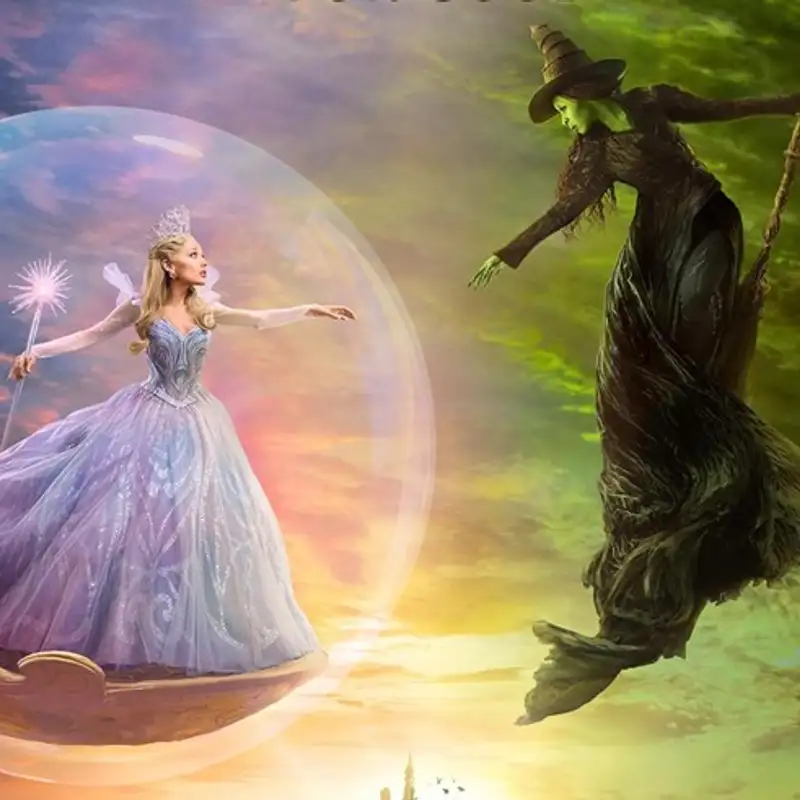
Wicked: For Good
Hi, Sam.
Hi, Hannah. What are we talking about
today?
We are talking about another movie
that we saw last night. Yes.
And that movie is.
Wicked part two for good.
Yeah. Yeah.
I know already coming out of this
that people are probably going to hear
what I have to say and think, wow.
He kind of didn't like that movie,
but I want to just start up
at the beginning
and say I liked the movie.
I it is definitely
a very rewatchable movie.
The songs are great.
I do think that
the songs in the first one
were maybe more spectacular,
but I think this movie is more
about the relationship
between the two main characters
and therefore is a little more insulated.
I don't know how anybody can watch
the movie that has no good deed in it
and say that the songs weren't
spectacular.
I found that spectacular.
You might listen to this and think, wow,
she really likes this movie
so much that she can't,
be very critical of it at all.
And you would be correct about that.
I love to be dazzled by musical theater.
Yeah.
But let's start with.
A speed summary.
Speed summary. Okay.
You have a minute and a half. Hannah.
Okay.
Now, before we go into the summary,
I just want to say that this is the second
half of an adaptation of a book
that is a variant plot
for a preexisting novel and movie.
So if you don't know the rough plot
of The Wizard of Oz or Wicked Part one,
you'll be a little confused.
I think I'm not going to try
to give all of that context,
so we're going to try to do
a speed summary.
I'm going to get a minute
and a half to go through
as much of the plot as I possibly can,
and then Sam is going to get a minute
and a half to finish it.
We're doing this because in the past
when we've done movies,
pretty much the whole episode
has just been us summarizing the plot,
which can be fine,
but we're trying something different.
Yeah. Okay. Ready? Boom!
Okay, we open exactly where we picked up
at the end of the last movie.
Elphaba is hidden away, isolated
from everybody and being presented
as evil, murderous,
and the enemy of the people.
Meanwhile,
Glinda has become a public figure.
There's a lot of propaganda posters
about each of them.
Glinda as Glinda the Good
this beautiful, morally pure character,
and Elphaba
as an evil witch who has to be taken down.
Elphaba does some direct action
civil disobedience.
She disrupts a work camp It looks like
where the animals are being abusively made
to construct the yellow brick road,
and she is chased away on her broomstick.
And then we go to Glinda,
where she's talking to her
PR team and she's getting a lot of awards.
And then it's established that she is
now engaged to Fiero who seems lukewarm
about the whole situation, even though
she is still very much in love with him.
They do the grand opening of The Yellow
Brick Road, which
Elphaba interrupts by writing in the sky
“Our wizard lies.” Oh my God!
Yeah, as soon as you were like
ten seconds in
I was like, I got a lot i’m
gonna have to lift right now.
Okay,
I think we need to rethink this approach.
No, no, I mean,
we have set the standards pre podcast
and we are going to uphold our values.
Are you ready for me to do
the last two hours of wicked part
two in a minute and a half.
Wait.
No, I think we ought to rethink this and.
Let me try and then we can,
We can go back and fill in.
All right. Ready? Go.
All right.
Our wizard lies.
Madame Morrible turns that into “Oz dies.”
so that she can manufacture
the plot that everyone hates Elphaba.
Then we cut to Bok and Nessa,
and there are spatting.
N-Nessa is still in love with Bok.
Bok, obviously..
Or you can tell does not love her.
Then we cut back to Elphaba.
In her place. She's discouraged.
She's trying to figure out
how she can get to change people's minds.
Then we go back to Glinda
and Glenda's doing stuff.
And then there's the marriage.
So Elphaba comes in and interrupts
the marriage.
You think for a second
that Glinda, Elphaba, and the Wizard
have reconciled, but no, the Wizard's bad.
Elphaba releases
the animals, ruins the wedding.
Glinda’s mad.
Madame Morrible drops a house on Nessa.
Elphaba is mad.
Elphaba and Glinda fight.
Dorothy
takes the shoes. Elphaba and Fiero.
Yeah, you fall. In love and they have sex.
And Elphaba, goes full hardcore metal.
Wow, this wasn't the best idea.
We should have gone with, like,
three minutes of.
I think
even then it would have been difficult.
I know this is like a very.
There's a lot that happens in this movie.
Yeah, but I think too
that I'm going to assume, especially as
you put the caveat upfront,
that if you're listening
to this, to try and get the full blow
by blow details of this movie,
this is not the podcast for you.
Some important plot
takeaways are that Fiero
in fact, is in love with Elphaba,
not Glinda.
Nessa has taken over
as governor of Munchkin Land,
and because she is so motivated
only by her love for
and need to control Bok
that she capitulates to the civil
rights violations of animals and munchkins
that ends in tragedy for Bok.
He gets turnt into the Tin Man.
Elphaba meets again with the lion cub,
who she thought
that she rescued in part one.
Turns out,
he feels that she ruined his life,
and after Glinda sends Dorothy away
with the slippers that belonged to Nessa.
There is a confrontation
where Fiero threatens Glenda's life
in order to save Elphaba,
and because of that, Fiero
is taken away and beaten.
He would have been beaten to death.
Except that Elphaba does some kind of
spell on him to try to save him.
That turns him into a scarecrow.
Now we have the tin Man,
the Cowardly Lion, and the Scarecrow.
Those are the three characters
who Dorothy meets.
And the ending is that Elphaba,
big spoiler fakes her own death.
Everyone believes that Elphaba is dead,
including Glinda,
and Glinda ends up sending the wizard
away,
overpowering Madam Morrible and becoming
hopefully a more benevolent ruler.
And then Elphaba.
Surprise, surprise is not dead.
The Scarecrow, i.e.
Fiero and she go off into the land
beyond Oz and live happily ever after.
Yes, Glinda has, a much more challenging
ending than Elphaba does,
which I guess makes sense because her
life up until this point
has been not challenging at all.
Whereas Elphaba’s has. Yes.
What's your personal relationship
to wicked?
It was the first Broadway show I saw.
We were kind of far back in the show.
It didn't leave me
with a great impression.
I also haven't been.
Wicked as a whole
Didn't leave you with a great impression?
Well just the show.
The broadway show didn't? Oh.
Because I think if I had been closer,
I would have been more into it.
Like literally in the spectacle of it.
And I think I was so far away
that it was like
I was staring at a bunch of people
in front of me who are watching the show,
rather
than like being enveloped into the show.
And I think that's just a product
of living in a society
where the show wicked is so popular
that they're going to sell out every show.
And the thing about wicked,
that really resonates with me,
probably is taking a story
that we all know well and telling it
from a different perspective that shows
while hitting all the same plot beats
as The Wizard of Oz.
It shows how maybe what we were shown in
the original
movie was an inaccurate portrayal
of the characters in it.
And I think that really is something
that change of perspective.
Is something again
that the movie talks about a lot
and I find very important in everyday life
and our analysis and understanding
of the things that go on around us.
That history is told by the winners
and that any story
can be inverted to force you to sympathize
with a completely different figure.
Yeah.
And I think this particular revisionist
story is interesting.
This is something that they do
a lot in comic books.
Like they turn the antihero
into a good guy.
But in that sense, what they often do
is they change the story.
In this adaptation,
all of the major plot beats still happen.
And instead what we see is
how decisions came to be made
that resulted in the same outcomes.
But we gain a better perspective
on the characters who we didn't understand
as well.
Which complicates
the idea of good versus evil. Yes.
And why is that important to you?
Because I think that good versus evil,
that very black and white thinking
was a very prominent
understanding
of the world that I grew up in.
How so? Is it a Christian worldview?
It's a Christian worldview.
It's a conservative worldview.
It's a simplified way
of viewing the world.
I could give a tons of examples
that I think would probably fit better
than me trying to underlay the ideology,
but it's the cops and the robbers.
It's the heroes of light versus
the forces of darkness.
It's the good boys and bad boys. Yeah.
And while I
definitely had a lot of stories
growing up that engaged with the nuance.
Dark Knight comes to mind. Yeah.
But even in that one, there's this
portrayal of everything that Batman does.
Even though he is a dark, brooding
character, he's still kind of like
the force of good, and the Joker's
very much the chaotic evilness.
One of my favorite characters
in the movies is Two-Face, because of his
struggle with the nuance of things
and the struggle to be good in a society
that kind of forces him to make tough
decisions.
We'll save that for the Dark Knight
episode.
Okay.
What is it about wicked
that resonated with you?
The first movie,
the first half of the play deals
a lot with stigma and spoiled identity
and how that affects somebody's
self-conception and relationships.
And I really relate to that
because of my experience being disabled.
You see the difference
between stigmatized identity
and spoiled identity in the difference
between how Nessa and Elphaba are treated.
That's an important distinction.
I identify a little bit with each of them,
and it speaks a lot
to the power of close female friendships,
the whole story overall.
And that's been a huge part of my life
from a pretty early age.
I just want to say
it would have been very easy
to make Glinda the dopey blond stereotype.
And I think by
fleshing out her character more
and putting them more on equal footing,
that it avoided that trope,
but also it gave much more weight
to their friendship in that way.
Yeah.
I wouldn't either accuse the musical
of flattening her in that way.
But I do think that they fleshed out
beautifully.
I feel like Wicked part one
belonged to Elphaba and Wicked part
two belongs to Glinda.
And Ariana Grande did a beautiful job
with that character.
And I couldn't help thinking of Ariana
Grande when she was singing.
We couldn't be happier.
Happy is what happens
when all your dreams come true.
That kind of predictable grief
that starlets go through
being held up as this flawless,
fragile, beautiful ideal.
And then, almost
without exception, torn down
when they fail to live up to the standards
of that pedestal.
For generations
that is something that our society loves
to do with women,
young, talented women in particular.
And I think that it's happened
pretty brutally to Ariana Grande.
I'm not trying to say like,
she's a perfect
angel who's never done anything wrong.
I'm just trying to say like, right.
She's lived through a great deal
of trauma, and she is often not well.
And she is also like a
once in a generation talent
vocally and as an actor and comedian.
Yeah, I forget the exact song
by Taylor Swift, but like, if basically
if I were a man,
you wouldn't be scrutinizing me
to the extent that you are.
No. And I always like,
feel weird saying that about starlets
because it's inevitably received
as me saying that
they do no harm and that their privilege
is not meaningful.
And it's not to say that
just to acknowledge a double standard,
you know what I mean?
And also to acknowledge
that when there's been a terrorist attack
at one of your shows, when an ex
and a close friend
has lost his life to suicide, like,
and when you have clearly dealt
with some major health issues that
I don't and can't know the details of,
that's got to be difficult.
Especially when the whole world holds
you up as someone with a perfect life.
That's a big part of Glenda's character,
and maybe that's why we get so much
of what people perceive as like over
the top sappiness with Ariana
Grande and Cynthia Erivo.
Yeah. Wicked is girlhood.
That's
why wicked is important to me. Yeah.
And to that point, Ariana Grande
and her facial expressions were great,
that they carried a lot of weight
in times that she wasn't speaking.
I was particularly impressed
with girl on the bubble,
but actually I just absolutely adored
both of the original songs in this movie.
Girl in the bubble I thought fleshed out
Glenda's arc and gave us real reason
to have faith that as the new ruler,
she was actually going to try to fight
injustice and restore
civil liberties to the animals.
Which I don't think that we really knew
that from the stage show.
And also,
it was clearly written for an R&B singer
who is also trained,
as a coloratura soprano.
We heard that gorgeous, breathy
R&B singing that is her signature.
And then we also heard plenty
of the beautiful, floaty, light coloratura
Soprano stuff that we associate
with Glinda and is a great way
to embrace the vocalists
that they actually had.
And then No Place
Like Home was a beautiful
recasting
of a phrase from the source material.
One of the pieces
of the original original source material,
The Wizard of Oz,
which is something that is it's really fun
when wicked does that,
and also a beautiful encapsulation
of the patriotism of protest,
which is incredibly relevant right now
and obviously resonates a great deal
with the struggle for immigration
rights that this country belongs
to immigrants, that immigrants are.
The best thing about this country.
And so we must assert
to welcome immigrants
and to make sure that immigrants
have the opportunity
to build a life
here is to be a patriotic American.
And we are so far from that.
So those were some things
that were really emotionally resonant
for me about wicked.
And I want to give
like a quick explanation of how this movie
can be read as an allegory
for fascism and scapegoating,
moral panics and the glamor and glitz
and spectacle of fascism.
Fascism is a political movement
that tends to come out
of a functioning democracy.
There is typically populism, right?
So a lot of rhetoric
about everyday concerns.
Being able to make your living
and support your family.
And intense nationalism.
Nationalism, meaning, ethnic superiority
and a strong invocation
of our connection with this land
and the superiority of that connection.
There tends to be a charismatic leader.
There tends to be an appeal
to a return to traditional values,
which tends to include strict
gender hierarchy and racial hierarchies.
There's always like an idea of this great,
glorious,
shining, beautiful future
that we would be able to reach
if we could only get rid
of the unwanted people in our society.
So those would be the scapegoats.
In Nazi Germany it was Jewish
people, Romani people, queer people,
disabled people.
And now I think what we're seeing
is that the scapegoats are trans
people, Latinos, immigrants, Arabs.
So in the world of wicked, the charismatic
fascist leader is the Wizard.
Fascist leaders inability
to actually enact social policy
that would uplift the working class
as represented by the wizard's
inability to actually do any magic,
that it's all smoke and mirrors.
There's a lot of spectacle
when it comes to fascism.
We associate Nazi Germany
with those huge grand military parades,
and in The Wizard of Oz, that's portrayed
as like that big, scary talking head
that's actually controlled
by a series of levers and pulleys.
the smoke machines, the sparkling,
twinkling lights, huge
architectural projects
that are powered by slave labor,
and the scapegoats in wicked
are the animals.
we see their freedom of movement
being controlled.
They can't travel through the land
without a permit.
We see them being caged.
We see their history being erased. Right?
Like in the first movie,
there's a big picture of a scholar
who was an animal at the university,
and we see that it's been covered up
with a big stylized poster of the wizard.
Those are some of the ways that we can
portray as fascism in the world of Oz.
And then we have these two main characters
that encapsulate different
theories of change.
I don't want to say that like,
this is a movie about politics.
Like clearly it’s
a story about relationships too.
But in Elphaba we have moral rigidity,
reactivity, inflexibility to compromise.
We see Glinda make the case
in many different ways to Elphaba..
When you fly off the handle,
when you have these huge emotional
reactions, what you're doing
is not actually helping anybody.
And you're feeding the opposition
to paint you as a crazy person.
In Glinda, we see a more incrementalist
feel good model of change.
So I'm going to work within the system.
I'm going to reassure people
and give them something to believe in
and feel happy and safe about.
I would say that Glinda doesn't
even develop that as a theory of change
until the end of Wicked Part two,
which is weird
because you see her starting
to formulate it in the first movie.
But I think that she she wants to believe
in the good intentions of the leaders
that she's working under,
and so she closes her eyes
to a lot of human rights abuses
or animal rights abuses,
but they're clearly representative
of human rights abuses.
That's my political theory of wicked, part
two for good.
And I think as you said,
while the movie certainly
is a product of 2025,
it is not meant to be a solution
or an answer
to our current political situation.
This iteration is a project of 2025,
but these types of stories have been told
a lot longer than that. Yeah. Yeah.
So I do want to get into
some of the cynicism in the film
that I expressed to you,
and then you kind of gave a word to it.
But before I do that,
I do want to say how powerful
the that relationship is between
the two of them.
Like by the end,
did you cry in this movie?
Probably.
I feel like I did.
I feel like. I mean, you definitely cried
in the first one.
I cried for the entirety of the first one,
but partially it was just I was crying
from the fact that I was watching
a good film adaptation of wicked.
Yeah. Yeah.
And I think in this one,
the emotional climax of the film,
by the time Elphaba closes the door
between her and Glinda
in the tower to hide Glinda away..
In both song and voice
and facial expressions,
you can just really feel the pain,
and even just in the words, like there's
something so powerful to me
powerfully like emotional in the words.
We may never see each other again.
Oh, yeah.
It well may be that
we will never meet again in this lifetime.
Yeah.
Knowing that your best friend and lover.
That you have to say goodbye to them.
Do you think that the romantic dynamic
between
those two characters is part of either
movie?
What do you mean?
If you were taking the movies on their own
outside of the context of the book,
would you read a romantic relationship
between those two characters?
--Yeah.
In a way,
the fact that Elphaba ends up with Fiero
in the end
almost seems like she got the second best.
She couldn't have Glinda,
but at least she got Fiero
as a happy ending to me, because.
Maybe the three of them just really ought
to have been a polyamorous triad.
Yeah. Yeah.
Yeah,
because I think Fiero certainly cares for
and has a deep affection for Glinda.
And she even recognizes that when
he points the gun, I mean, he clearly.
Oh, yeah, when he points a gun at her.
And she said
he was never going to harm me.
Yeah, and she knows that,
and he knows that.
And he- I still read that moment
as a pretty intense betrayal, though.
Oh, yeah. For sure.
Because he was pushed to the point of
in his own
black and white thinking it's either
Elphaba or Glinda.
And who am I really going to want to save?
He's put into a situation where he feels
the only way he can save
Elphaba is by threatening Glenda's life
And he knows that Glinda is not in danger.
Yeah, because he knows that deep down
he couldn't harm her, and she knows that.
Also, like Elphaba is in danger
from the guards, and Glinda is
in no danger
from the world that she lives in. Yeah.
But I do agree.
Yes, it definitely is a shock to Glinda.
And it definitely is him being forced
to kind of decide
that that is the ultimate like decision.
Point is, whose life am I willing to risk?
But I don't think he romantically loves
Glinda.
Glinda.
Maybe he identifies with her struggle,
being a child of privilege
and having the expectation to put upon him
to project perfection all the time,
and to inspire and delight everyone
around him to never turn off the charisma.
I think maybe that's something
that they share, but Glinda
never really gets vulnerable
with him about it.
She doesn't allow that connection
to take root. Mhm.
To go back.
If we aren't reading them
as a polyamorous triad.
I mean, obviously,
the emotional resonance between
Glinda and Elphaba
is just so much more visceral, you know?
And even in the very final moments
of the movie,
I think the very last shot is Glinda
whispering something into Elphaba’s ear.
Yeah, which was a little callback
to the famous Broadway poster.
Yeah, I didn't even think about that.
But I also think it encapsulates
the fact that Glinda and Elphaba
are really the true couple of the movie,
but they can't be together.
Yeah, and so that song for good
really weighs so much more,
because the fact that they aren't
going to get to be together.
It also shows how, in a certain sense,
they do get to be together
because they have now
become a part of each other permanently.
The language of that song is mostly about
you've changed me forever, I am altered.
There is part of you
living on in me forever now.
What that change is for each of them
is that Glinda,
pulls the gauze from over her eyes.
She takes off her rose colored glasses.
She pops the shiny pink bubble,
and then sees the injustice and cruelty
in the world around her and realizes
that she needs to tell the truth.
She's going to hold on to her inclination
to be kind, to be gentle, and
to make people feel comforted and safe,
but not at the expense of honesty.
That's the change that we see in her
at the very end,
when she's addressing the munchkins,
when she calls all of the animals out,
and when she says, you know,
I have real limitations
and I am only going to do my best
to help you,
which is not something that you would have
heard her say at the beginning.
And then the way that Glinda changes
Elphaba
is realizing that
by acting purely on her own principles
and speaking only the harshest truth,
that you can actually affect
change that way,
that you have to also meet people
where they're at.
You have to also be strategic
and practice self-restraint.
And there are multiple ways
to look at the same situation.
You hear her say when Fiero
first calls her beautiful,
she says, you don't have to lie to me.
She thinks the world treats me as ugly,
and therefore it is objectively true
that I am ugly
and through her relationship with Glinda
and her relationship with Fiero
she realizes that you can
look at the same thing
through a different pair of eyes
and see beauty in it, in herself
and in Fiero once she's been changed.
That ability that Glinda has is part of
what will allow her
to be a change maker in the long run,
which is lovely.
And also, I think many could
rightfully argue, is a political message
that does not meet
the needs of the current political moment.
I don't know that I would argue that,
but I think it's a valid argument.
One more thing
I want to talk about about the movie.
This is probably where I'm going
to come across as very critical.
I couldn't help but thinking, even
in that last song between the two of them,
how if you consider what is happening
from a broader viewpoint,
in the end, the Wicked Witch,
her effigy is getting burned.
Everything that is good about Elphaba
and everything that Elphaba fought for
is being carried on through Glinda,
but through kind of like a lie
that Elphaba was the bad guy
and the Wizard gets to go away unscathed.
I Think he's quite tortured.
In the minds of the public I'm
now talking about.
And this is where you brought up
how the film is kind of cynical.
Perhaps due to the limitations
of its source material, treats
the collective of Ozians
as misguided, stupid, harsh.
And I said,
I don't think that that's because
of the limitations of the source material.
I think that that is how this story feels
about the masses,
that they can be easily misled,
and even that masses of people can't
at least immediately
handle unvarnished truth, that they need
to be spoon fed and manipulated.
I wouldn't necessarily
call it a critique of the film.
The film is much more powerful
by being about the relationship
between Elphaba and Glinda.
But if you were to try to draw
a political analogy to it
to a tee, I wouldn't agree with that.
I wouldn't agree that we should do
what is best
in order to, in cynical way,
say manipulate, but I'm sure
some other people would call it
to guide the perceptions of the public.
You know,
this conversation is making me think
of Zoran Mamdani and like conversations
that I've had with my coworkers
about his charm, his winning smile,
his warmth and his charisma.
I do think that part of the reason,
at least,
why it's so very compelling,
because it is rooted in authenticity.
This is a real New Yorker
who is truly embedded in grassroots
labor movements, and I think
he has the best interests of the city
that he lives in, in his heart.
And that was why he won the election.
Yeah.
And a coworker of mine,
when we're chatting about this said, yeah,
but I mean, do you think that all of that
would really work if he weren't
also, you know, 34 and very handsome
and a man, I was
like, I think all of that really helps.
Yeah.
But I also think that a gifted
political leader
can tell you something that you don't like
in a way that is not condescending,
but empathetic and charming,
and perhaps uses
a little bit of dazzle
to guide you in the right direction.
No matter how good someone's
morals and principles are.
And I think this is where a lot of people
get frustrated about politics,
is that you can't really be a politician
without being charismatic.
No. So you can be the most principled,
the most valued, the most humble person.
But if you can't win people over,
that's kind of for better and for worse,
is part of the requirements
of being a public leader.
Which is terribly ironic, don't you think?
When you when you apply
what you just said to conservative
frustration
and conservative cynicism with politics?
Because I think a lot of people
who contribute to the public good
but aren't great public speakers or public
figures, end
up serving as bureaucrats and toiling
for an entire career in like a
not very high paying public service job.
Wouldn't you know, that's the
go to scapegoat of most right
wing populist movements.
Anyway, that's a little bit of a tangent.
That's not super duper
related to wicked, but.
Well, no. Yeah.
I think in thinking about how the movie
ends, I also think about like, it's hard
not to think about what our next steps
are as a populace moving forward.
Because we can't just get the right
charismatic leader in charge
and get the unjustly imprisoned
people out of cages
and back participating
fully into society immediately.
And I think that not
the ending of the movie,
the ending of the movie,
I felt was a little disneyfied.
But parts of the movie show
how fascism affects people's
psychology, attempts to show that.
So we see the animals lose
any sense of faith in their own homeland.
They lose their patriotism.
They are ready to leave.
We see the other animals
who have been caged as political prisoners
literally lose their ability to speak.
And we see Elphaba lose
not just the motivation
to try to help others,
but we also see her question
whether she was ever motivated
to help others in the first place.
Remember, when we get into the flashbacks
during No Good Deed and she says,
was I really seeking good or just seeking
attention or something like that?
And they show, Like the moment in part one
where she levitated
Nessa against Nessa’s
wishes, the moment where she.
I don't know
that they showed this in the flashback,
but it was another moment
where her reactivity got the best of her.
She sends everyone
in class to sleep, kidnaps
the lion cub, and goes to set him free.
And she questions
like, were my motives there actually pure?
Was I trying to help others, or
did I just want to create a huge splash?
Is all of this downfall my own fault?
I think its a good take on the toll
that all of that scapegoating
has on a marginalized person,
no matter what good I try to do,
will always be seen as evil.
Yeah.
How long can you keep on being a perfect
victim under those circumstances?
You can't.
And then as soon as you do slip up, that's
more fodder for the outrage machine.
Yeah, but it's very colorful.
And the songs are great.
Yeah. Yeah, yeah.
What was your favorite song?
Obviously no good deed. Okay. No question.
I think mine was, despite my whole rant
against the fakeness of obviously
in the spectacle of fascism,
I still really liked wonderful.
It was very compelling.
Yeah, it was very compelling.
And I don't know, is there something
maybe that we want to talk about, about..
I know, like I'm
not trying to go all poor white guy here,
but what happens to the wizard
throughout this movie?
It seems that the real villain of the
movie is Madame Morrible Oh.
I think the Wizard is the puppet
that Madame Morrible uses
to try and maintain her own power.
In the end, he learns that and believes
that he has killed his daughter
and is basically forced to live
with the consequences of his actions.
Because even in wonderful,
it seems like there is a real desire
for the Wizard
to try and reconcile with Elphaba.
I don't think so.
There's a real desire
for him to use Elphaba.
Yeah, but I was waiting for the moment
where the monkeys
were going to get released
and they were going to capture Elphaba,
or he was going to somehow manipulate
the monkeys getting released to show
how Elphaba was doing
all this battle along.
He promises her
that he's going to free the animals.
And then she immediately
finds a secret prison.
Right.
And he doesn't appear in the background
saying, “Ah, you foiled my master plan.”
He comes saying, “oh God,
I can explain.” Like.
And he's truly what. Yeah but that’s
what every villain would say.
You can scratch the surface
enough times to find
some kind of moral self-justification
for any villain.
But I think if that were Madame Morrible,
she would have said,
“Ah, you foiled my master plan.”
I don't think she would have.
I think she would have kept on appealing
like she did with Glinda.
She kept on appealing to Glinda.
Well, once
she knew that she had lost all the power.
Yeah, which is exactly what the wizard did
with Elphaba.
I see the wizard as the puppet.
Not that we should feel sorry for him
for that.
He gets off light, relatively,
in the sense
that he gets to fly away back
home, having learned his lesson.
Quote unquote. I don't know, man. I,
I think that
he is as evil as Madame Morrible.
And I also like I felt that his come
uppance
was rather bleak at the end of the movie,
finding out that you've murdered
your daughter and then being banished.
Yeah.
From your chosen home. Yeah.
I don't I don't know that were.
Yeah, I agree about the Wizard, but yeah.
Because like he
he is manipulated by madam Morrible,
But I definitely read wonderful as him
manipulating both of those women.
Pretty viciously. Yeah.
By nature that is his trade.
He is someone who manipulates the
perception in order to create a spectacle.
And I think that's where I'm coming from
in that he thinks he can,
yes, manipulate these two women.
But in order to try and create
a greater spectacle
that he kind of deep down
believes will be good.
But I don't care if you deep down
believe it will be good
if you snatch people off the streets
without due process and imprison them.
You're bad, you know.
Yeah, yeah, I don't I'm not trying to say.
Oh, maybe he was good.
All I think there was a nuanced difference
between him and Madame Morrible.
I don't think so. Okay.
There was a qualitative difference
between their personalities,
but I don't think that
there was a difference
in terms of each of their moral character.
I think there were both dirty,
rotten fascists.
Yeah.
I don't think we should feel sorry
for either of them. No.
And I think that the calculating ness
of Madame Morrible, I think that that is
the role that in fascist movements,
marginalized people have to take on.
Right?
The fact that she was a woman meant
that she would not be able to be perceived
as the powerful, strong leader
and the fact that he was a man
and that he's using all of this spectacle
and misdirection and projection
of strength and power with like, the sheer
size of the figurehead
that he created in the flames and that,
yeah, the long, dark, scary hallway.
Like, I think all of that speaks
to the spectacle of masculinity
that is inherent in fascism.
And like the glamorization
of military might.
Is there anything else
that we wanted to talk about?
I'm sorry
I disagree with you about the Wizard.
You don’t have to feel sorry for that.
I think I also disagree with you
about the Wizard.
Oh, yeah, that's true.
I think.
Yeah, I think we can let our viewers
decide who is really right.
Yeah. So final thoughts.
How can we use
what we learned from Wicked Part Two colon
For Good to act
in a more loving way in our society?
The first thing that comes to my mind
is that anti-fascist
activism necessitates
a diversity of tactics.
That you need confrontational, disruptive,
direct action, and that you need great
storytelling, charisma, warmth,
welcoming people into the movement,
getting their basic needs met,
and that you also need to work within
preexisting political systems,
get really good candidates into office,
and reform how politics is done
at the most local and the highest level.
That you need your Elphabas
and you need your Glindas, and
that they need to learn from each other.
And they can both be flawed people.
Oh yeah, that the fact that you are flawed
does not mean that you cannot be a change
maker.
Yeah, in fact,
every effective change maker who has ever
existed was flawed in some way, right?
Because every person is flawed.
And that part really stuck with me too
how throughout the course of the movie,
neither character was too shallow or too
righteous to be portrayed as without flaw.
They easily could have gone too far
with Elphaba’s activism
to show her to just always be right,
because a lot of the times she just is.
And it wasn't that she wasn't right
about the inhumanity that was happening,
it was just.
Her lack of restraint and her
emotional reactive ness made it such that
a lot of the time, she caused more harm
than actually helping with Nessa
or the lion cub, and Glinda
made people feel so comforted and safe
that she didn't always actually spur them
to ask any important questions.
The power of this movie,
and the thing that I will take away from
it is the movie wasn't black and white.
It was pink and green.
Yeah, that's cute.
If that makes sense.
Like, it's not either or.
It's this shade or that shade,
or not even this shade or that shade.
It's this shade in that shade.
Yeah. Pink goes good with green.
Great. Well,
have fun in Japan. Sam’s going to Japan,
you guys.
Yeah.
And if you're listening to this
five years from now, I went to Japan.
Maybe you went back to Japan. Maybe i did.
I'm excited.
So this is going to probably
be our last episode of 2025.
Yeah.
So this was our first year of podcasting.
Yeah.
And I'm really excited for next year.
I think we have a lot more great ideas
on what we want to talk about.
Yeah.
And so I'm looking forward
to the books, the movies.
And the weird thing.
And the weird things
and maybe even having some other voices.
Definitely. Also, we welcome suggestions.
Oh yeah. For sure.
Yeah.
If there's a book, a movie or,
phenomenon or figure that you would
like us to talk about, please tell us.
Yeah. And with that.
I love you Sam.
You have changed me..- For good!
For good.
Bye Bye!
bye bye!