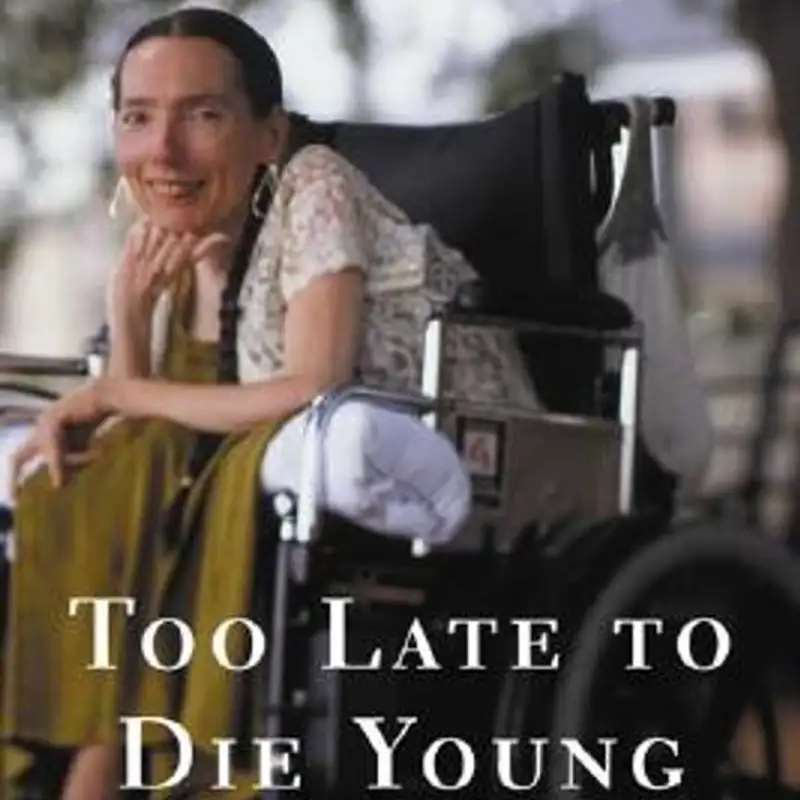
Too Late to Die Young
Hi, Hannah. Hi, Sam.
How is it going? Little sleepy.
Very happy.
Yeah. Yeah.
We are recording this
just after New Year's,
after having some fun upstate New York
with some friends.
Yeah. Happy to be home with the cat, but
was also happy to be up there
with the hot tub.
So it's the new year,
and we're going to be
talking about a book
that we read last year, though.
For me, I finished this book right before
I went to Japan, so about a month ago.
And for you
I think I read it like in September.
So I'm less fresh.
And I also didn't take notes on it
because I read this book and I loved it.
And then I asked you to read it.
So when I was reading it, I was not
thinking about the podcast at all.
So you're going to kind of be
leading the charge today?
Yeah. But wait, what are we reading?
Oh my God, we're talking about “Too Late
to Die Young” by Harriet McBride Johnson.
Yes. Who is Harriet McBride Johnson?
Harriet McBride Johnson passed away
a few years ago, unfortunately.
She was a disability rights lawyer.
She was a southern genteel.
Yeah. Very “I’m
just a simple southern lawyer.” Southern
charm.
Lots of southern charm.
Lots of very radical politics.
to do with the essential humanity
of disabled people.
I think probably it's accurate
to say by extension, the human
rights of all people
to have their basic needs met.
Harriet
McBride Johnson had muscular dystrophy.
She was in college
when Reagan was in office,
so she would have been born
in the 50s or 60s.
And so she was part of the first
generation of kids with muscular dystrophy
to live into and then well
into adulthood because of the advent
of improved antibiotics.
She was a committed atheist.
She was a human rights lawyer.
She was a lifelong Democrat.
She was an activist with Not Dead Yet
and other disability rights groups,
and she was a great storyteller.
This memoir is fantastic.
I read also her young adult book
called Crip Camp,
about a summer camp
that seemed to be kind of modeled
after a camp that she went to
when she was a kid.
She's one of those people who’s
just, like, so talented
she could have had about 20 careers,
but I would say the disciplines
that she committed herself to most
were law and writing.
And this book was such a joy to read.
Yeah.
It's kind of like a memoir of hers.
The subtitle for the book
is “Nearly true stories from a life.”
I feel like that subtitle “from
a life” is carrying so much weight,
because the first thing that we hear in
this book
is that some of her earliest memories
as a child was becoming aware
of her own mortality, and that she,
in fact became aware of her own mortality
before she became aware
of anyone else's mortality.
Because there was so much forceful
messaging around her
about muscular dystrophy
leading to early death.
And so, as a young child
thought of herself as uniquely doomed,
didn't understand yet
that her non-disabled parents and sister
and other loved ones would also die.
And even as she's starting to understand,
mortality is a more universal thing.
She didn't yet know
that she would live to an advanced age.
Every year was an unexpected gift.
Not that she would have phrased it
that way,
because she doesn't believe in a creator
who's gifting her years of life.
And she's, again,
very clear about that in the book.
But she frames the first chapter by going
through the different stages of her life.
If I'm if I'm going to live to age 18,
I might as well live as a student.
Or if I'm going to die,
I might as well die a lawyer.
And so it's like a really unique
relationship with mortality that I think
shaped her personality and worldview.
And it's funny that such an expansive
and charming and sometimes
a little bit flowery of a storyteller
can be also so bracingly blunt.
This book just absolutely grabs
you with that.
Yeah.
And I think another important thing
to point out there is that,
or at least my impression, was not that
she was an atheist
out of some sort of contempt
for the world.
- No! She loves the world. Yeah.
Because I think there's that perception
of atheists as somewhat pessimistic.
And then, of course,
I think that speaks a lot more
about American culture generally.
But I think it's really important
to point out
that her atheism comes more out of her way
of thinking about the world.
Well, she doesn't get into it
much, does she?
No, no.
But I think as you read through her life
experiences, it's very clear
that she was meant to be a lawyer
in the way that she thinks about things
very logically, logically and precise,
while at the same time
recognizing that facts are limited
to our perception of the world.
Yeah.
I mentioned her atheism
because I think, like
after reading this book,
if you say who was Harriet
McBride Johnson?
And I want to describe her on the terms
that she would describe herself,
I would say Harriet McBride
Johnson was a human rights advocate.
She had radical politics
centering disability.
She was an activist.
She was a storyteller,
and she was an atheist.
And I think those are like
the most salient things about herself.
And she was a Southerner.
I think those are all the things
that it seems that she wanted to convey
about herself in this book.
Yeah. And the book is 11 chapters.
I think the first chapter is
kind of just an overview of
maybe why she wrote the book
or of her general perspective on life.
And then the remaining are basically ten
different experiences
that she had throughout life.
And her reflection on it
both through the lens of disability,
but also just through, again, all the
different worldviews or perspectives
that she held as a person, as an atheist,
or as a disability rights lawyer,
or as a radical leftist
who grew up in Charleston, South Carolina.
Oh, and who loved it and who loved the way
that she writes about Charleston.
Like makes you want to go there. Right.
The way she writes about like the trees
and the sidewalks
and the way that people interact
with each other.
It just sounds like so beautiful.
Let's go to Charleston. Yeah.
I mean, not, you know, now. Yeah.
So I highlighted some
of the things in the book that I found
most thought provoking in terms of her,
her sharing her perspective.
So let's get into it.
And I'm mostly just going to read
what she wrote because she writes
it much better than I could ever try
to summarize it.
This first one comes from a story of hers.
If you're reading along
or you have read the book,
this comes from chapter eight,
which is entitled Getting Thrown.
And generally the chapter is about
her experience being out of state.
Suffering an injury,
falling out of her wheelchair
and then having to get medical care
out of state.
A lot of the disability rights movement,
and therefore a lot of
her career
is focused on deinstitutionalization.
So there's two ways that people will talk
about disability in regard to people.
And one of them is known as person
first language.
So you've probably heard a lot
like you wouldn't say a disabled person.
You would say a person with disabilities,
you wouldn't say an autistic person,
you would say a person with autism.
And the thought there is
that people are fundamentally
defined by their humanity
and that the disability is something
that they have or experience,
and it doesn't define them.
And then the other preference,
I guess, is identity first language.
And that is where you would say, I'm
a disabled person, I'm an autistic person,
I'm blind person, I'm a deaf person.
And that stems from the belief
that disability would be an adjective,
just like any other adjective,
that it's neither good or bad,
and it is intrinsic to our life
experiences.
I prefer identity first language.
I describe myself as a disabled person.
I wouldn't say I'm a person
with brunette-ness
or a person with Jewishness,
or a person with womanhood,
so it makes the most sense to me.
I don't think that there's anything
morally wrong with identity
first language, especially if it's coming
from people who live with disabilities.
And I certainly wouldn't
tell them that their feelings about how
they would prefer to refer to themselves
and be referred to are wrong.
But there isn't one
like gold standard practice,
and I'm just going to use the one that
I use.
So that's that spiel.
So Harriet McBride
Johnson fought
hard against institutionalization,
then that is like part of disability
rights is making sure that disabled
people are not trapped in nursing homes
and that instead
have as much as possible home care
and the highest degree of independence
and the highest degree of being able
to be out in the community, interacting
with people and working and doing stuff.
And what happens a lot,
because it's the most cost
effective in the short
term, is that disabled
people end up in nursing homes
where they have very little autonomy.
And her big, big, big fear in this chapter
about taking the fall
was that she would end up incarcerated
in a nursing home.
And because of that, she's very resistant
to seeking medical attention.
And I just found that very eye opening
because, you know,
I probably break my arm,
broke my ankle, whatever.
I'm sure that
that would be a terrifying experience,
but I wouldn't be afraid that my life as
I know it would end.
And this is also like,
I think, a comparison of the treatment
that she received out of state
compared to what she's used
to receiving in state
in her home of Charleston.
So this comes directly from the book.
I’ll just read it.
“This is something I’ve
never encountered in a hospital:
professional solicitude and respect.
Other than my longtime primary care
doctor, never has
a medical provider
acknowledged my responsibilities.
In past hospitalizations, I’ve dealt
with people who refer to my law practice
in the past tense,
give me Medicaid paperwork after I’ve
presented my bar insurance card,
show by every word and deed
that they see my occupation as disabled
and my life as nearing its end—
and none too soon.
They charge in to toss this
or that piece of me here or there,
denying me dominion over my own body.
Here, it’s
“We’d like to take your blood pressure.
Can I get your arm here and lift it up?”
So, as a health care provider myself.
This passage really spoke to me.
And this,
I think, is reflective of not just someone
who is a health care worker
working with a disabled person,
but a health care worker working
with anyone really, is how do we as health
care providers
treat the people that we're working with?
And I'll be honest,
I sometimes have trouble
with the language patient or what
the use of the term patient,
because I feel like it creates
this somewhat hierarchical distinction
between the health care provider
and the quote unquote patient.
And I think there is this overwhelmingly
large perspective among health
care workers that they know what's best,
and not that it's black and white,
but that generally they just know better
what is best for the people
that they're trying to help,
and not really taking into consideration
how the person being treated
feels about that.
I feel like this was just a great example
of how, in one of the times of her
most vulnerable experiences,
how much of a godsend,
no pun intended, it was to have a caring
and empathetic health care providers.
Tell me about your relationship
with Bedside Manner.
I guess I'm thinking in particular
of when you administer vaccines.
Oh yeah.
I remember asking you about that early on
after we started dating.
I was curious about how you dealt
with administering vaccines,
especially to kids when they're scared.
And I guess,
you know, hearing
you talk about this book now,
I'm curious about how you started
with bedside manner
approaching
this goal of humanizing the patient
and keeping them on the same level
as you power wise,
and how that's evolved over your career
so far.
I think, honestly, my quote
unquote bedside manner
is probably more informed by my history
or by my past as a martial arts instructor
working with kids and adults.
There was a big emphasis in my leadership
training on distinguishing
between the times when, as a leader,
you have to step up and lead, take charge
of the situation and progress it forward.
At times when maybe the people
that you're leading aren't able to.
Distinguishing between that
and being a leader that always knows best
or sees themselves
as the end all, be all of the situation,
the ultimate authority,
the ultimate authority.
In ways that I don't even think
necessarily the training itself realized.
It was kind of emphasized on me
how much of a partnership teaching is.
And so I naturally, for me,
it kind of rolled over into health care,
that health care is not about me,
the authority, coming down
to take care of the sick person,
but me providing my knowledge
to help lead and guide the person
who is there for treatment.
Yeah, it's kind of like you're
the expert in pharmaceutical knowledge
and they're the expert in their own body,
of their own health.
Right?
And and you're collaborating, Right.
And what is it been like for you
to work as a medical provider
with disabled people?
Is it different
from working with non-disabled people?
I would say
the difference is more structural,
maybe in the sense
that our built structures are built
with non-disabled people in mind first,
most often.
So I guess the thing
I'm thinking about most is like getting
into the vaccination area.
For me personally, I always try
to make it as accommodating as possible.
Specifically regarding vaccines
or the process
of getting a vaccine done
in a retail pharmacy.
Having worked in
not just for a number of years,
but also in so many different locations.
There's a set procedure
to be followed, but
there is not a set
setting for vaccinations.
I've given vaccines with people
sitting in aisles, in chairs,
and I've given vaccines in separated rooms
that are private
and everything in between.
So in that sense, I think it very much
does make a difference
for a disabled person
if they've got to maneuver around
lines of people waiting for prescriptions
to get to the vaccination area,
and it's kind of
in plain sight of everyone else,
or maybe they can't get to
the vaccination area
because it's behind a curtain,
because it's not big enough
to accommodate a wheelchair,
and therefore they just have to get
their vaccination
in the sight of the public,
which I remember, like
getting in particular
my Covid vaccinations.
Especially the early ones
that were like pretty rough.
I have Erb’s Palsy
which is paralysis affecting my left arm.
So my left shoulder
arm wrist, hand fingers all nerve damaged.
So limited use of that portion of my body.
And so I always get vaccines
in my right arm
because of the way that sensation works
in that area.
And my left arm would make it
unpleasant experience.
And I and I knew that the Covid vaccine
was going to make my arm really sore,
and I would have trouble lifting it.
And, you know, convincing them to do it
on the right side, because I didn't
want to go through that on the left.
And then kind of dealing
with the next couple of days
of having limited use of my right arm.
It was like a moment
when I felt my disability
interacting with this novel experience.
Yeah, I think like disability
is such a fluid thing.
Novel processes tend to be more disabling
than your own routines,
because your own routines,
you already know how to do them
and they’re routines, right?
I know how to cook and dress myself
and shop and take the subway and,
you know, get from here to there
and any accommodations that I need,
they're already built into my life.
But when I start to try to do something
new, like a new, very important,
very good vaccine that will protect myself
and everyone around me,
it ends up becoming disabling
because I have not yet
figured out what those accommodations are.
To a certain extent,
I guess that is something
that is navigated by everyone
getting a vaccination in the sense
that like, it's not part of their routine,
but because you're adding that
on top of your routine,
which already has to navigate a world
that is often
not accommodating for disabled people.
That adds an extra layer of complexity
to it.
Something I've noticed at the pharmacy
is that the, the counter is quite high.
How do you work with wheelchair users
as a retail pharmacist.
When you say the counter is high
you're talking about the checkout counter?
The counter you go up to you
to be like “I'm here to pick up my meds.”
Do people have trouble reaching it?
Sometimes. Yeah.
And I think
also the nature of retail pharmacy,
the majority of our population is over 65.
So I would say generally most retail
pharmacy workers
are used to assisting people with either
reading the prompts on the screen
or helping them maybe having to speak
a little louder or a little bit
more slowly to help them understand
if they're hard of hearing.
So in terms of accommodations,
in that instance,
if someone's not able to reach a screen
or something, the person working would
generally I think, go around the counter
and help them out..
Which is cool,
but it really like
now that I'm thinking about it,
It really kind of seems like there
could just be a lower part of the counter.
As you were reading that passage
I was reminded of over the past
few months, I went through several levels
of screening for breast cancer.
I don't have breast cancer. Yay!
But for the first time in my life,
I had to go get a mammogram because
I'm only 34.
And before I think age 40,
that's not a routine screening.
That's something that you get done
if they find something
that they're worried about.
And so I went on a mammogram.
And if you've gotten a mammogram,
you know,
that you just stand really awkwardly.
It's a very awkward, very funny procedure.
And because of my arm,
it was challenging for me.
And it was challenging for the technicians
who were working with me.
You're really supposed to lift your arm up
above your head when you're
being squished in the big squisher
machine, and I can't do that.
My arm
does not go above my head unassisted,
and even if it is being assisted,
doesn't go that high up.
And so we had to work together, actually.
Yeah.
Just like you and I were just saying,
we had to work
collaboratively
to get the images that they needed.
You know, it was a long day.
I kept on, like, leaving, coming back
again, leaving and coming back in.
But as I told you afterwards,
the thing that I was the most upset about
was I need to get back to the office
and file this story before the deadline.
Otherwise, I'm going to have to cancel
my evening plans. Right?
And like I've had other experiences
in healthcare settings where, like,
something like that would have been
traumatic because I have been made to feel
sometimes like the fact that my disability
is an obstacle for their machinery
or for their procedure is something
that I should feel guilty about,
that I'm being burdensome and problematic
and just difficult.
And you know eye-rolling,
scoffing, clear frustration.
Instead these technicians were brisk.
They were competent. They were efficient.
But the underlying attitude
that came across to me
that day was, “I'm so sorry
this is such a pain in your ass.
Thank you for being so patient,”
coming from them
like I was doing them a big favor.
And also, you know, as she said
in the passage, “May I lift your arm?
Can you hold it this way?
Can you hold this position
for ten more seconds?”
Always asking consent before touching me.
Asking me how my body worked.
Telling me what outcome that they needed,
and then getting my say in
how to achieve that outcome.
And again, just like the attitude of
“We're so sorry about this,
you're being a champ,” as opposed to
“Why would you do this to me?
It's so annoying that you came in here
disabled.
it was very considerate of you.”
Made it overall
an annoying and tiring day
and not an upsetting day.
And I think if you asked health care
workers, you know, 95% of them
would agree that, you know,
none of this is your fault.
Obviously, there is a prejudice
against disabled people and also sometimes
people let their frustrations
about just working generally,
especially if they're in health care
working short staffed or under pressure.
Letting those frustrations that they feel
end up coming across to the patient
or the person they're working with
and making them feel as if,
Ugh this inconvenience
that you're giving me, like, in my head,
I know it's not you,
but I'm still frustrated
and I'm still going to show this
frustration. Right?
Which is one thing when you know, you're
dealing with trying to get your flight
changed at the airport or whatever,
but when you're a health care worker,
you're interfacing with someone
who's probably going through
like an exceptionally vulnerable time.
So that's hard.
This is really relevant
to like the classical definition
of emotional labor, right?
Like the Arlie Hochschild
definition of emotional labor.
The feminized labor of like presenting
a certain emotion and suppressing
your actual emotions
for the benefit of the consumer.
A strong case can be made
that it is much more called
for in healthcare roles
than in customer service roles.
Anyway, shout out to Lenox Hill Radiology.
Everyone who works there is an angel.
And thanks for finding out
I don't have breast cancer.
Yeah.
So the next passage that I
have is from chapter ten,
which is entitled Art object.
And in this chapter she is recounting
her experience getting her picture
taken for the New York Times Magazine
for an article that she had written.
And I'm skipping around in the book.
I'm not necessarily
going sequential order of the book.
And if you know of Harriet McBride
Johnson already and not from the book,
then you probably know of her
from the article
that she wrote for The New York Times
Magazine.
Actually, she wrote it for her own blog,
and in the New York Times
Magazine picked it up.
It's called Unspeakable Conversations,
and it's about her experience
going to Princeton to debate Peter Singer,
who is a philosopher
mostly known
for his animal liberation positions
but who also advocates for selective
infanticide of disabled people.
Which is bad.
Which is bad! In case..
In case anyone was wondering how we feel
about selective infanticide
of disabled people,
we are all the way thumbs down on it.
Yeah. As was Harriet McBride Johnson.
The chapter has much more to do
with the actual experience
of getting the picture taken,
but this is regarding the final product
“The New York Times Magazine cover
has been described as beautifully
disturbing, and most non-disabled
people seem to see it that way.
I prefer to call it
disturbingly beautiful,
but I'd take it the other way around
if I must.
The disturbing part happens inside
people's heads,
this unconventional body draped
and lit and posed like a fashion model.
Apparently floating in space
and a power chair disturbs preconceived
notions, makes people question
what they think they know.
The beautiful part, well, that's me.”
The reason I highlighted
that is because the first thing
that comes to my mind
when I hear that latter
part of that paragraph is
I think it was Victoria's Secret
that had a disabled model.
Yeah,
or maybe even an entire show that was..
Oh, yes, I remember this. Yeah.
And Victoria's Secret uses
a lot of disabled models now too.
Yeah.
I think that at one point
there was a backlash against the comment
saying to the effect of you're
trying to be nice, but this isn't
actually beautiful. Yeah.
Or even like you're being exploitative.
Yeah.
Which I think is, as we've talked
about many times on this podcast,
I feel like we say this every episode,
but where this feeling of disgust
or of what's natural comes up in
someone's head and then they see something
that challenges that preconceived
notion of what should be beautiful
and what should be relegated to, quote
unquote, disgusting or awkward or weird.
And they have this disconnect
with what they're seeing.
Do you remember when Jordan Peterson
showed his entire ass on the internet
for the umpteenth time?
It was the cover of Sports
Illustrated Swimsuit Edition,
and it was just like a plus sized model.
And he put out some statement about,
objectively, she is not beautiful.
And everybody was like,
Jordan Peterson, your boner
is not like an objective measure
of objective beauty.
Beauty cannot be measured objectively.
But this is a man who is so invested
in ingrained hierarchies
that he's built up an entire
philosophical system to, in part, scaffold
his own boner’s inherent wisdom about what
is natural and good and beautiful.
And most people are not quite so committed
to build their entire career
out of these reactionary
politics, stemming in part
from that disgust response.
[censored] Jordan Peterson,
but you have these experiences, right?
And if you know better,
then a lot of the time the best we can do
is to catch ourselves
in that knee jerk reaction and think,
“What am I feeling right now? Like,
what's happening?
Why is it weird for me to see a person
with down syndrome modeling underwear?
Why do I have a problem with that?
Do I think that people with down
syndrome don't need underwear?”
Because they definitely do. Do I
think the people of Down's syndrome
ought not to be sexualized,
because I think most of them
would disagree with me quite strongly.
You know, they're adults
and they have sexual relationships
and they experience themselves
as sexual beings.
So maybe it's
some learned infantilization.
Maybe it's some learned ideas
about what it means to model underwear,
that you should be somebody
who I should consider a sexual being,
somebody who I would want to interact
with sexually, or who my peers would, and
a good thing to do is to interrogate
all of those reactions.
And another thing that people do
instead of interrogating those reactions.
I think a lot of the time is to come up
with an ad hoc justification
for why their response of disgust
or anxiety or disapproval is justified,
and morally good.
Yeah.
And honestly,
I think that's a perfect segue
into the next quote of hers,
which comes from her final chapter.
“When non-disabled people start
learning about disability, what seems
most startling, most difficult to accept
is the possibility of pleasure.”
Such a beautiful last chapter.
Oh yeah.
The last chapter is her recounting
her own experiences
with finding a beautiful relationship.
She doesn't share a great deal,
but you know, she alludes to the fact
that she has fallen in love or,
I don't know, she's fallen in love.
She started a romance
and it might grow to be something
really fulfilling and exciting.
And in reflecting on pleasure,
this is something that stuck with me.
she talks about how her body
and her abilities have changed
over the course of her life,
and how with the evolution of her,
I guess you could turn them impairments,
how she has found new joys.
So she talks about using a power chair
to navigate
the streets of Charleston,
playing a game with herself to see, like,
can I navigate all the way to the office
with one continuous motion on my lever?
And I feel like I made this point
in different forms,
in different social settings about like
disabled beauty and disabled pleasure.
And people are very resistant to it.
Non-disabled people, I mean. Yeah.
Are very resistant to it.
I think because they are very committed
to understanding disability
as only deficit, only impairment,
if not tragedy,
then at least something negative
to be overcome or counterbalanced.
Right.
Which also gets into one of the beginning
chapters with her
and her fight against the Jerry Lewis
telethon.
Oh yeah. Yeah.
There's this sense that disabled people
are meant to be an example to be pitied
and therefore are not people
in and of themselves Yeah.
The function of disabled people
is to be an object of pity, to inspire
in non-disabled people gratitude for all
the good things that they already have.
And as I say that out loud,
I realize that that's
not just objectifying to disabled people,
but also that whole dynamic
is perfectly engineered to crush radical
thought in the non-disabled people,
because it's like,
you mustn't
want anything better for yourself.
Look, at least you have legs.
Do you know what I mean?
I feel like a lot of ableism
and disableism works
so well with capitalist hierarchies,
keeping the poor, poor,
and trying to prevent the poor
from agitating.
Yeah.
For things that would improve their lot
in life, like universal health care,
strong labor unions, safe and affordable
housing, robust public transit.
All these things that disabled people need
are things that everybody needs
or could benefit from.
Right.
And if we're able to push this paradigm
of disabled
people are objects to be pitied
and look how bad they have it,
and you don't have it that bad.
So what do you have to complain about.
Yeah. Don't rock the boat.
Which was I feel like something coming up
in a conservative Christian household.
There was these compiled instances
of pointing to people
who were rocking the boat,
who are unsatisfied with the status quo
as somehow deviant or morally
wrong for not being happy
with what they have.
The moral high ground was to be grateful
and to work.
Yeah, but I feel like that's
like a very American ethos too, right?
Yeah.
That agitation
to improve the lot for everybody is
somehow morally wrong
and a symbol of laziness.
Yeah,
the only morally pure work is the work
to strive for social mobility for yourself
and your immediate family.
And somehow the labor
that goes into agitating for strong labor
laws for fair compensation, for universal
child care, universal health care, great
public housing, all of these things
like that's not morally
good labor because it would benefit
everybody and not just you.
Yeah, it goes against
the individualistic mindset
that if you're not doing something
that is seeking
to make you more money in your life
and your immediate loved one's better
off, it very much
fits in with the capitalist mindset of
if you're not bringing value, values
a very ambiguous word.
But I would say that they're talking about
ultimately shareholder value, but value
in terms of like making money
on top of money or, you know, earning
interest on money or,
you know, building yourself a nest egg,
all in terms of money and not really
in terms of societal well-being.
And it's not that money and societal
well-being are diametrically opposed.
But in this culture that I grew up
in, you are expected to pull yourself up
by your bootstraps, and therefore people
who aren't doing that,
who are advocating for changes in policy
and the way that society is enacted.
Yeah, they're being lazy or the views
kind of like
if you really want to advocate
for yourself,
you just need to, like,
become the entrepreneur that enables you
to live a comfortable life.
And the individualist ethos carries over
to how we think about health.
It is not morally good to improve health
outcomes by agitating for safe sidewalks
so that folks can walk or use
their mobility aids to get to
and from wherever they need to be.
It is not morally good
public health practice to agitate
for affordable groceries
that include fresh produce, public
housing that includes full functional
kitchens, playgrounds, soccer fields.
You know, all of these things that improve
public health outcomes, free
health screenings.
That's not what we think about when
we think about wellness and health, right?
When we think about wellness and health,
we're thinking about discipline,
individual discipline, waking up at 4 a.m.
and meal prepping for the week,
going to the gym that you pay
your membership for in your car
that you drive only yourself in.
Moralizing of health status goes
hand in hand with that individualistic
mindset about health and so bad health
outcomes, disabling health outcomes
must be due to moral failure
on the part of the disabled person.
Yeah, and so it is best for disabled
people to hush hush, don't complain.
And to always be a beautiful,
gleaming example of gratitude and sympathy
and when disabled people instead
talk about the pleasures of our lives
and the strength and the joy in community
and in our embodied experience, well,
that goes quite against the grain
there, doesn't it?
Yeah.
And, man, and I feel like we've just been
segueing one quote into another.
Oh really?
Yeah, I feel like this, this next and
this is the last one I had highlighted.
But this comes from the chapter
Believing in Dreams.
And it's her recounting her experience
going to Cuba.
And this was in..
Oh I love that chapter. That was so cool.
I feel like
this was in the 90s, right? Yeah.
So this is post USSR
like Cuba is still a communist country.
And she goes there
for a disability conference. Yes.
She goes with her sister and she's kind of
comparing Cuba to America.
And the most interesting thing
I found about this chapter
was just her talking about Cuba
and what it was like in Cuba, because,
you know, the thing
I've been told my whole life,
at one point being not 60 miles away
from Cuba in Key West, Florida,
was that Cuba is this communist hellhole
where there's the ruling government on top
that takes all the money, and everyone
else just lives in abject poverty.
Oh, yeah, definitely not.
So this next part I'm going to have
Hannah read because there is a..
A reclaimed slur.
A reclaimed slur
that I don't feel comfortable saying, nor
is it appropriate for me to say so
she's going to read this.
The only thing I wanted to preface it with
was the first part
where she's talking about the system,
she's talking about Cuba,
and then when she goes on
to talk about our system,
when she says our system halfway through,
she's referring to the American.
So she's comparing
Cuba to the American system.
“The plan reveals a system where
well-intentioned experts decide
what's best for people with disabilities
as they decide for people
without disabilities.
There's not much about choice or freedom.
But then I ask myself,
what does freedom really mean
for the average cr*p in our system?
Living hand-to-mouth in the community
or languishing in a nursing home?
The average cr*p is guaranteed
liberty and due process,
but not health care,
housing or a living wage.
Knowing how
little choice there is at the bottom
of the pecking order,
I'm impressed by a society
where inequality is not accepted
as a regrettable fact of life.
In Cuba, inequality is intolerable.
It's unpatriotic.”
I thought that was a great dichotomy
to America, where we talk about
patriotism all the time, and certainly
there is an American brand of patriotism.
And I think the political moment we're in
is almost this question
of does American patriotism
tolerate inequality?
And I would say on a large scale it does.
I would say that a standard issue,
American patriotism requires
inequality, right?
Because if we valorize social mobility
with this bootstraps ideology so much,
then inequality is necessary, a guaranteed
outcome, a guaranteed outcome.
And the best you can get within that
framework is lifting up the floor.
Which hell I'll take it.
You know,
but it's a completely different paradigm
than the one that she introduces
in that chapter about Cuba.
I can't say enough good things about this
book.
It's also very funny.
Oh, yeah, she's a great writer.
Yeah,
I would recommend this book to anyone.
Yeah. Everyone should read it.
And it's also like it's not just about her
experience as a disabled person.
She's pulling from so many different
facets of her incredibly diverse life.
And incredibly full of experience.
Yeah.
Another thing that could be part
of our conversation today is “Unspeakable
Conversations,” right to die and eugenics.
I think we table that
I think we do another episode
about right to die,
the law that recently passed in New York.
And that's where we talk about
unspeakable conversations,
because I have enjoyed the lightness
of our conversation today.
And also we've been talking for a while
already.
Yeah.
Unspeakable conversations,
as you mentioned before, was the article
that she wrote in response
to her experience being invited
to come and debate with Peter Singer,
who was in part
advocating for selective infanticide.
You had mentioned that article to me and
sent it to me, and I read that article.
I think I kind of said, like,
we're in a relationship now.
You must read “Unspeakable
Conversations.” Also, you must watch Walk
Hard: The Dewey Cox Story, and Saw,
because that's what I'm like,
all of those things
which I thoroughly enjoyed. Great!
I've watched all of two
episodes of One Piece,
and that's a moral failing on my part.
We'll get there. We'll get there.
And I think maybe we should take the time
to think like for you and I specifically,
how has this book made us think about
how we love in a society?
You mean for each of us individually
or for the two of us as a pair?
I mean for each of us individually. Yeah.
And maybe I should go first,
because I probably am more representative
of the general nondisabled persons
who would be reading this book.
The book was a very exemplary
highlight of how
we as non-disabled people over emphasize
on the disabled part.
And with that disabled part,
they also narrow
that to this certain view
of a unfulfilled life.
And if there's anything
this book taught me, it's that
everyone can live
an incredibly fulfilling life
as long as they have the resources
that they need to pursue that life.
Yeah, and that what makes your life
fulfilling won't be the same
as what makes another person's life
fulfilling.
Yeah.
Non-disabled
people really value independence.
A lot of the time.
But because of ableism,
by which I mean, like THE system,
the cultural system
that privileges non-disabled
people over disabled people, right.
What we think of as independence is,
in fact,
dependance on systems
that our cultural norms render invisible.
So you are not independent.
You're not out living in the woods,
foraging for mushrooms and and hunting
deer with a spear that you sharpened
yourself with, I don't know, a big rock.
You're driving places in your car,
or you're taking the subway or the bus.
You're using electricity
to cook your food
that you picked up from the grocery store.
Next door.
And yet, when non-disabled people
think about depending on a home health
aide, depending on a mobility device
medication, all of this is perceived
as a loss of independence
and a fundamental loss of dignity.
And I think that one thing
that non-disabled people can do to act
more lovingly
is to to stop thinking of disabled people
as uniquely dependent,
to stop thinking of disabled people
as the exception to a rule of independence
that in fact, we all need each other.
Yeah, I feel like that point that you just
made about our kind of interdependence,
it's not that like, “Oh, I'm so dependent
on other people for my life.”
I think it's more of this view of like,
we are all interdependent on one another.
Yeah, we need each other.
We need each other.
And if you want a brief
examination of that
from an economics perspective,
you can look at my, as of now, recent
YouTube video.
“People ARE the Economy.”
Yeah. I can't wait to watch that.
And also one of your earlier videos,
when you were doing a lot of stuff
about Fatphobia and Fat Liberation
and stuff, like you talked about
the social model of health, that health
ought to be measured by the ability
of the person to live a fulfilling life,
whatever that means to them.
That made such a huge impression on me.
You talked about it really beautifully
from a lot of different angles in those..
that series of, I think like 3 or 4 videos
that you did about fatphobia
and fat liberation,
and everyone should watch them.
There's so much fun.
If you want more content with me talking.
I love content with you
talking. Well, your biased.
The thing that I learned from this book,
that was like
a really important takeaway for me,
and that I think I've also been reflecting
on these past six months,
you know, seeking out,
as I have been disabled, community
in a way that I haven't done before
is a lot of the ideas that I have
I did not come up with.
There are and have been disabled
thinkers, writers, activists,
athletes, artists who have come up
with a lot of really similar ideas
to what I have
and expressed them better or differently,
and that I ought to joyfully seek out
those perspectives
more and reflect upon and draw
further attention to the giants
whose shoulders I stand on.
There have been times in my life
where I've thought,
oh, I just have such a unique perspective
about disability.
There there can be no one who's ever
thought of things this way before, because
the party line is so much inspiration
porn-y, person first,
like very conventional
tug at the heartstrings worldview.
But in fact, people have been critiquing
that aggressively since before I was born,
and I certainly won't start my yapping.
But I should be also doing
a lot of reading and listening.
What a joyful task that is to have.
Yeah, yeah
yeah, to be in conversation with others.
Well I have enjoyed our conversation today
and I'm looking forward
to watching silly crime
mystery Knives Out new movie.
Me too.
And I'm looking forward to watching
your video essay about vibes economics.
Yeah, I love you. I love you too.
Bye bye everybody.
Oh, happy new year.
Happy new year.
an entire
philosophical system to, in part, scaffold
his own boner’s inherent wisdom about what
is natural and good and beautiful.