Storytelling and the Trans Experience
Hi Hannah. Hi, Sam.
How is it going on this Sunday?
So cold.
Yeah.
So cold.
Yes. Very, very cold.
But we're going to be enveloped
by the warmth
of our dear friend’s creativity again.
Yeah, It's funny that,
we had Morgan Boecher
on the podcast, to talk about something
that is not his book.
And now here we are
talking about his book.
No Morgan.
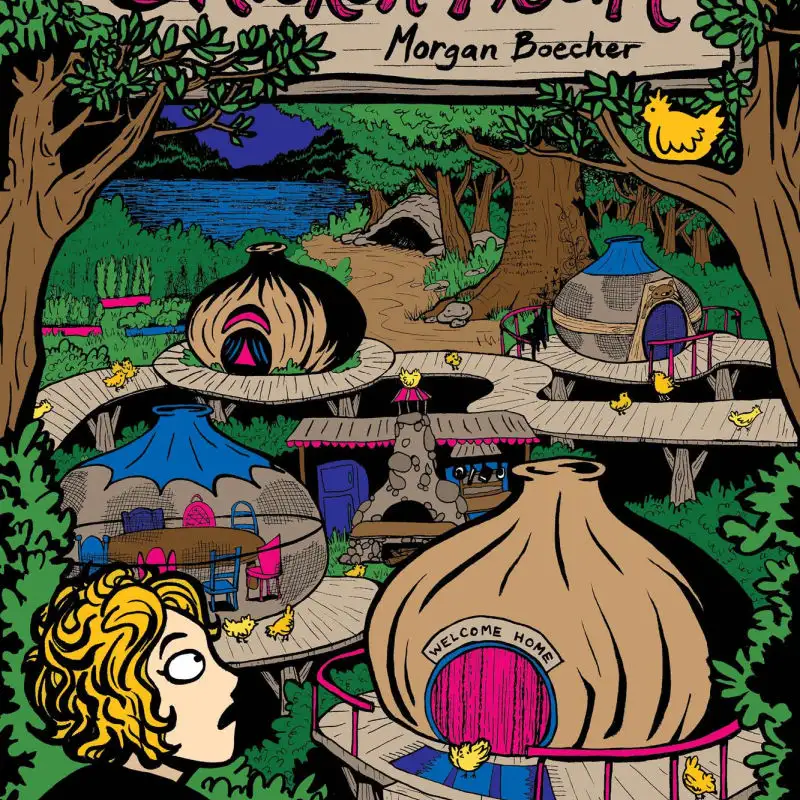
And this book is called ChickenHeart.
This is Morgan's second graphic novel.
His first was
a, I guess, semi-autobiographical.
I don't know if he would describe it
that way.
Compilation of comics
that he worked on, during
and about his transition
or just transitioning in general.
And this is now a work of fiction.
It is also about a trans person,
a trans man.
So You want to tell us
about ChickenHeart Sam?
Yeah.
ChickenHeart is a story about Jackie
Locklear, who is a closeted trans man.
And...
He works as a comedian, works
as a comedian in a big city,
and he gets the news that his aunt,
who is also a trans, ...
Shoot.
Sorry, honey. That's my.. That's okay.
I have to go take a hormone Some quick,
gender affirming care for a cis person.
Yeah.
How easy was it for me to access this
gender affirming care?
So easy.
Well, probably
not as easy as it could have been.
Probably
not as easy as it could have been,
But Yeah, I'm just kind of thinking
about how, like, Like, if you are a cis
woman who's taken birth control,
then you had gender affirming care.
If you are a man who has had, like,
any kind of treatment to prevent balding,
then you've had gender affirming care.
Like we conceptualize gender
affirming care
as something that only trans people need
because they're weird and different,
but actually a lot of medical care
is gender affirming care for everybody.
Yeah. Yeah.
Anyway, okay, so Jackie
Locklear is a, is a comedian.
He's a closeted trans man,
and he had an Aunt Sheila
who was also trans, a trans woman.
And Jackie gets the news
that his aunt has passed away.
Prior to her passing
Jackie hadn't really maintained
a close relationship since he was a kid.
He did know that she left.
She was rejected by the family
and she left to
form a commune
in, the woods outside the city..
Called the ChickenHeart..
Was it the ChickenHeart Love Commune
or just the ChickenHeart commune?
The ChickenHeart Commune
something along those lines.
Yeah, yeah.
And, and Sheila
and Jackie had a special relationship
when Jackie was a kid, and he always kind
of, like, had it in the back of his head
that he would hope to reconnect with her.
But I think well, I don't know that
this is stated explicitly in the book,
but it seems to me
that part of what is holding him back
from rekindling that connection is fear
of like facing down his own gender.
And Sheila has died by suicide.
And Jackie decides to go to the chicken
heart love commune for Sheila's
funeral. Yes.
And if you..
this sounds like an interesting story,
and you don't want to know anything more
about the story before we continue,
you can pause it right here.
And you can go to your
local independent bookstore
and pick up a copy of Chicken Heart.
Yeah, you can also buy it online,
or you can order it online through your
independent bookstore.
You could I mean, you could go to pretty
much any major bookstore and get it too.
But I don't think that we're going
to give any major spoilers today.
No, but yeah, if, if,
if you're like, I want to read this book
and then hear what
Hannah and Sam's thoughts..
Not nec-
maybe not necessarily on the book or
but like the thoughts
that they're having that
come from the book,
the discussion that they're
going to have coming from the
the themes in the book.
Yeah. Then you can do that.
It's also like
the art is really beautiful.
The humor is, really charming.
And, it's not just about plot, although,
the plot has a lovely arc to it, too.
Despite being a major weeb
I don't know much about comics.
And I found Morgan's use of color
in this very Almost mesmerizing.
Yeah.
The color, is, cool visual cue
that helps you understand.
Are we in a fantasy flashback?
Are we in the here and now,
or are we in the woods at the commune?
Right.
it often serves more as the backdrop
than as the, Coloring of the characters.
Yeah.
He's he's he didn't color in, like,
the people or the things he colored in.
I think mostly the background, to
so that it's it's indicating setting.
Yeah.
So the big thought that I had after
finishing the book the other day Is how
and so for our, listeners
who are just tuning in this episode
and are not already a part
of our millions of listeners worldwide,
I come
from a conservative Christian background.
And so the things that the thought
that I had coming out of this,
is reflective of the thought process
that I had as that I was
that was kind of instilled in me as a kid
and that I had growing up
and as a young adult,
which was that I took for granted
the fact that as I move around society,
I can look at someone and be able
to accurately assume their gender.
And the point of this book is not to
question that assumption specifically. No.
But it's because of my background
that this book brought up this..
Novel thought for you.
Right this novel thought for me
that there is a within
a, conservative viewpoint.
There is this assumption
that, people present
their gender in specific ways.
And so it's not effortful to have to look
at someone and determine their gender.
So when..
I think like to go further than that, it's
not just that
people
present their gender in certain ways.
And that you can effortlessly
and automatically clock
someone when you meet them accurately.
It's also that, people naturally and
always fall into one of two categories.
And that all of the things that go
along with, with each of those categories,
which is to say chromosomal makeup,
primary sex characteristics
such as, you know, whether you have
internal and external genitalia,
secondary sex characteristics
such as fat distribution,
facial hair and body hair, height
and musculature, and gender expression,
which is like how we dress and style
and hold ourselves
in order to present our gender that all-
none of those things are separate,
that they all go together and they all
fall into two separate categories.
And that these are mutually exclusive,
perhaps like God ordained categories.
And that to deviate along
any of those lines
is unnatural
and perhaps immoral and causes friction.
Right.
And I think the, the causes friction part
is the part that I wanted to hone in on
is that when confronted with trans people
or non-binary people,
I think the conservative ideology faces
is this grating sense of their worldview
that I didn't,
you know, I was operating with this
baseline assumption that colored
my foundational view of society.
And now I'm having to confront
that and reflect on that.
Why are you making me do this?
And like to be clear, my upbringing
was not one of a de-gendered society
where it was normal to not assume
someone's gender based on looking at them.
like growing up, for me,
it was very much normal
to think there are boys
and there are girls.
I remember, like referring to genitalia
as boy parts and girl parts.
So there was like a lot of collapsing
of sex and gender.
And I think that there was just
the difference that we can like,
that we can identify between
each of our upbringings with regard
to like, that idea that you can clock
someone's gender by glancing at them
is that there was a lot of room
in my upbringing
for gender deviation, and in fact,
it was kind of encouraged.
Tomboys were a thing.
You didn't need to always dress your baby
in pink or blue bows or overalls.
And like I remember from, like,
the earliest age that I can recall,
it was just completely normal in my house
that,
you know, a parent would say,
do you have any crushes on any boys?
I would say yes or no,
and they would say, any girls?
That that was just expected
and normal in my house.
And this was in an era
where like the fight for marriage
equality
was actually only just heating up.
So that might have been
particularly progressive.
So it it wasn't that I, like,
grew up with this, like, you know, utopian
or depending on your point of view,
you might call it dystopian.
I would consider it to be utopian.
de-gendered society where it was,
like, already ingrained in me
that, you know, physical characteristics
don't dictate social roles.
It was just
that there was a lot more flexibility,
than it sounds like there was for you.
When I was in, like,
middle and high school,
the end of middle school,
going into high school,
I got involved with this organization
called GLSEN which is the Gay,
Lesbian and Straight Education Network.
And, it was a
anti-bullying advocacy organization.
So like they did, the Day of Silence
is where, like a lot of millennials
would remember.
They, gave a lot of resources for gay
straight alliances in, in schools
and then they would expand
to other campaigns and days of action.
And I was a part of their, like, youth
organizing task force, basically.
So, like, every summer
I would get flown out to a training,
like a, you know, 3 or 4 day long training
about, organizing and LGBT issues.
And then I would go back to my school
and work with my gay straight alliance
at my school, to try to like, you know,
share out what I had learned and organize
against bullying in my school.
I identified with it
because I got bullied a lot,
although, only, I think tangentially
related to being read as queer.
And I think I was really only read
as queer because I was like,
I think that being queer is fine,
but I was 12, so that was like a big deal.
And I remember, like, going
to one of these trainings and we had this
workshop called like Gender 101.
And like all of these concepts were
presented to us as a roomful of teenagers,
and we were being taught like,
this post-modern breakdown.
And I distinctly remember post-modern
because, like, we were 15 minutes into one
of these workshops
and all of us were like u-duh
like all of our eyes were crossing.
We were so confused.
And the facilitator said, like,
what you are learning right now
is post-modern gender theory.
So if you are confused by it
or like struggling to wrap your brain
around it, that's why because, you know,
we were a bunch of like 14, 15 year olds.
But it was presented to us,
like the breakdown that I just kind
of presented by rote, right?
That there are physical characteristics
that people have that you can separate
into these buckets of primary
and secondary, sex characteristics
and that, there are also gender roles,
that are like defined by
what is expected that you should do about
which primary and secondary sex
characteristics that you have,
and then gender expression, which is how
you convey your gender to the world.
And like that mind bending
breakdown of like, yeah, these physical
characteristics are objectively true
and they exist on our bodies.
But everything, all of the meanings
that we build around them are manmade.
So, like the idea that
like that,
they all must go together, right?
Like, fat distribution
more around the hips and the chest,
less dense muscle tissue, softer
facial features, whatever that means.
And like a vagina and XX chromosomes
all must always go together.
And and what that means is a woman, like,
that's a, that's a made up thing.
We could categorize people,
based on all kinds of other
physical characteristics, and build
all kinds of social meanings around them.
The example that was given to us in
this workshop was like,
whether you have brown or blue eyes,
We could organize our society
around those physical characteristics
and it would make as much sense.
And in fact, in that has happened before,
I think most notably in Nazi Germany.
Yeah. Yeah. That's true.
I'm so sorry that I just had that reaction
to what you just said.
Yes. Yes.
We we organize racial hierarchies,
based on physical characteristics
that do exist, but that we ascribe
a whole lot more meaning to,
than is accurate, and that, is bad.
We can all agree that when that happens
or, I don't know, I wish we could agree.
It is apparent, I think, to
more people maybe,
that ascribing all kinds of, deep seated
meaning to that leads
to very bad social consequences.
so, like, I just like I remember
having that experience
and being really fascinated by it
as a teenager
and then like, coming home and,
you know, my friend Liz.
Liz is going to come on the podcast
sometime in the next year.
I'm very excited about it.
And like having a phone call with her
where I, like,
broke all this down to her
and she was like, I love this.
I like we we were just, like,
nerding out about this stuff.
And like, I just, I imagine that
those concepts would not have reached you.
Definitely.
In fact I don't think
those concepts reached me until probably.
pharmacy school
at the earliest, which is very unfortunate
and sad.
Yeah.
Because like, once you actually start
learning about, like, biology
and like medical care, it is necessary
to start to to break down those concepts.
because physical reality
is not cut and dry like that.
The thing that I was thinking too, was
I think that maybe a part of why
postmodern gender theory
explaining that to a bunch of 14
and 15 year olds was difficult, Like, it's
not just
because it's philosophically dense,
but also because you were brought up
learning sex and gender
in such different terms
and putting them
into different categories.
And so you were having
to completely deconstruct that,
rebuild and or and try and rebuild a new..
Understanding.
And that's like,
you know, I would later learn that
that's really what post-modernism
means, is deconstructing a lot of stuff
that you've taken for granted.
And to be clear, they didn't say, like,
welcome kids to your postmodern
gender theory workshop.
They said, we're going to have a workshop
where we talked about gender.
And then once we all started
getting really confused,
that's when the facilitator
kind of leveled with us
and said, here's
what I'm trying to teach you right now.
It's okay that you're wrestling with it.
So yeah,
that was a little bit of a tangent.
But yeah.
What was it about the book
that, made you have this thought about,
why must we feel the need to categorize
someone based on gender immediately
upon looking at them?
Why must that be a frictionless process?
What was it about this book
that put that thought in your head?
Because I noticed myself trying to do it.
And I think
there were characters in the book that.
Came across as gender
non-conforming in a way
that I immediately ascribe to them
one gender or another.
Even as maybe a trans man
or a trans woman.
And later
realized that they weren’t actually that.
The issue was not that
they didn't conform to
what my expectation of their gender was.
The issue was that from the get go,
I started
having this automatic processing of what
their gender was.
And so I think for me
it was the realization that I am
I'm still caught up in that schema
of typifying people into a certain gender.
I feel like I have a lot of conversations
with like my non-binary loved ones where-
and this isn't true
of all of my non-binary loved ones,
but a lot of them,
like seem non-binary to me.
A lot of
non-binary people, my most of the time
present
feminine or masculine, and it is even now
still for me, more mechanical
to like,
remember to use they/them pronouns
or to just like, bear
in mind that this person is not a man
or is not a woman.
But then there are certain non-binary
people who present
as a lot more androgynous,
and when they tell me about how frequently
they get misgendered, I'm like,
I don't understand how.
because you give non-binary vibes.
Your secondary sex
characteristics are non-binary.
Your voice and mannerisms are non-binary.
I mean, which is not to say that, like,
more androgynous, people
are more legitimately non-binary
than like feminine or masculine people.
But just like where I'm at, you know that.
Like it it is, less effortful
for me to immediately,
like, read someone as non-binary
because there is room
in my automatic, like,
non-conscious schema, for androgyny.
Whereas, like,
I think other people instinctively reach
for, hey,
I gotta put you in one box or the other.
And to take it a step further,
I think the thing arising from this
that is most concerning,
is that what this boils down
to is trying to put people in a box.
So that you can understand them
without having to really understand
them as a person.
And that in the same way
as like looking at someone
solely based on their race
or any other characteristic is..
Dehumanizing.
Yeah.
And like and the resistance to
it comes from well, but in order to absorb
fully and engage
fully with who you are as a person,
I would need to rethink how I understand
people in general in the world.
And to that I say, yeah, you should do
that.
It's good. It's fun.
And, it allows you to be, kinder
and more expansive.
It's pretty much win win.
Yeah.
Another thing I wanted to share
in response to this, insight that you had,
is like something that has been coming up
often a lot for us, like,
related to climbing,
because we can't have a podcast episode
without talking about rock
climbing and disability. Sorry.
Is, like
this idea of by existing
in my body in these spaces,
I cause friction.
It's not anything that I'm doing.
It is my existence that causes friction.
And I think that that's like,
that might be why I related
to trans narratives and the trans struggle
from a very early age, like,
or one of the reasons why,
Something that happened to us recently was
we went to a new rock climbing gym.
And, when you go to a new rock
climbing gym and you're doing top rope,
you have to get tested in this skill,
because if you're bad at it, y’know
people could die.
So like we were getting tested
in that at this gym.
And when I belay people,
I look different from what you look like
when you belay people.
My hand looks different.
My left hand
does it differently from my right hand.
I can belay people safely,
but my grip looks different.
So I was getting tested.
in belaying and the person,
the staff member who was testing me
said, first
he said to you, you're looking great.
No worries.
And then he said to me, I'm not sure
what's going on with your technique there.
And I said, oh,
my hand is partially paralyzed.
So my grip looks different.
And instinctively I said, I'm sorry.
I, I forgot I'm wearing a big,
bulky sweater, and you can't tell
by looking at me.
And he kind of, in my estimation,
he rolled his eyes at me and said,
okay, well, that would have been
really good to know beforehand.
It came across to me as like, exasperated.
And I've done this belay test at one, two,
three, four different gyms now,
and sometimes I say something
and that seems to come across as weird.
Sometimes I don't say anything
and that goes by totally fine.
And other times I don't say something
and then that happens.
So it's like, damned
if I do, damned if I don't.
Because the staff members have not, like,
integrated into their worldview
the idea that a disabled person
would be belaying someone.
And so by being a disabled person who is
belaying someone, I am causing friction.
And it's unfortunate.
It's unfortunate to cause friction.
Just with an immutable characteristic
about you that, like.
There's no reasonable way to suppress.
And I think that that's something
that I really my heart hurt for Jackie
because, like, the choice
that Jackie is faced with in this book is
do I trans- And this is like something
that Morgan spoke to, in our episode
about trans woman in sports.
Do I,
make the choice to be true to myself?
Which I think for a lot of trans
people, it's not so much a choice.
Like it is something that you must do.
And in doing so, sign up for an existence
where I am causing friction
everywhere
I go, just by virtue of who I am.
And, like, causing friction is the phrase
I'm using right now.
It could mean something like the story
that I just told you,
where someone was exasperated me
with me, and I felt uncomfortable.
Or it could mean real violence.
And like, discrimination
that messes with your life prospect.
Like your ability
to find housing or employment.
Like your ability
to meet your basic needs.
Yeah. Yeah.
Yeah.
So, Sheila, Sheila dies by suicide.
And something
that's really refreshing in this book
is, that we get to know Sheila
not as a, not merely as a tragic figure
and not even for a moment
is Sheila represented
as somebody who was weak or who gave up.
Sheila is presented
as somebody who had a great deal
of joy and connection
and beauty in her life,
And yet, despite that,
was completely rejected by her family.
Well, I mean, a lot of the joy
and beauty and, and connection
that Sheila discovered in her
life happened after she was disowned.
Yeah. Yeah.
I think maybe touching upon
why you would say this..
it was refreshing for the story to be
told in this way is because I think that,
there are common storylines
to fall on of- And this is a perspective
that can be heard
even within groups that are sympathetic
towards the trans experience.
Where they might
you might hear something said like.
You know I, I support people being able
to live their own lives.
But I think that maybe trans people
have a underlying mental health issue
that needs to be resolved.
Oh, I didn't even think of that.
That is like not the direction
I was expecting you to go in.
But that's such a good point.
Yeah, yeah. And how..
and I think this was actually something
you know, conversations that I had
with my family that, I think the concern
maybe that, and concern in air quotes
because I think there's still a lot of,
bigotry towards
trans people
that gets, reflected in this worldview.
But part of the concern of like having,
trans people interacting with,
kids like,
you know, the drag show story time,
is that this confusion
that some people believe this
causes will lead to a mental health spiral
that will be
the cause of mental health illness
in certain susceptible individuals.
Right.
Because if you believe that there are
two categories of humans, naturally,
then you believe that the only way
that gender variance
happens is
if an idea is planted into somebodys head
and that that could
somehow, like, corrupt and harm them.
There's a lot of anxiety about that.
But like if you understand
the reality that gender variance
is actually part of human nature
and has been part of human nature
for all of human history,
then you understand
that is it is actually the suppression
of gender variance.
Actually,
I should stop saying gender variance
because I like, I like the phrase
gender expansiveness a lot better
because it is, it's
it sounds a lot happier.
Gender variance implies that, like,
there is a natural norm that is binary,
gender like corresponding
to sex assigned at birth, but gender
expansiveness, implies that,
there are some people who do identify
that way.
And also humanity
is far more expensive than that.
And I just think that's lovely.
Yeah.
If you understand gender expansiveness
to be simply a part of human nature,
then you understand that the
the pain and trauma and mental health
struggles, are not related
to the gender expansiveness itself,
but to the material realities that happen
to people with gender expansiveness
and like their inability
to get their basic physical
and emotional needs met.
Right.
It's a difference between seeing it
as a problem with the individual versus
a problem with their surroundings
and the society at large.
And I think like the way that Sheila's
story conveys
that is that we see again, that she was
not simply someone who suffered
and suffered and suffered until she died.
She was somebody who was traumatized
and who did battle
with this great darkness.
And despite that,
built this beautiful community,
and took great joy and meaning from it
before she lost her life.
Yeah, I don't know, I'm
kind of reminded of like I remember,
being in high school Two of my siblings
are adopted from Ethiopia.
And so like when my little sisters
who are from Ethiopia joined my family,
like I, started to learn a lot about,
like the realities of Africa and Africa
in like the Western imagination.
And like one thing that was very eye
opening for me was like starting
to understand
that like depictions of African poverty,
are very objectifying a lot of the time.
Because we as Westerners are invested
in the idea of African poverty
as something A) separate and apart
from the poverty that happens here, in
quote unquote developed countries.
And B) something that means that, like,
there is no joy, there is no happiness,
in that existence.
It is an existence
of like squalor and misery.
And that is so dehumanizing.
In service of trying to convey
the intensity of poverty,
the severity of the poverty,
we objectify the people who live, in
relatively, lower resourced conditions.
Right. And if I can add on to that. Yeah.
C) that the imperial powers of the world
didn't have a hand in..
Creating those conditions. Yeah, totally.
For so many, countries throughout Africa.
So much of the world. Yeah.
And the one other thing I wanted to add to
that was that.
Yeah, I think that gets to how,
this is something that,
an idea that first popped into my mind
from John Green's book.
Everything is Tuberculosis.
That's going to be our next book episode.
Spoilers. Spoilers!
But this idea of romanticizing poverty.
And by romanticization, I mean.
Stressing the dramatic-ness of it
and the..
The drama and the dignity the stoic virtue
of, of those living in poverty.
Right. It others them.
Yes. It others
African communities and African states
and makes them seem
as if they are incompetent and that it is
actually incumbent upon the white Savior
to come in and fix things.
Yeah, but I was going to say that
like, likewise,
I think the figure of like the tragic
trans woman dead mother who dies
by suicide is dehumanizing,
and that the character
of Sheila complicates
that beautifully by showing,
like in some of the most tender
pages of the book.
I think Morgan actually, like,
identified, a Sheila page
as his favorite page in the entire book.
Sorry if I'm wrong, Morgan.
It was a poem.
A love poem
that Sheila wrote for her wife.
And it depicted,
like, their intimacy together.
And so, like, we see that
this person who suffered a great deal
and whose death was a great tragedy
to the many who loved her, had.
Yeah.
A beautiful
life also with meaning and joy.
And like that these are two truths
that we must hold in tension.
That the material realities for trans
people are such that,
many of them struggle
to get their basic needs met
psychologically,
physically and emotionally.
And that that must be changed.
And also that trans people and queer
people and gender expansive people
have, like,
come together to build community
and experience all of the good things
in life and will continue to do that.
That's, I think, like what
people are getting at a lot of the time
when they talk about joy
being an act of resistance.
So the chicken heart love commune is
presented as a place where misfits thrive.
That's their slogan.
That's their slogan.
And Jackie hopes
to go there and find belonging.
I think actually, is it is it
where they thrive or where misfits belong?
I forget So
Jackie hopes to go to this commune
and instantly find belonging and safety.
And instead, Jackie really struggles.
Like he feels out of place.
He doesn't have the skills necessary
to, to meet this..
the demands of this lifestyle.
One of, like,
the early jokes in the book is like,
Jackie doesn't know what rutabaga is.
Is it a root?
Is it an herb?
Like, Jackie doesn't know about gardening.
if you pointed at a tree and said,
hey, Jackie, what kind of tree is that?
He would be like,
I don't know, a tall one.
And when he gets to the woods,
it's not what he expected.
The community is not what he expected.
And the lifestyle
adjustment is not what he expected.
He's put off by, how do the toilets work?
Like, how are you supposed to deal
with the threat of bears?
And, I think it hits upon this,
fun dualism about, like,
spending time close to nature
that it is like healing and nurturing
and it, like, connects you to these,
feelings of, being close with something
that is much bigger than yourself.
And that is something
that, like, feeds the soul.
And also it's like dirty and uncomfortable
and sweaty and like, there are all
kinds of threats to your life
that you have to constantly be aware of.
And I thought that
that would be interesting
for us to talk about in the book
and also like in each of our lives,
because I feel like,
the natural world of Florida
and the natural world of,
Massachusetts are really different.
I think, like you grew up
camping, boating, doing
a lot more nature-y stuff than I did.
And I thought of myself as an indoor cat
for a long time.
I would go to day camp,
but the idea of, like, actually
camping overnight in the woods
was, like, pretty daunting for me.
And I thought of that as something
that, a different type of person does.
Yeah. Yeah.
I mean I think as you pointed out,
I like the idea that Morgan
kind of challenged this idea that, like,
everyone just feels..
can feel at one with themselves.
And so Jackie's
kind of confronted with this idea that.
I'm not feeling like I belong in the city.
I'm, I'm having this kind
of existential crisis going on here.
And maybe if I go to this commune
I can figure myself out.
Because I, I think of myself as a misfit.
And, maybe this is, this is for me.
So Jackie goes to the commune
and he realizes that, or
not realizes immediately,
but he has experiences
that are not that stereotypical oneness
with nature type experience.
It's very much a oh, wow, I don't..
this is so all so foreign to me.
I did not grow up with this.
I haven't experienced this before.
It's all very unnatural
and it's not making me feel like I belong.
Yeah, and I think the phrase safe space
is commonly mocked
in conservative circles.
And the idea of a safe space
is like something that I think
the conservative imagination
is very threatened by.
And I think part of
it is the idea that if a safe..
if a space is meant to be safe
or is aspiring to safety,
emotional safety, that what that means is
you are never challenged there.
That your every whim
and comfort is catered to
and what the inhospitality of life
in the woods
gets at for me in ChickenHeart
is that a safe space is actually
about being in a community
where the person who you are
and your emotional needs, aren't
threatened so that you can be challenged.
And like something that I have grown
to love about spending time in nature is,
what I like to or I've heard other people
term as, productive discomfort.
So, like, it's a little cold.
It's a little wet.
There are bugs closer to me than I would
prefer for there to be bugs close to me.
I have to wait a little longer
to eat my breakfast than I'm used to.
And I have to do things to meet
my basic needs.
I have to do a little bit more labor.
I have to haul water over from the well,
or I have to work to build a fire.
And, it helps me to withstand
a little bit more discomfort
than I'm accustomed to.
It helps me be more flexible.
And it helps me really enjoy
the fruits of my labor a lot.
And that's something that, like,
I really it's, it's closely
coupled in my mind with spending time
in the woods, spending time
at the beach, spending
time, like, close to the natural world.
And I think it's part of Jackie's story.
Yeah.
And the thing I was just thinking about,
as you were saying, that was I, as you
mentioned, about the the conservative
that turns their nose up to..
The idea of a safe space.
The idea of a safe space.
I think what they're getting or what
they're thinking is that, oh,
we're coddling the next generation.
We're not developing
and raising resilient children.
And I think that what they misunderstand
and maybe something that,
I think I can speak of in my own life
is that having that ability
to be in places
where, environments like the outdoors.
Where you are uncomfortable, while
also having the people around you
that are there to console you and teach
you and be patient with you
and not just tell you to man up
and get over your feelings,
but actually recognize your feelings.
And allow you to have those feelings and,
and let you know that it's okay
to have those feelings and,
and because of that,
that safe space is really about
not the actual physical environment,
but the people there and the the community
that allows you to face
and actually become resilient.
Rather than a place
where you are just forced to adapt.
And you
are told that your feelings don't matter.
They're just thoughts within your brain
and are something
to push away and avoid.
Yeah.
Like I see a lot of frustration
toward and about this
concept of gentle parenting.
And like understanding gentle
parenting to be like immediately
catering to the big feelings of the child
when in reality, like the the ideal
gentle parenting model would be like,
I'm really upset
because I don't want to put my shoes on.
It might be, I'm going to be here with you
and address your feelings of upset
about putting your shoes on.
And also, I'm here to tell you
that you do need to put your shoes on.
So, like.
Like you were saying, like making space
for the emotions and also saying, like,
yeah, like I'm imagining
like a kid on a camping trip, right?
Like you don't want to be here.
It is. It is cold. You are sweaty.
And you're hungry and you're uncomfortable
and you're really upset about that.
I can see that.
I would love for you to have some food.
What we need to do for the food to happen
is for you to go collect some firewood.
You know, like
coaching
through, and also like, presenting reality
as it is.
As, as non optional.
There's a way to do that
that is like, so much less harmful
than, as you say, like, saying
your emotions aren't welcome here,
your emotions aren't safe here.
Don't cry, don't pout, don't feel.
Just do. Just do. Yeah.
As opposed to like I'm here
with you in these feelings.
And also here's what needs to get done.
Yeah.
And I think like Jackie almost
gets like gentle parented by the words,
you know, he's like,
I wanted this to be an immediate utopia
where, like, I would be nurtured and safe
and not challenged
and, like, be able to come into my own,
just effortlessly.
This is the place where I'm going
to find myself.
And instead, what he finds is,
a place where he has
to learn and be humble.
And also where he is met
with, acceptance and a lot of space
for what he's going through. So..
All right,
so do we shift into how we think
ChickenHeart helps
teach us to love better in society?
Yeah, I would say that again
the big takeaway for me from my own
background is..
I think I do a good job
of accepting people as they are.
But I think not seeing
that acceptance as a place
I have reached, but understanding
as a continual process
and knowing that I still have more
I can do to challenge the way that I think
but more importantly,
maybe to recognize those
just baseline assumptions
that come up for me
about gender stereotyping, about,
you know, even as someone
who would consider themselves fairly
well versed at this point
I, I can still be curious
about what assumptions
I make about people and stories I can
I can try to welcome people more
and so that I can let them know
that I want to see them
as their true authentic self.
I think my takeaway from this conversation
is, something that I can learn
from reading more graphic novels actually,
slowing down and being more still.
Taking time with the art, instead of
just trying to get through the plot
as quickly as I can.
I think that is not unrelated
to the last point that we just
just touched upon about, like creating
a safe space for people to be challenged.
Like, so much of that is just
being willing to be still and present,
and accept their emotions as they come.
And I think that's something
that I've shared with you over the past
couple of days is that personally,
I've just been like reflecting a lot
on the people who have done that for me
and how important that that has been.
And like in reflecting on
how I interacted with this book,
when I read it, rush-
kind of rushing through it, and how I
sometimes interact just in interpersonal
like intimate conversations,
rushing through to express
or reach conclusions instead of, like,
trying to be still
and making space for, my loved ones
feelings and insights.
That it's not an expansive way
of interacting with the world.
And so without like,
trying to be hard on myself about it,
if there are moments
that I can catch myself and say,
can I be more still and patient and open,
that I think that will help me be
more loving.
And I think, something that I love
about our podcast
is that it's light and happy and hopeful.
And so I don't want to fault us for that.
But I do feel the need to acknowledge
that, like,
we are living through a period of life
threatening persecution of trans people,
and that we're talking a lot
about how much we can learn from our trans
loved ones and from trans art.
and, I think that's wonderful.
And I think that
that is part of resisting,
the terrifying moral panic of transphobia
that we're living through.
But I also like, want to make space
in our conversation for the fact
that this is urgent
and that, people
are living under very real threats.
And so if we are inspired
by these stories,
if we, can see the humanity in Jackie and
and Sheila
and if we want like the Jackies
and the Shelias of the world to,
like, be able to contribute
and thrive that we need to be
vigorously advocating for gender
affirming care,
for protections against housing
and employment discrimination.
And for just like the legal
rights of trans people to exist.
in like literal legal records.
Right, like on their passport or whatever.
Those basic civil rights are,
under a greater threat right now
than they have been since before,
trans people became much more visible
in the mainstream.
And that the stakes are very high.
And like, we've been talking,
I think more happily and playfully,
which is lovely, but that it's important
to acknowledge how high the stakes are.
Yeah, yeah, yeah.
And, and that we are coming
at this as two cis people.
Totally. Yeah.
Which, if you would like the perspective
of a trans person,
then you can listen to our last episode.
And some of the ways
that we can be more loving to
that end are to, call our legislators
and talk about how important it is
that trans people be legally
allowed to move through the world,
be able to access public spaces,
including bathrooms,
that we want employment
and housing discrimination protections to,
depending on where we live,
continue to include trans people,
or like for that legislation
to be introduced.
And that. Yeah,
we care about trans people.
We're not going to sacrifice them
on the altar of,
you know, the big picture of the fight
against fascism.
Yeah.
Which I think some in the Democratic Party
may be inclined to do, to do.
Yeah. So sorry to bring the tone down.
I, No.
you brought up very good points
and you know,
I don't think every episode needs to end
on a super happy note.
No. It's..
there is sadness in the world
and it's okay
to point it out,
and it's actually good sometimes.
Yeah.
and that we should look to trans people
for how we can best resist because,
they've been resisting for generations,
and they're not going anywhere.
Yeah.
I love you. And the video. Okay, okay.
Bye bye.