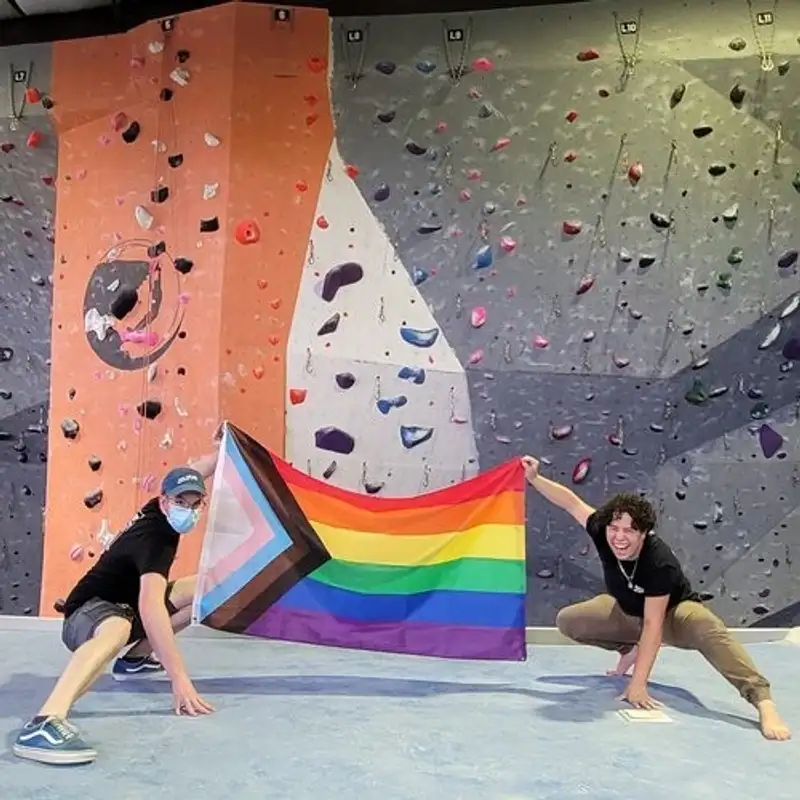
Rock Climbing
Hi, Sam. Hi, Hannah.
How are you doing today?
I'm happy because today is a day
that's full of my new favorite thing.
Which is.
I want to bring you back
to the first episode of this podcast.
We were talking about what we don't
talk about when we talk about fat.
By Aubrey Gordon.
And we were talking about
what health means to different people.
And I said to you in a rather mocking,
dismissive tone
that something that health means to you
is going into a room with a bunch of big
tall plastic walls
that have colorful rubber rocks on them,
and seeing if you can make it all the way
up to the top of those walls
with only the power of your body.
And I said
that as if it was a silly pursuit
that I would never be interested in.
And now here we are, six months later.
I'm so obsessed.
It's my favorite thing in the world.
It's all I can think about.
And when I am not rock climbing,
I am counting down the days
until the next time I get to go
rock climbing.
Yeah. Yeah.
I also count the days of my week
that will end up going towards
rock climbing.
Why don't you talk about how you started
rock climbing
and what made you fall in love with it?
My introduction into rock climbing
really came ten ish years ago.
A good friend of mine had joined the rock
climbing club at his college,
took me and my
then girlfriend at the time out to go
rock climbing outdoors.
Oh, that was your first time was outdoors?
Oh, damn.
And more specifically, it was bouldering
without any ropes or harnesses
and I enjoyed it.
I think it was over winter break.
So it was colder weather
which typically is better
for climbing in general
as long as it's not too cold
because it reduces the amount of moisture
and the chances of you slipping.
And, growing up as a kid.
I was very much an avid tree climber.
There is a great story of me
climbing a tree
and getting to the top, and then falling
all the way down the tree,
getting caught by branches as I do.
And somehow I amazingly
did not hurt myself whatsoever.
And it was actually pretty fun.
Every little boy has something of Mowgli
from The Jungle Book in them.
I said, is it for you,
little girl? Yeah, I was going to say.
Every little
child is a little bit Mowgli
from The Jungle Book.
For sure.
And a little bit Sarah
from A Little Princess.
Right.
And then fast forward like 7 or 8 years
and I decide
to try out the local rock gym near me.
What I go with is bouldering this time,
because I'm limited to the fact
that I'm going by myself
and I don't have other options.
Stone Climbing and Saint
Augustine opened in like 2021 or 2022,
and I was living there at the time,
and I was familiar with rock climbing
from my friend over the years,
and decided that I would try out
this new rock climbing pace,
and it quickly became my new hobby.
You wanted to go there
because you just like trying
different activities with your body.
Yeah, I grew up doing martial arts a lot
and since then not really found anything.
After graduating college
to really replace that.
This was still a couple more years
after I graduated, but yeah,
I found stone climbing
and from there the rest is history.
And what was it about it
that grabbed you and kept you coming back?
So for me, the part
that intrigued me,
even when I was first trying it,
even though I didn't quite hook
on, was what they call the root problems.
In the sense
these are like puzzles that you're
trying to solve but very obviously
physically demanding puzzles.
And the more advanced you get,
the more techniques you can use to try
and basically solve these puzzles.
And so it's very rewarding
when you go to climb
something you can barely even get on it.
And then two weeks later
you can climb it from start to finish.
That was 2021.
That's really
when I would say I got into rock climbing.
How did you get started?
Because of you.
I learned it from watching you.
Is that a good thing or a bad thing?
I'm. I'm quoting an old anti-drug ad.
So we started dating and we wanted
to introduce each other to our hobbies.
And I knew that you really liked
rock climbing.
And I was like, I don't know, that
seems like a silly, weird thing to do.
It smells like feet in there.
And I think a big part
that was underlying my reluctance.
Then I said to you at the time was,
that's not for disabled people to do.
That's something
for non-disabled people to enjoy.
And if I were to do it,
I would simply not be very good at it.
And that's embarrassing.
But you still were willing to give it
the college try?
Yeah, I will, I will try whatever.
I feel like something happened to me
between my early 20s and my mid 30s, that
now I am much more willing to give
any kind of physical activity a shot.
Whereas in the past
I was much more self-conscious.
And there is a touch of this
that didn't get to me when I first started
rock climbing with you, which is
I have some paralysis in my left arm
and so my thumb on my left
arm has very little range of motion.
It's not really an opposable thumb.
My wrist always is bent at an angle.
My elbow does not straighten, and my arm
does not extend all the way above my head.
That extends almost to shoulder level.
My arm does, and so my hand will make it
up to like the same height as my head.
My arm also doesn't go behind my back,
and it's just physically less strong
than my right arm
because many of the muscles are atrophied
and this happened due to a birth injury.
It's called Herb's palsy.
So a lot of physical activities
when I do them,
I either look different doing them,
like with dance,
or I have to figure out
how they will work for me.
Like with yoga, I remember
it took me a while to figure out
that I can do most of a typical yoga flow
by putting weight on my forearms
instead of my hands, because my left hand
does not go flat to the floor, and my left
arm does not extend far in front of me.
When I'm learning a new physical activity,
I'm having to do two things
at the same time.
I'm having to learn what it is,
and I'm having to learn
how it will work for me.
And it's hard to do
both of those things at the same time,
because it's hard to figure out
how something will work, modify it for you
if you don't know how it works
in the first place,
because it's a new skill
and the layer of emotional baggage
on top of this was for me,
being moving in a visible space,
moving in a public space, I should say,
where if I'm new at something
and I am therefore bad at it
because I don't yet know how to do it.
I have this fear that people will watch me
and see me and think,
oh, she's terrible at this
because of her arm and not,
oh, she's terrible at this
because
she's only been doing it for a week.
And that they will then conclude
that all disabled
people must be bad at this thing.
I will kind of take on the pressure
of representing all disabled people.
And so I feel like I'm not allowed
to be okay at something or to be bad.
At it, despite the fact that everyone,
when starting rock climbing.
Is bad at it. It.
Unless you're just like.
Isaac. Well, you.
My friend Isaac,
I took for the first time last week
and he was very good at it
and it was very rude.
So I wanted to try it
because it seemed really fun.
It's colorful,
and I think that there is something
in every person
that we just want to climb stuff.
I was like that as a kid too.
I wanted to climb trees.
I wanted to climb big rocks.
I wanted to climb playground equipment,
and I couldn't climb very high.
Even like when I went to physical therapy,
I would be like climbing
the mats
and the exercise balls and things.
And it's something about our ape ancestry.
We just want to just want to climb.
And it's also a very compelling metaphor.
I did not think that deeply about it
before we started out.
I was just like, oh,
this seems like kind of scary and exciting
because I'm also scared of heights.
So what we did was called top roping,
not bouldering.
Top roping is where you are
secured in a harness.
There is a rope
that extends from the harness
all the way up to the top of the wall,
and then is in like
a little pulley up there,
and then makes it all the way back
down to the ground.
The other end of the rope
is attached to your partner
and your partner
is basically reeling you in as you climb.
And so that does fetch like a fish.
You're really like pulling up the slack
as they climb.
The first couple of times I did not
make it up to the top of the wall,
but I kind of had fun.
I was kind of self-conscious.
I feel defensive about saying
that I'm self-conscious about anything
related to my disability,
because I think a lot of people hear me
say that, and they think somehow
that the self-consciousness was my idea.
I came up with it.
And in reality, it's
stemming from very real experiences
that I was subjected to by other people,
by non-disabled people.
So things like,
you know, doing the school musical,
when I was in middle school
and overhearing a couple of girls
talking about me,
I did not know these girls,
and they were saying,
this is like a core memory I'm sharing.
It's not even that mean
what they were saying, you know.
Have you seen her arm?
What's going on with her arm?
And kind of speculating about it?
And then one of them said, but,
you know, she's in the school musical.
The other one was, oh, yeah.
She goes,
yeah, she's actually pretty good.
Like a surprising, like,
if you have a physical difference,
you're not allowed
to be good at something.
And if you are, it's a
surprise,
a lifetime of experiences like that
add up to this self-consciousness
and this extra pressure.
I was watching non-disabled
people at the gym
make it all the way
up to the top of her, out their first day,
and it was my second and third day,
and I still hadn't made it.
And I think at that point
I was kind of like,
I don't think this is going
to be the thing for me.
But then you found a flier.
I found a flier for a group called para
cliffhangers.
Yeah. And told you about it.
And they met up about once a week
in various places throughout New York.
I know Queens and I know they also are
like getting set up at a gym in Brooklyn.
And the pair of cliffhangers
is a group for adaptive climbers.
Before we went to our first pair
of cliffhangers meetup,
I had made it up to the top of her out
and I was feeling a lot more optimistic.
Also because you were telling me, like,
I see you improving.
And I was like,
willing to believe that that was possible.
But when I started climbing
with a pair of cliffhangers,
it was like, I unlocked a new obsession.
And I think part of it
is that prior to this, I hadn't
had a social group of all physically
disabled people in my life before.
This is my first time
that I've gone and hung out
with a bunch of disabled people
once or twice a week and gotten to know
them and been able to, like, commiserate.
And it's not just about being with people
who get it.
It's about like, I'm there.
I'm in my first six months of climbing
and my first year of climbing.
I'm climbing routes that are lower graded
below the intermediate level,
beginner level, right.
And then there are other people there
who are wheelchair users,
who are amputees, and they're climbing
pretty advanced routes.
So some of the pressure gets taken off
that I need to represent
an entire type of person
in a public space.
We show the full range
of experience levels
and it takes away
the pressure of being the only one.
And also, just like watching people
with physical differences do it,
it makes it non theoretical
that I could do it.
It makes it literal
right in front of my eyes.
I remember you and I had talked about
whether I could learn
how to belay, which is where you reel
the other person in.
And we said, yeah,
I don't know. I don't know.
And I go to meet the pair of cliffhangers
and they say,
do you want to learn how to belay?
And I say, yeah,
I don't know if I'll be able to.
And they say, well, we've taught one
handed people how to do it.
And, you know, immediately
the question left my mind.
It wasn't like, let's see if this works.
It was let's see how this will work.
And that is such a different approach
and such a different feeling.
And I immediately learned how to belay.
It was not a problem.
So I've absolutely fallen in love
with rock climbing.
We're going to be rock
climbing later today.
And you're going to be going
to the National competition
in for sure in the U.S.,
but also possibly Canada.
Yeah, there's like a whole world
of disabled climbing and I will be going
to compete in these para climbing
competitions, of which there are many
a lot of people will go and climb
in the national para climbing competition.
It's their first ever competition
because of this kind of a small world.
I was having a conversation
at para cliffhangers
with one of the non-disabled volunteers.
One day.
She was coaching me
through a difficult route,
and I got off the wall
and I was really happy,
and I was reflecting on how
well it had gone.
And she said, like,
when I'm here with you guys,
I think rock climbing is for disabled
people.
It's not for people like me.
It's for people like you.
And then it makes it weird.
When I go to the gym
and there aren't disabled people around.
And, you know, I think, why is that?
And another para cliffhanger
this person had pointed out to me, it's
among the most accessible sports
that there is, which is ironic because
it's among the most dangerous sports
and it's incredibly physically demanding.
Everyone who is climbing with a rope,
at least, is climbing
with some sort of assistive device,
in the sense that the rope itself
is an assistive device.
The tools that you use are
the same as the tools that I use.
Yeah, there does exist a harness
that different adaptive climbing
organizations use for folks
who really can't
bring themselves up the wall, just with
the power of their bodies, which is great.
They will help bear some of your weight
and pull you up the wall
so that you are climbing, but you are not
pulling up your entire body weight.
That does exist. I have not.
I think I saw it in action one time,
but the majority of adaptive climbers
are just climbing while being disabled
because the wall does not care
how you get up the wall.
Most of your power can come from
your legs, or you can not use legs at all.
Like the paraplegic climbers
that just use their arms.
You can mostly rely on
one side of your body or the other.
If you have spasms, you can get thrown
off the wall and swing back around.
Grab it and keep climbing.
There are techniques
that you can learn and improve,
but it is not nearly as prescribed.
I feel like as a lot of other sports,
climbing, being a place
where disabled folks gather
is pretty in line with the reputation
that climbing has as an alternative,
queer.
Inclusive. Inclusive, funky space.
And I think part of why
we wanted to talk about it
is that we're interested in why that is
because it could easily be
a lot more broke and exclusionary.
Yeah, and I'm sure
that there are or have been circles
that are more so that than not,
I guess why you can compete with others
in climbing for certain,
like in the climbing of different routes.
It's certainly not like a head to head
match
of something you are climbing
something on your own when bouldering,
or you are climbing with a partner
when you're a rope climbing.
And so like something that I noticed
kind of early on is that like I can climb
with somebody
who's been climbing for ten years
and I don't feel like I'm dragging
them down or ruining their good time.
They're still climbing the routes
that are appropriate for their level.
I'm climbing the routes
that are appropriate for a beginner
and it doesn't make a difference.
It's not like they have to dumb down
their climbing to climb with me, right?
Yeah, and they almost need that break
between climbs
to belay, to rest and recuperate
before climbing again.
Because part of climbing is
that you are expending all of your energy
and all of your strength
for a brief amount of time.
Yeah, it's not particularly cardio
endurance heavy, but it is very much
absolute muscle power and to a certain
extent, muscular endurance.
And I think the other
aspect, which we kind of touched on there,
that makes climbing
maybe more of a community space,
is that ship
if you want to call it, between
the climber
and the person supporting them.
And obviously when you get in a gym
setting or even outside,
you have a bunch of bilayers
next to each other who are there
attentively belaying their partners, but
also have a community of people
around them that they can talk to
and hold conversation
with at the same time.
While it is a very momentarily
intense sport, there's a lot of chance
for reprieve and relaxation and reflection
on what is happening.
It's cooperative.
It's interdependent by necessity.
It involves rest, and people
naturally socialize while they're resting.
With rock
climbing, I think less
so than in other sports.
There's not really an ideal body type
in the sense that there's such a variation
on the types of routes that you can climb,
especially in bouldering,
that someone who's tall,
lanky is not always going
to have the easiest time on routes
that maybe are a little bit more cramped
and so in that case,
someone who is smaller,
more compact
may have an easier time on a route.
Whereas like if you think of
something like soccer or golf or basket
like, I imagine those type of sports
to lend themselves more towards
a certain body type.
Yeah.
And there's so much variation
in the types of routes that you can climb
that different body types
can be advantageous in different contexts.
And then another point
that people have brought up to me
is that a lot of muscular men
with lots of upper body strength
and do lots of pull ups will start out
and advance pretty far pretty quickly,
and then hit a hard plateau,
like hitting the brakes in their progress.
Because they have been able to essentially
do pull ups this whole time and rely
so much on their upper body strength,
they never had to develop technique.
Whereas if you're a shorter,
if you're disabled, if you have more body
fat and or less dense muscle,
I guess when you first start,
you have to learn how to climb efficiently
and strategically from the jump,
or else you won't even be able to climb
even the easiest routes.
And so I don't.
Maybe this was kind of a pep talk
that I was getting,
but I do feel my technique coming along,
even though I'm only climbing
beginner level routes in a way that like,
you know, a friend of mine who I brought,
who is a tall man with lots of upper body
strength, was climbing
much more difficult routes
than I was right away, but he even told me
afterwards,
just completely relying on his biceps.
That option is not available to me.
And so in the
long run, it can end up being advantageous
to have to be forced
to learn proper technique
and to learn the appropriate technique
for what you're working with physically.
There's a lot of memes and jokes
about rock climbing,
attracting queer people,
polyamorous people, outdoorsy hippie
dippy people.
I saw a joke online recently about
I go to the rock climbing gym
and I'm blue haired, non-binary person
or checks me in, and then I fall
off of a wall for two hours or whatever.
And this had the same kind of stereotypes
that you hear about.
Like, baristas are the types of people
who would rock climb,
and it's so different from what I think of
stereotypically and online as being
the type of person who is attracted
to other types of fitness activities,
like CrossFit or weightlifting.
Those types of interests
tend to be so burly,
they will actually kind of send
you down an alternate pipeline
if you start seeking out
content about them online.
Yeah, whereas with rock climbing,
you have this reputation
as being very queer, very neurodivergent,
very like left wing.
Why is that?
I think maybe it could have its roots.
And this is all just speculation
in the beginnings of rock climbing,
where kind of be a certain
kind of personality
to want to go out into the woods,
find a rock wall
and decide that you're going to climb it,
figure out how to climb it.
And at the end,
your reward is that you climbed it.
It's not really any.
There's no social validation.
It's very dangerous.
You have to rely on yourself
or your partner who's there with you.
So in that sense, it can be kind of an
intimate activity between the two people,
even just in terms of maybe bouldering
or solo free climbing,
there's almost a somewhat higher
level of obsession to it that I.
Obsession is not the right word,
because you can certainly find that
in probably gym culture too.
But hermit this.
Yeah, yeah, there's
some reclusiveness to it that I think
lends itself to more queer personalities
and more neurodivergent personalities.
They're just like personalities
that are unconcerned
with social validation and investing time
and energy and interest
into socially sanctioned activities. Yes.
So now that it is evolving
and it seems wildly popular to me now,
there are new gyms
popping up all over the place.
I think I am one of many people
who in the past couple of years has gotten
really into it, including myself.
Do you worry about the culture changing?
Have you heard other people worry
about the culture changing?
If anything, I see lots of affinity groups
popping up like a cliff
hanger is adaptive climbing group.
And then there's like Asian
climbers, queer climbers, women climbers,
black climbers, monkey climbers.
Oh yeah, kinky climbers.
I think because
the roots of climbing were
what they were that it will retain its
diversity of personalities
and types of people and the.
Attraction to odd personalities. Yeah.
I hope that some of the structural
things that we identified about it
will carry the day
in terms of defining, like
what kind of community it attracts.
In terms of how you climb
the partner system, the belay system.
Yeah, it being either a solitary
or a partner, an activity,
but not something that you need
to be matched with people
at the same appropriate level
so that you can try to beat each other.
Yeah.
You have someone climbing a 512 route
right next to A56.
Yeah. Both people are up there
struggling together.
Yeah.
And they're going to jump
when they get into the bottom.
Yeah.
They're kind of the structural
I think as you put it, nature
of climbing lends itself towards that.
The interaction that I had today up on
that wall was so lovely and so affirming.
Yeah. Why don't you tell us about it?
Among the easiest routes would be like
a 5.5, and I am comfortably up to a 5.7.
A 5.8 is like what's appropriate for me
right now.
I have like gone up to a 5.8
that I've never climbed
and just climbed up to the top of it,
but usually I fail
a couple times
before I comfortably climb a 5.8,
so I was really working toward
finishing a 5.9.
Not all in one go, but just finishing it.
And it was this 5.9 that I had attempted.
I've probably attempted it
like 4 or 5 times in the past,
and it's a semi-normal kind of wide route
until it gets up to these two really
chunky holds luckily on the right,
which is good because I can reach for them
with my right hand
and then it goes right into a pretty
dramatic overhang
and then it's pretty close to the top.
I was like, I'm going to try it
and I'm not going to be able to finish it.
And the person who was pulling me
was like, yeah, that'll be tricky for you.
And I start climbing and I realize
that somebody is climbing
next to me a 5.11.
So like two grades higher,
I stop to let her get past
because we don't want to be climbing
so close that if one of us were to fall,
we could hit the other.
And she says, oh, you can go.
And I say, no,
this is going to take me a while.
You go ahead. She goes, okay.
So she goes ahead.
When she's a reasonable distance past,
I start struggling up,
as we were discussing
when we were walking home.
I do not know how I got
past those big holds, but I did somehow.
And I remember thinking, Holy moly,
I can't believe that just happened.
I've never been able to get past those two
big holds,
and I start struggling over the overhang.
And at this point
I have caught up with the person
climbing the much more difficult route
right next to me.
And she starts encouraging me.
And honestly,
I think once I got to that overhang,
I might have said, okay,
that's good for today.
But there was this person next to me
who was encouraging me,
and she was encouraging me
in very gentle ways.
You know, she was saying, don't
forget to keep breathing, take a break.
Do you want some chalk?
It was so affirming because it was coming
from a place of admiration and respect,
for this is going to sound so corny,
but where I am in my journey,
when you see someone
struggling with the level of difficulty
that you remember struggling
with not too far in the past,
there's a feeling of almost I'm
envious of you because like,
you get to experience
this progress, it's not condescending.
It was genuine warmth and excitement
flowing between us, from me to her
and from her to me.
And we both got up to the top
and I was so happy
I, I did not think
that I would make it up to the top.
And of course
now all I can think about is okay,
but I got a flash,
a 5.9 flashing means you you climb
all the way up without taking a break
and leaning back on your harness.
So like, you can take a break if you're
still holding yourself up with your body.
And it was just a really beautiful
interaction to be coming from somebody
who is such a more advanced
climber than I am
that it wasn't like,
you go, buddy, you're a very cute beginner
and it's really inspirational
that you're doing this.
Even though you have a bum arm.
It was more like, I see the grit.
I see the progress that you're making
and I'm genuinely thrilled for you.
I love having those types of personalities
around.
The thing that's coming to mind
for how we can use what we discussed today
to act more loving in society is to be
that type of personality for other people.
Yeah. Be genuinely excited.
Yeah,
I think there is a place where competition
or competition has its place,
but especially in American culture today
and been like this for a long time,
there's not enough of that solidarity.
You know, you and I were talking
last weekend, I think about
how those two dynamics
aren't mutually exclusive.
Yeah, I was commenting on a friendship
that you have with somebody
who has like a lot
of the same athletic hobbies as you.
And I said, it seems like
you guys are competitive with each other
in like, a really affectionate way
that motivates each of you to work harder.
That was an awful observation for me.
You know,
you want to talk a little bit about that.
Yeah.
We've known each other
just for over 20 years now.
And it's very much at the level
of having a close brother.
And I think both of us being on it
and also growing up doing martial arts,
which very much in the opposite way of
rock climbing,
is the most intense level of a head
to head type competition where it's like
not just really trying to get the ball
in the other person's basket,
but you are trying to like,
move like the other person.
But it was always done
with so much respect.
I am glad that we have the type of
relationship where we can push each other.
The two of us experience
more of like a solidarity type of rivalry
when we go to rock climbing,
because it's not that head to head.
It's okay, you've climbed it
now I want to climb it,
and I've seen you climb it,
and I've seen how you do it.
And I'm trying to make that work.
Well, I mean, this literally happened
just the other day.
Like I saw Spencer climb it.
I knew the techniques that he used,
and I tried doing it that way
and it didn't work.
And so I had to figure out a way
that worked for me that was similar.
But seeing him climb it made me realize
that while this seemed kind of impossible
before, like, I can start to see where
all these things linked together,
and so now I can start to piece together
myself.
It's such a similar mechanism
to be an adaptive climber,
because like when I watch somebody
like You climb something,
I have to rethink almost
all of the left handed reaches.
If I'm watching you climb
a route with left handed reaches,
you wouldn't climb very many routes
in my grade in the first place.
But if you did, you know
I can emulate how you approached it
in certain spots and in other spots
I have to rethink.
But when I'm rethinking,
a lot of the time, I'm pulling
from other things that I learned from you,
like a high leg or a knee drop,
or crossing one arm in front of the other.
That is a big thing
that I got from you, that I turn left
handed, reaches into right hand.
It reaches with by crossing my right hand
in front of my left.
It's the same mechanism that non-disabled
people have to do,
because we all have to adapt this
activity to our own bodies.
Not to say it's exactly the same.
It is different for me,
but not really because
of rock climbing, more because of cultural
and emotional baggage.
Honestly,
Somebody who volunteered
with para cliffhangers once told me like,
this group is so inspiring
and I wanted to say, we're inspiring.
You're inspiring.
I'm watching you climb.
And I'm thinking someday
I'm going to get that good.
You know, that's
where competitiveness meets solidarity.
When you watch someone be able
to do something that you aspire to.
Yeah.
And instead of feeling resentful
or jealous
you can instead feel okay then why not me.
You know.
How are you going to use what we learned
in this conversation
to act in a more loving way in society.
More queer solidarity.
On the wall.
And off the wall.
And off the wall. Ooh.
I just want to encourage you,
if you think that
this is not the sport for you
because of the way that your body looks
or functions
or something about who you are, you think
means that you don't deserve to be
in a space like a rock climbing gym.
Ignore that voice.
And I highly, highly encourage
anybody to seek out an affinity group
because there's tons of them,
and it's such a great way
to not have to worry as much
about being the only disabled climber.
The only fat climber, the only queer
climber, the only woman climber.
Whatever it is that's tripping
you up like I promised,
I was in affinity group for it.
So seek out community and be the sparkly,
encouraging person on the wall
for somebody else.
Yeah, and that his climbing.
We did it.
We figured it all out.
Good job everybody. Good job. Everybody
I love you.
I love you, too.
Okay. Bye bye. Okay. Bye bye.