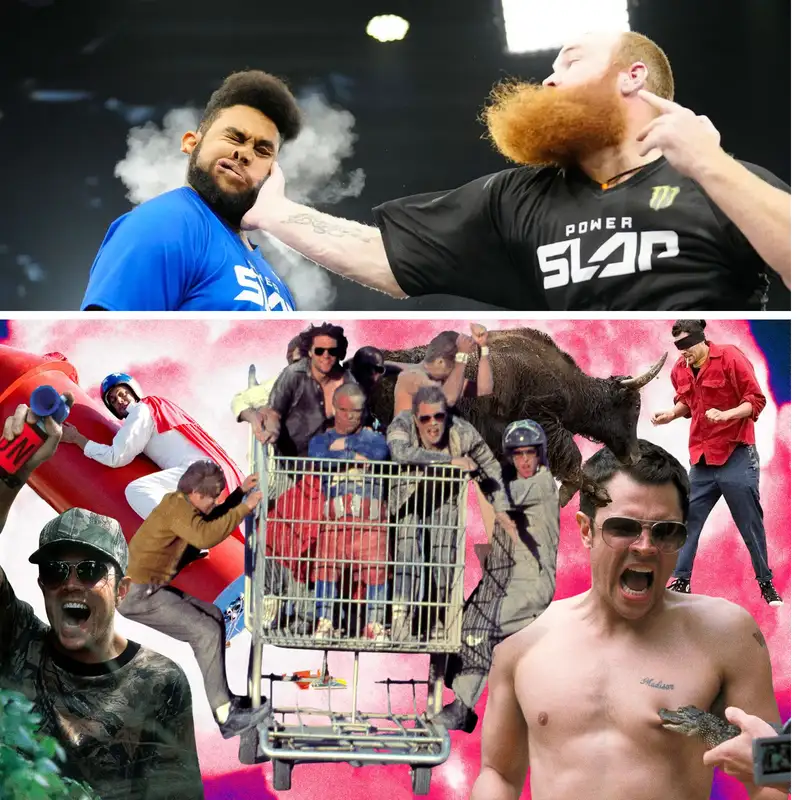
Power Slap and Jackass
Hi, Sam. Hi, Hannah.
How are you doing today? I'm.
I'm full of dread.
Why are you full of dread?
Oh, because of what we're talking about
today.
Yeah. Yeah.
honestly, what I'm curious about
is like your relation to today's topics
as a boy, who grew up doing martial arts.
Yeah. Yeah. But now currently. Man.
But former boy
who grew up doing martial arts as a boy.
I mean,
sometimes I consider myself a boy still.
I know you do.
You're wearing a backwards
baseball cap right now.
Yeah. Yeah.
So today we are talking about two topics,
and I actually, you know,
this is why I love collaborating with you.
And you had the great idea
of bringing in a a foil, if you will.
Yeah, that's a great way to put it.
Yeah.
A foil to power slapping,
which is jackass.
Jackass.
So I'm going to start out
and talk about power slapping.
Briefly describe it.
Go over the rules
and then we'll talk about
some of the controversy surrounding it
and our thoughts on it.
And then we'll go on to talking about
jackass and then see how the two compare.
Yeah.
And throughout we are,
I think, going to be talking a lot
about masculinity,
about consent, about spectacle.
Yeah. Yeah.
All all very charged words
in this day and age.
Oh, yeah.
Consent.
Masculinity and spectacle.
Yeah. I definitely think so.
Okay.
So I'm going to start off
with power slapping.
What could be more American?
Yeah. Yeah.
And I think and we're not going to get
too much into the history of it,
but there certainly has been slap
I think there's a big Russian slap
fighting scene
that and I'm sure that like cultures
around the world and prior to 2025
have had something very similar.
Maybe not as, crystallized
into a, company of which
Dana White, the CEO of UFC, owns.
But certainly I think there have been
men and women
hitting each other back
and forth for fun for a long time.
Oh, yeah.
I've I've done that with my friends. Yeah.
You know, you're drunk and you're like,
let's serve each other in the face.
Yeah.
Or why don't you hold up my hand, punch
as hard as you can?
Yeah. Yeah, yeah.
Which is interesting from a, I guess,
someone who's done
martial arts in the past
from that standpoint.
You do get a lot of people like,
generally when you tell people that like,
oh, I'm a black belt.
Like the first thing they’ll ask is “Oh
can you beat me up?” So there's this,
Really?
yeah. Yeah. For sure. Like there's this.
When you told me that.
Yeah.
Well, I mean, I think, I, I don't think
it's all the time, but I think that with,
that kind of reaction
is something that does happen a lot.
And I'm sure many people
who do martial arts can testify to that.
I think it's meant jokingly obviously,
but it is very is often
a reaction that I get more so from guys.
I feel like humor is maybe a way
to defuze discomfort a lot of the time.
And maybe the reason why
that is a functional joke
is that they know
that you could beat them up,
and maybe that's not very comfortable.
Yeah.
And I think there's also this element of,
“Oh, you think you're better than me
because you're a black belt.”
which is another reason why I think
unless you're like an actual paid
professional fighter
who does this for a living,
if you just casually do martial arts
on the side or as a hobby,
you're probably not going around
telling offering
that information to people.
Yeah.
I don't think that you think you're better
than me because you're a black belt.
I think you think you're better than me
because you're an environmentalist.
Yeah. Well, that's a topic for another.
But, Okay, so
power slapping power is what this.
So. Yeah.
So I mentioned before, it is a power
slapping or I should say Power Slap.
Is specifically a company that is owned by
Dana White, who, again, is the owner or
the CEO of UFC, which is the Ultimate
Fighting Championship.
UFC has been around for 30 plus years.
As a company.
And as we've said, MMA
as a sport
has been around for a long time.
MMA being mixed martial arts, for me,
a layperson I know it as like the most
dangerous,
like kind of anything goes toxically
masculine,
intense, sort of competitive fighting.
More so than boxing, more
so than wrestling.
Yeah.
so Power Slap
as a company came along in like 2022
or officially premiered in 2022 or 2023.
I can't remember.
But, you know, we're
talking very recent. And
let's go over the rules real quick.
So interestingly,
Power Slap is a licensed sport
by the Nevada State Athletic Commission,
which
the reason it's Nevada
is because Las Vegas,
and I'm sure there was
work done behind the scenes to ensure
that it was actually licensed as a sport
because Dana White
was going to be premiering it
alongside UFC
as another sport competition.
so Power Slap
the company does use rules similar
to those established
by other slap fighting leagues.
There are others fighting leagues.
Yeah, yeah.
So like I mentioned before, like there are
I don't know about American.
I'm sure there are other sports.
Oh right. Like in Russia and stuff.
Yeah. Like in other countries.
I'm sure it is.
Power slap is the largest, I would think.
You know, worldwide,
and it is largely because
of Dana White's influence on it as the,
you know, as a leading character in it.
okay, so back to the rules.
So the interesting thing,
I think the rules for
this are very interesting
because I think really the controversy
because I think some people
would throw power slapping in together
with MMA and be like, “Well, you know,
what's the difference?” Like, people are.
Yeah, people are beating the crap
out of each other.
Why is that make power slapping
any worse than in MMA?
To briefly,
explain or to briefly tell you my biases
as far as MMA goes, I, am
I think I, I do respect it as a sport,
as a legitimate sport.
There are certainly a lot of technique
involved in it and skill.
Yeah.
So that's a, that's that's what
my instinctive answer to that question,
what's the difference would be,
is it like, well, one requires
strategy and skill
and like decision making.
Yeah. And the other is just.
Brute force distilled.
I am going to push back on you
a little bit there
because I think as the rules will show,
there is strategy
and skill and technique
that all goes into power slapping.
But I think it is the specific structure
of power slapping that makes it.
Something different from MMA.
I am so curious about
what kind of strategy goes into power.
Well, as a established sport,
there are going to be people
training for it.
so there is a, there is, you know,
obviously, you're trying to maximize
within the limits
when within the constraints of the rules,
you're trying to maximize
the amount of force
that you can deliver in a open handed palm
slap to someone's face.
And there are rules about where
you can hit, specifically for Power Slap.
It must be below the eye,
but above the chin.
And you can't lead with the palm.
So you have an open palm,
but you can't lead with the palm.
Like to where you're the
butt of your palm is hitting them.
Such that it would be,
like, more bone than a full open hand.
Yeah.
So there are constraints
on how the slap is delivered.
for the person
on the receiving side,
there are constraints.
And this is where I think
I would say it to me becomes, spectacle.
Yeah.
And it becomes, reality TV and,
and there is a, the show,
which we'll talk about more like this is a
like an official competition,
just like UFC is, but also just like UFC,
this is a they kind of make a reality
TV show out of it.
so for those being slapped,
they may not flinch,
raise their shoulder or tuck their chins.
So let's just pause on that for a second.
So what basically, you are not allowed to
take any defensive measure.
And I think that's that is the point
where we're separating ourselves from MMA.
Because in MMA, part of the technical
aspect of it is knowing
how to defend yourself properly
and often time well, I'm not going to,
you know,
There is a technique to the defense. So
we move to power
slap and in power slap, there is certainly
a technique to how you hit the person,
but on the receiving side
there's no technique to it.
It is simply you must
resist your natural inclination
to protect your most sensitive organ
in your body, your brain,
and, and merely just take it
without flinching.
and this is where, even,
like other, people in,
martial arts, sports, boxing,
even people in the UFC have called out
power slapping as being kind of stupid
because there obviously is
serious concussive forces that are taken,
and that's not unique to power slapping.
But to take it in a way that you aren't
allowed to defend yourself from it
in any given way.
I mean, yes, these sports are,
you know, to some level consensual,
which we'll talk more about,
but you're still you are signing up
by doing this sport
to receive brain damage.
That is for sure.
Now again, like, the reality of it
is, is that if you're an MMA fighter,
you likely will have brain damage.
But but there's something about the way
in which you are not allowed
to protect yourself, which really,
separates this from the others.
There are such funner ways to sustain
brain damage
than getting slapped in the face on TV.
Yeah.
So how do you figure that
power slapping does involve
strategy and skill?
Because, well, we talked about
the technique in the actual slap itself.
We talked about the regulations
regarding the actual slap itself,
but I don't I still don't understand
what the technique is.
Besides, you know, with a flat hand, exert
as much force as you possibly can.
Well, one other thing we didn't mention
was that the, the slapper, in addition
to not being able to lead with their palm,
also has a limited range of movement.
They can't
they're they're kind of put inside a box
and they can't make any torque
of the feet, any twist of the feet
or step outside the box.
Any of that will disqualify their slap.
Everything you're saying
is making me think that this entails
less strategy and technique.
Yeah, to a certain extent,
I mean, I, I guess the strategy
and skill of this comes from the fact
that you are constrained
to a point where you have to practice
because as someone who's at
the technical
aspect of this comes from the fact
that you are so constrained
that you have to spend training time
practicing slapping
without overexerting your body you know,
without using too much of your body.
So you have to gain a technique
that is allowable within the rules.
And that is a good point.
I think that also does make for a way in
which this is different from other sport,
other MMA type sports
where, you know, in, in UFC or in boxing,
you know, as long as you throw a punch,
you know, without, yeah.
I don't know exactly.
You know, it's
you can't do like,
fish hooks where you're,
like, grabbing people's mouth
with your fingers.
You can't, like, poke people in the eyes.
You know,
you can't, like, grab people's skin.
But other than that,
if you're striking the person,
the technique is kind of open
to however you want to throw it.
So you have,
I guess, a broader you do have in MMA,
a broader range of the type of technique
that you could see.
Whereas in in power slapping,
it's all about being constrained
to the point of you, you know,
you must learn how or or train yourself
to generate as much force
as you can within the limits of the rules.
I just have such an urge
to pose the question, what is it
about fighting and violence
that people find so enthralling?
Yeah. And then, and then I thought
I demanded that you go see, 28 years later
with me yesterday.
I love the saw franchise.
Like, yeah, I'm not without sin.
So I could ask myself the same question.
What is it about violence?
What is it about fighting?
And also what is it
about fictional violence like fictional,
sensationalized, gratuitous
built violence that I find
not just unobjectionable,
but entertaining?
Yeah.
And why does that not carry over
to fighting sports,
which I have no interest in whatsoever?
Yeah, well,
I think the distinction there is
that there are actual people being harmed.
Probably. probably.
if there is to the extent that there is
a controversy surrounding MMA,
it is that, you know, there is you know,
even in boxing, there's there's a lot of,
you know, a life of someone
who spends their life time
as a professional boxer
is certainly going to leave,
you know,
their lead, their lives, their later days
with some likely
some form of brain damage.
Yeah, I remember there was,
there was that,
I don't want to call it a controversy
because that lends it too much credence.
There was the the hoax about the Olympic,
women's boxer secretly being trans,
which she was not.
Yeah.
And a lot of people
who have not really seen much
or any boxing watched that fight
and were horrified and I like had the
I had the
urge to say, yes, boxing is is gross.
It is quite distasteful.
I also don't care for it.
You know,
I don't think that people who don't watch
fighting sports
realize how intense they are.
Yeah, yeah, there's a lot of blood.
There is a lot of like
you will deformed faces.
I didn't show you specifically
before we started this, but there's.
There are some pretty
nasty faces where people get slapped,
they stand back up,
and their whole half of their face
is just, like, ballooned.
And now
they're going to take another slap.
Oh no no no no no I don't like it. Yeah.
Oh I don't like it Sam. Yeah.
And I think you know,
the spectacle word that you used
I think is a really good point.
It's giving Hunger Games.
Yeah.
Where, you know, it's no longer fictional.
Yet in a way it is,
because There's almost a way in
which TV itself, like,
you know, we have reality TV
and there's an extent
to which we recognize that even that is
staged, staged, fictional.
And so when something
when we see something from a screen,
I think spectacle is a great way
to describe it
because it's not happening immediately
in front of us.
It's not like
it's on a two dimensional plane.
even though
people are really hitting each other
and people are really getting hurt,
it makes it easier to digest.
On the grand scheme of things,
for some people,
you said this is not something
you would want to watch.
I generally do not watch.
I mean, I just don't have an interest.
I would say
I don't really have much of an interest
in sports watching sports generally.
So, I mean, I've certainly watched
several UFC bouts before,
but more so with friends,
and I don't follow it myself.
Yeah.
Well, but also, like,
if you were to watch a fighting sport,
you would be watching people
doing something that you know
something about and you'd be able
to, like, assess what they're doing.
Yeah. Yeah, to a certain extent, yeah.
I would just be watching
actual people getting hurt.
I wouldn't have any insights in it.
Yeah.
And I think that has a lot to do if you,
if you sent me to one martial arts class,
I bet I would be a lot more interested
all of a sudden in watching it.
MMA fight.
Yeah, yeah.
So I mean, in that way,
I think, that is what But not.
Oh, sorry.
But not the case with our slapping.
Yeah, yeah, yeah.
so obviously there have been scientists
and doctors that have come out
saying that not only is it very, kind of,
it goes beyond just stupid.
It, you know, it's very
I think they would label it dangerous.
And, they talk about how you can see
in some of the
and again, these things happen in boxing.
They happen in MMA.
But just the fact that they
happen in power slapping,
I would I would venture to guess
that they're going to happen more often
if the sport continues.
Because
there's just no defensive aspect to it.
But they talk, the doctors talk about this
thing called fencing posture,
which is, you know, you
sometimes you'll see
after the person gets slapped,
their whole body kind of curves inward.
And it's a, I believe it is like a,
like an instinctual reaction.
It is also very significantly associated
with traumatic brain injury.
So what you're watching
basically is, is someone's body
responding to getting hit so hard
that it's trying to.
Yeah, I don't know actually
what the fencing posture is trying to do
or if there is an actual
biological physiological benefit to it.
But but you're watching someone
who's, who's undoubtedly leaving that ring
with brain injury, traumatic brain injury
from the concussive forces.
I mean, probably it's an instinct
to curl in because,
you're kind of wrapping your body
around your essential organs, right?
Like, in the same way that, like,
if we're scared
we would go into the fetal position.
Yeah. yeah,
I that's kind of what I would think, too.
I don't know if that's actually the
the the.
Yeah. That's true. I'm just guessing.
Yeah. Yeah.
And but I think regardless
where, where there's evidence that,
you know, these people are undoubtedly
experiencing traumatic brain injury
so there was actually a tweet
from a neuroscientist
who was also a former wrestler.
And, you know, he's
he mentioned and showed
the fencing posture and the significance
of the traumatic brain injury.
And so his, comment was, “What's next?
Who can survive a stabbing?”
Yeah.
So it's like at what, at what level do
we draw the line or what what point do
we draw the line and say okay like sure
we can get people to agree to do this.
And, and
and that's where I'd like to go with this,
to speak of it more from a sociological
standpoint is the other thing
he said is that that people who don't,
who aren't taking
these risks are exploiting those who do.
So I mean, in the sense
that it is consensual. Yes.
The people who are competing in power,
slapping and going up into this
ring have agreed
and to a certain extent know the risks.
But I think there is an argument to be had
that these are also people
who are possibly being exploited,
in the sense that they are
being promised money and fame
for doing something that will
undoubtedly alter their lives
because and they pursue it.
Maybe certainly in part
because they want to do it,
but also in part because of the money
I imagine and I don't know
the statistics behind it, but I imagine
that the there's, there are not many,
people who are making a quote unquote
decent wage or decent, living
who are going into this.
Yeah.
That and that's
what about it feels different
from something like a hot dog
eating contest.
Like even the elite hot dog eating contest
like very few of those hot dog eaters.
That's their whole career.
Most of them have their day jobs
and that's like a fun wacky thing they do.
Yeah.
And add
something like power slapping which
also appears silly.
Yeah.
is at the same time
much more physically harmful.
And perhaps people are,
you know, not not doing it
as a break from their day jobs.
Yeah, yeah, yeah.
And, and I think there's
a probably the, the, the maybe
clearest association we can draw
here is gladiators or football.
That's
Well,
and there's an, you know, an interesting
discussion
for another time about football.
again there's, there's, there's
a level of, there's a degree of separation
between football, between MMA, between
boxing and something like power slapping.
Because, yes,
in all four of those activities,
you know, there's a degree
in which you're, you're
more likely to come out of it
having brain injury.
And now we're going on a break.
We'll be back to talk about
Dana White.
Dana White.
And we are back.
I want to finish talking
about the last section.
Did you have any other thoughts?
When talking about the,
you know, we I mentioned gladiators.
You mentioned in football
this way, in which as a society, we can
sometimes exploit those who are quote
unquote in the lower class.
To have something to aspire to
for fame and a way to make a living
that is very harmful to them
and is to the quote unquote, upper class,
a source of entertainment.
So it kind of it's, it's
kind of in a way it's like,
you know, dangling a carrot for someone
to do something that you
then You watch them
struggle to try and grab the carrot,
you know, giving back those kind of vibes.
Did you have any other thoughts on that?
Yeah I mean
it's just like it's it's just a,
it's a Marxist thing.
Right.
If you have to sell your labor to survive.
Yeah.
Then you are in
many if not most cases selling your body.
Selling the use of your body
whether that be
manual labor, factory labor, sex work.
Pro sports.
I mean, hell, an example comes to mind of
like ballet dancers and ballet companies
advocating to learn different tracks
in the different ballets.
So you're not just doing
the same choreography day after day
after day, which breaks down your body
a lot more quickly than if you're doing
different choreography on different days,
but cost the company more money
because you have to teach the same dancers
different tracks.
Yeah. So
and this is a concept that we see
satirized in stories
like Squid Game, Hunger
Games, Battle Royale, Because it's it's
what it actually is as a matter of degree.
To what degree are we breaking people's
bodies at the altar of
capitalism, at the altar of growth?
And to what degree do the people
entering into that transaction
have, agency in it?
Yeah.
To what degree do they have other options?
No more.
Is it more prevalent
than in power slapping?
I would I would venture to say it's
a, it's a really great distillation.
Yeah. Yeah. Yeah.
So the last thing we want to talk about
is a interesting
event that happened before the premiere
of the first season of Power Slap
Road to the title,
which was kind of, as I mentioned before,
this reality series that they made
to go alongside the actual power slap
competition, much like they do with UFC.
But so the and I'm, I, you know,
I'm not going to give exact dates here
because you can go on Wikipedia
and look it up.
But effectively the show was supposed
to premiere like the first week of January
of 2022 or 2023 on
New Year's
Eve of the the week before the premiere.
A video came out where Dana White,
the CEO and owner of Power Slap,
was caught slapping his wife.
And because of that controversy,
The show ended up getting delayed
a full week.
Let's unpack that. Okay.
There's a lot to unpack here.
Yeah.
Yeah.
But, like,
can I just tell you my knee jerk reaction?
Yeah.
My knee jerk reaction is, Yeah.
Power slapping.
It seems to me a very, like,
male dominated, masculine coded activity
because women would be less likely
to elect to do something like that
for fun, because the threat of violence
looms larger in our everyday lives.
Yeah.
And to be clear,
there is a women power slap division.
Yeah. to me whether or not.
Dana White slapped his wife
Didn't you just say that it was on video.
no no, no. Yeah.
What I mean to say is not whether he had
or hadn't slapped his wife.
I still think this sport would be
deserving
of the controversy that it has garnered.
I think the this event where
he slapped his wife and it was caught on
camera is just kind of
emblematic of the problems
that surround this type of sport.
I'll go on to say,
now that I am not a big fan of MMA.
I find that, MMA brings a lot of.
Hostility in in competition.
You know, it's funny, one of the best
examples of, like, a martial arts fight,
that I, And, of course,
you know,
I'm referring to both real and, fictional.
But one of the best portrayals of it
that that sticks has stuck with in my head
for the past
25 years of my life
is one of the very first episodes
of Power Rangers,
and in it, Jason, the Red Ranger.
And like Tommy, the Green Ranger
future like Power Rangers together,
but at the time, like, didn't know
each other, are sparring with each other
and, in like a karate class
or in like a, yeah, like a karate class
and they're both showing off
incredible skill,
which I think all UFC fighters do.
But then at the end of it, there's
just so much there was so much respect,
so much like recognition
of the other person's abilities and skills
and I'm sure some people are going
to listen to this and say, well, yeah,
it's Power Rangers, it's a kid show.
They're not going to have them like
beating each other until they're bloody.
I get that.
and also I know that in UFC,
you know, there's a lot of often drama
stirred up before matches.
And then afterwards the competitors
generally are somewhat
like they tend to recognize the skills
of the other person.
And they're there's
they're to a certain extent respectful.
But it, it is it again with,
you know, alongside
with the spectacle of the,
the kind of reality TV aspect of UFC.
It just brings in a lot of this just
vitriol kind of
towards the other person
and a lack of respect.
And it's not that that couldn't be seen
in other sports too.
You know, I'm
not I'm not certainly not saying
that UFC is unique in that
or that power slap is unique in that.
But but there's a way in which it's
very much about
more than in any other sport,
just like being
the sense that you are just dominating
this other person,
you are hierarchically superior to them
and can physically.
To a certain extent,
you could physically kill them.
I mean, that's that's kind of
it almost goes there for me in UFC,
and that's why I don't like it.
I don't think that's a reason
that it should be stopped.
I'm not,
you know, going to advocate for it
to, you know, that it
people should stop watching it.
But it does breed this certain culture.
And alongside with this example of Dana
White slapping his wife, which.
You know, I was
going to say, to be fair to Dana White,
I let's not be yeah, I don't think
we need to be fair to Dana White.
I would love to be very unfair to him.
Yeah.
I don't think that people
should be slapping their wives.
And I'll go on the record
as saying that. Yes.
For sure.
Dana White
also said that what he did was horrible
and that there's no excuse for it,
and that he deserves all the, crap
that gets thrown at him for that.
All right. Good.
Let's get some literal crap at him. Yeah.
I don't like that, man.
Yeah, but but I think the point here is
that it's not about
Dana White being the person
he is and corrupting this sport.
I think it's about it's a,
more of a, a broader issue with these,
these types of behaviors
that draws out, this, this hatred,
this cruelty,
this vitriol, this othering of people.
I'm going to throw in while
we're talking about this,
the definition of toxic masculinity.
Yeah.
Toxic masculinity in gender studies
refers to,
not not the idea that masculinity is toxic
in and of itself.
That's a very common misconception,
but a type of masculinity,
that is defined by violence
or the threat of violence.
So the idea is that if a,
a presentation of masculinity
or a masculine identity is rooted in.
The, the concept of like being able
to do violence to other people,
that's what toxic masculinity is.
And like, I just wanted to throw
that explanation in because I think
we're going to be tossing that phrase
around a lot during this conversation.
I also had a thought
while I was listening to you talk.
I was remembering when I was in like
middle school, in high school,
and I just had no interest in sports.
And, and I did a lot of theater and,
and I remember, like,
articulating when I was a teenager, like,
I like
the idea of cooperation, of collaboration
and of, like,
striving for something great
with a team of other people.
But there was something that seemed
ugly to me about doing that
with the end goal
of beating another team of people
as opposed to the end goal of
just creating a piece of art
that was as good as it could be.
And like I remember,
I don't I'm not
that, you know, dogmatic about it anymore.
I, I understand,
like the value of healthy, cordial,
respectful competition and sportsmanship
is like a way to bring people together.
But, you know,
my prefrontal cortex was not developed
at the time that I came up with that.
So, but as I got older, I was one of those
people who, like, started.
Moving my body more in my 30s.
And the way that I became a fitness girl
was I got it in my head
that I wanted to do a Tough Mudder.
And I, I love to tell
people about Tough Mudder is I'm
like the biggest Tough Mudder evangelist.
Tough Mudders for some anyone who
doesn't know they're an obstacle course.
A very messy obstacle course.
Lots and lots of mud.
And you're supposed
to, in doing these obstacles,
they're supposed to present you
with common fears, like fear of heights,
fear of enclosed spaces,
fear of, of extreme cold.
What else do they. Oh, yeah.
Fear of electricity.
And so when you see, like, pictures
and videos of these events, like,
they seem very intense,
you see people like very wet,
very dirty falling from extreme heights.
Their faces are showing like a grimace.
And it might even look
a little bit disturbing.
Like to look at it.
Until you find
out that, in a Tough Mudder,
it is not a competition.
There are no winners and losers.
You don't have to do any of the obstacles.
They tell you at the beginning.
The only way that you can fail
today is if, you don't push yourself
as hard as you can.
And the only person who will be able to
tell you whether or not you failed is you.
And they're very collaborative.
They are built.
The obstacles are built in such a way
that nobody could possibly
get over a lot of them without help.
You're supposed to, help others
and not just the people
that you came there with, but strangers.
So I've had, like, incredibly
affirming experiences doing Tough Mudders,
falling from,
you know, eight feet up in the air
and and a complete stranger caught me,
dragging somebody up a mudslide.
you know, being part of a human ladder
and then climbing up that ladder.
and it's interesting
because it's confrontational
and it's messy and it's ridiculous
and it's intense and you get hurt like,
you know, after the first one that I did,
my friends and I sent pictures of,
like, what our legs looked like,
our bruises and scrapes and stuff.
But it's not competitive
and it's not confrontational at all.
Yeah.
And I think, like
when I started getting into it,
when I started, like, getting that feeling
of, you know, competing against my own,
Prior physical capabilities or competing
against my own, like, mental limits,
and cooperating with others to do things
that I thought maybe I couldn't do.
feeling that adrenaline pumping, feeling
that that shaking in my hands and, like,
pushing through the fear. I was like, wow,
this is I'm feeling masculine
in a way that I never had before.
I get it, you know, I want to get
really muddy and jump out of that tree.
Yeah, yeah, yeah,
I, I can't wait to do one.
Yeah. Even more so.
I can't wait to do one with you.
Oh, yeah.
It'll be very different
from when we were at the beach.
And it takes me
ten minutes to get into the water.
Yeah, we will be jumping into ice water.
Yeah. Yeah.
Which, as I've told
you, is the best way to do it.
Yeah. You're right.
I think like
I associate political conservatism
with, a dogmatic belief
and strict gender differences,
and a dogmatic belief
in natural hierarchies.
Yeah.
And like if you, if you really believe in
natural hierarchies
and essentialist gender differences.
Yeah.
I think a fixation on violence
and the threat of violence
naturally follows that.
Yeah.
Because it's proving
what you already believe lies
at the kind of the foundation of
society.
Yeah.
And, and so it makes sense to me
that it follows to,
like, build spectacles and entertainment
and that are about violent competition
and watching people get hurt.
And I think that's a great segue
into talking about jackass.
jackass.
Do you want to take a break
and get some coffee?
Yeah. Okay.
Part three.
Jackass. Jackass.
Coming to a Earbud near you soon.
a great foil to power slap.
The show is jackass the show.
And this is something that you, know
more about than me.
So I'm gonna let you take this one.
Yeah, I'm a jackass expert.
You listened to one podcast.
I listen to one podcast episode or,
an episode
of a great podcast
called American Hysteria.
Which is
much,
much better researched
and more beautifully
written than anything that I'm saying on
Mike right now.
But we're bringing new connections in.
Yeah, yeah.
So we're traveling 20 years,
22 years, prior
to the premiere of Power Slap.
When a and this is I'm reading right off
Wikipedia right now, the American reality
slapstick comedy and comedy television
series
and media franchise was created,
by Jeff Tremaine, Spike Jones and Johnny
Knoxville.
This was an MTV show.
If you are a millennial,
you probably recall it from your youth,
even if you weren't a fan.
I certainly wasn't a fan.
I found it so distasteful.
I kind of I wanted in my head with this,
this culture of
crudeness and violence and messiness
and confrontation that I didn't like.
not unfairly, but basically jackass was
comedians,
entertainers, pro skateboarders.
That was a big part of it.
It came out of the pro
skateboarding scene doing physical stunts.
For comedic purposes.
So we just watched a few clips,
before we started recording.
My favorite was the duck hunting one.
Yeah.
You want me to describe it?
Yeah, you describe it. Okay.
So in the, duck hunting,
if you have not seen this,
there are several, men sitting in a boat
with, paintball guns.
And then. And they’ve got there.
Oh, they've got,
they got their hunting hats.
Their hunting gear. Their camo.
They are they are ready to go.
And they are waiting for two
men to jump off a
bucket truck, it looks like, into,
onto one of those inflatable.
I don't even know what you would call it.
It basically like a giant ass air
mattress.
That is not all the way inflated.
Yeah, or like a giant beanbag.
And like,
they the two men jump off the bucket
truck, land on one end,
and there is subsequently another man
on the other end dressed up like a duck,
and he goes flying into the air,
and the men in the boat,
mercilessly shoot him with paintball guns,
and try to get as much
as much mini welts on him
as they can before he lands in the water.
and everyone is quacking.
Yes, yes. It's silly.
It's violent,
but it is notably not fighting.
And I think Lake, the biggest difference
that comes to mind
between jackass and power slapping is,
the creativity involved in one
and not the other.
That they're both using harm
to the human body
as entertainment and spectacle.
One is doing it in a way where the people
who are undergoing the physical harm
and people who are coming up
with the stunts that they're performing,
That are as much comedy bits
as they are physical stunts.
and they are harming themselves
and each other.
Yeah.
Whereas
you see something like power slapping
the participants
who are undergoing the physical harm.
They didn't come up with the idea. Yeah.
And there's an esthetic of, like.
of structure and rules.
That are enforced by the institution.
Whereas jackass is like
chaos coming from the cast. Yeah.
Who invented this show themselves.
for that reason, it just doesn't
leave as bad of a taste in my mouth.
Yeah.
And there's no one who's not getting
their fair share of the violence.
Oh, yeah. Yeah, yeah.
No, most of the time with a jackass stunt,
the person who came up with
it is the person who then does it.
Yeah. So what kind of jackass stunts are
there?
Was the duck hunting one
that we just talked about.
There are, like, gross out ones, where,
like, you know, they eat gross stuff.
Yeah. There are ones involving fire. Yeah.
and aerosol cans.
Yeah, a lot of them are
skateboarding based,
and then they pull pranks on each other.
Yeah.
Something.
Noteworthy to me about jackass is.
Okay.
Two noteworthy things about jackass.
The first,
this is a cast of all white men.
And it's coming out of this Gen
X skateboarding culture.
And it's, it's
presenting this esthetic of, like,
chaos and gleeful nihilism.
And I think that that is,
that's political,
or at least it exists
within a political context.
and I see it as separate and apart
from toxic masculinity conservatism.
Yeah. I this was definitely not a show.
I mean, to be fair MMA wasn't
something that we watched going up.
It wasn't
something that my parents watched.
But this I would, I would
there's a, there's a sense in which
I would argue that something like this
would be more crude and less
less likely to appeal to,
someone with a conservative background
such as mine than something like MMA.
Oh, that's so interesting. Yeah. Yeah.
Yeah.
It's interesting,
but when I think of, like, leftist
sensibilities
and leftist esthetics now in 2025, I,
I do not think,
something like jackass or a comedian
like Lenny Bruce or George Carlin.
I don't think of performance art
that's really irreverent
and intense,
and inappropriate for children.
But historically, like,
that kind of performance
art has been a force
for progressive politics.
And I think
in the fact that, that
the cast of jackass
is, you know, all white men.
But it's coming out of Gen X
skater culture.
The, the concept that, Chelsea Weber
Smith introduced
in their episode
about Jackass on American hysteria.
One of many great concepts that
they introduced was the idea that, like,
you know, the next generation of white men
coming after the civil rights movement,
coming after second wave feminism.
they might not know
what to do with themselves
or what to do with their white privilege
or their male privilege.
And so there's this
I'm going to take this punishment
to my body.
In an entertaining spectacle
for people to enjoy
because nothing matters
and isn't that hilarious and delightful?
Yeah. I find that weirdly charming.
Yeah. You know, conceptually,
even though I don't want to sit down
and watch jackass.
And then another aspect of it
that is deceptively progressive
is, there's there's
a lot of, homosexuality, shall we say.
There's a lot of kissing and hugging
and grinding each other on the butts and,
you know, using your
Using your schmuck for a stance.
Usually using your your butt
for a stance.
There's a fixation on the genitals
and the butthole.
And an interaction
with each other's genitals
and butthole
among all these straight guys, you know?
That is weirdly
accepting of, of queerness.
Yeah.
John Waters is a big fan of jackass.
Yeah.
John Waters is somebody
who I would also, lump with the
those other performance artists
I listed off earlier
who do, like really irreverent,
in-your-face stuff.
And it's more pushing
a progressive social message.
Yeah.
And the
there are quotes from the cast of jackass
where they're very aware
that this is what they're doing.
They say we, you know,
we like to bucket to to homophobes,
make them uncomfortable, with this
homoeroticism that we share between us.
Yeah.
And another thing
that was noteworthy for me about jackass,
that when I was a kid,
I found very uncomfortable.
And now as an adult, I'm like,
no, that's that seems fine.
Mostly is, jackass and the the magazine,
so was there was this
magazine called Big Brother.
That Johnny Knoxville, I believe, was
associated with before jackass came to be.
And it was a skater magazine.
and it was,
you know, similarly controversial.
Similarly, the topic of moral panics.
There was a skater featured
in that magazine who had dwarfism.
Who is name is escaping me.
And then there was a cast member of
jackass
who also has dwarfism, Jason Wyman Acuna.
you know,
at the time I read the inclusion of,
visibly
physically disabled person in this cast.
Not incorrectly as
something of a modern day freak show.
You know, this is like,
this is really dirty and ugly,
and they're doing a lot of death
defying stunts, and, oh, look,
there's a little person.
Yeah.
There's something in the American freak
show tradition.
Something about,
like, the spectacle of the other.
Yeah. Going on there.
But at the same time, like, This was also
an incredible athlete,
and a comedic entertainer
in a cast of incredible athletes
and comedic entertainers.
Yeah. Without much differentiation.
Yeah. And
I feel like You can you can draw the line,
from the inclusion of Jason Wieman Acuna
on Jackass to the inclusion of, I believe
two members of the Harlem
Globetrotters who have dwarfism.
And if
you go see a Harlem Globetrotters game.
They're they're dwarfism is not commented
upon.
I think people like bring up
the trampolines more for those guys.
Yeah. But no that's about it.
And it's funny
because the Harlem Globetrotters are
very vaudevillian,
like physical comedy sketches.
And they don't
the the height, the disability of these
athletes is not part of the
the comedy show.
Yeah. And likewise with jackass.
Like, obviously his moniker was women,
but, like,
he was just one of the dudes, like,
he was planning stunts.
He was participating in stunts.
He was pranking his friends. Yeah.
There was a real passive acceptance.
Yeah.
But I don't think that you would have
found in a lot of other places.
Yeah.
I mean, I think
I think you kind of got to the point of
why we're doing this episode
particularly, is
that we're we're juxtaposing
power slap and jackass.
And I think the difference between the two
after our discussion here
is really the egalitarianism of jackass.
as you were describing
the nature of jackass, the
the chaotic ness of it, there's this
somewhat diverse group of white guys,
who are coming up with stunts
and harming themselves
physically, for entertainment
in the same way
that a power slap fighter would.
But in the power slap competition,
Dana White isn't competing.
And I think that speaks to a major
difference between the two and a way
in which I don't know
if we can tease out now or or if, But like
a representation
of two different kinds of masculinity.
Yeah.
of the
there are infinite kinds of masculinity.
And we're just talking about these two
right now.
Yeah, yeah. Yeah.
And I think there's also the Mister Rogers
masculinity.
There's so the strong, stoic
father masculinity.
There's there's a lot.
And I think that.
You know, if we're talking,
about how we live in a society together,
how we love in a society together,
there's a way in which
jackass,
as a form of entertainment involving
physical harm, does a better job at.
Utilizing masculinity
to showcase its entertainment
that in a similar way Power Slap does not.
And I think like.
There's something inherently
anti hierarchical
about gleeful nihilism.
If nothing matters then how can ingrained
hierarchies possibly matter?
If nothing matters, then
how can we possibly be attached to
natural what we see as natural hierarchies
and the need to enforce them?
Yeah.
And in that sense, I feel like this kind
of goofy nihilism that jackass embodies.
is a sort of egalitarian ideology.
And I feel like that's where, like,
the acceptance,
the simultaneous acceptance
and mockery of queerness is, like,
very in line with that kind of ideology
or lack of ideology.
Yeah.
And I find it charming. Yeah.
You know, in a way that.
Abstractly.
Yeah, in a way
that power slap does not capture. No.
Because surface level,
it's like it's very silly.
Yeah, it's silly and it's bodies
in jeopardy and yeah, like they're on the.
Yeah.
Like and that's really the point is that
on the surface level, these two things
seem like
they would come from the same types of
masculinity.
But I think what we've really tried
to show here is that they don't.
you know, they don't.
there's an important distinction
between them.
Maybe not like a moral one per se,
like I don't other than Dana White and,
I'm sure there are other people
other than Dana White
who participate in Power Slap.
You know, I don't think it's necessarily
that the people who participate in
the show are morally wrong.
But it's just as a product of.
A sociological phenomenon within,
the social values that it espouses.
Yeah. Yeah. Are,
I would say, problematic
in a way that jackass isn't.
Yeah.
Weird wholesomeness.
And also, I'm going to add that, like,
as a student of comedy power
slap has one joke, and it's where watching
somebody get slapped in the face.
Yeah.
Jackass has infinite jokes,
and most of them are about buttholes.
Yeah.
And on that note,
I will say that I think we have found
a way to love in a society
slightly better today.
Oh. What's that?
I mean, I think, I think the
if I had to distill it into a word
or a theme, I think it'd be a
if you're going to do
physical harm for comedy, make it equal.
Yeah.
Everyone gets their fair
share as long as they're consenting.
Yeah.
I'm going to say.
don't
dismiss a freak show.
I feel like I'm somebody who
has dismissed
a lot of freak shows in my day.
And a of the time, I return to them
and I go, oh, no, there is
there was value in this,
but it it invoked discomfort in me.
Yeah.
Because of a way that I prefer
not to feel like I am visible.
And because of.
Internalized ideas about what taste is.
What good art is.
Yeah.
That we can always do well to question.
Yeah.
Yeah. And.
If you're gonna put your body
in jeopardy for entertainment,
then for God's sake,
at least be creative about it.
Yeah.
I enjoyed talking about this
with you today.
And, I think a lot of the things
that we discuss here today,
we will go on to discuss in more episodes,
but this was the first of our kind of
like non
book, non movie, episodes
where we just kind of
look at something in society,
and talk about it.
And I think it went really well. Yeah.
I have so much more fun
talking about power slapping and jackass
than I would actually watching
power slapping or jackass.
Yeah, yeah, I,
I feel that I feel that Let's go.
Rock climb! Yeah! Yay!
what word phrase for dick Schmuck.
Hahahahahahaha.