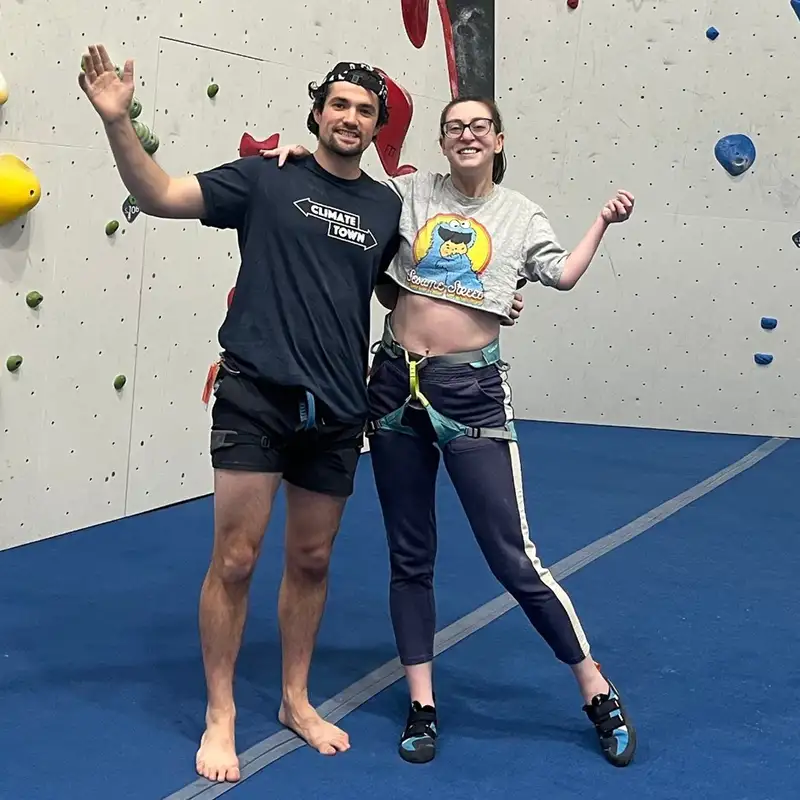
Paraclimbing Nationals 2026
Hi, Hannah.
Hi, Sam.
What's going on? Oh. So much.
Yeah. Yeah.
There's lasagna in the oven.
There's a cat walking up to us.
Meowing.
And we just got back from Houston, Texas.
More specifically, Katie.
Katie. Texas.
Where we were at the USA climbing
para climbing national championships.
Yeah, that was a lot of fun.
It was a lot of feelings. Yes.
Including joy.
Yeah. Yeah.
So what is the para climbing
national championships?
So USA climbing has lots of different rock
climbing programs and competitions.
they have, competitions for pro
rock climbers who are not disabled.
They have competitions for youth.
They have collegiate competitions
and they have para climbing competitions.
Yeah.
And this was a national para
climbing competition.
That feeds into the,
I believe, three World Cups
that happened later in the year.
It was very big this year
because the in 2028, we're going to have,
rock climbing as a Paralympic sport
for the very first time.
Yeah.
So folks came out of retirement
and people started turning out like,
people are like, excited
to try to qualify for the Paralympics.
Yeah.
And we went together and I competed.
Yeah. Yeah.
How was the experience?
Intense.
I don't think it can be captured
in one emotion.
No, it was high highs and low lows.
Yeah.
Yeah.
And also, just like novel feelings.
Yeah. Yeah.
Yeah.
As a, non-disabled climber.
I went obviously to support you.
And I also was very interested
in getting to watch
a national, climbing competition.
But I did not expect to learn
so much about not just the para
climbing community,
but also just climbing in and of itself.
I feel like I took away a lot of things
that I can do to be a better climber.
Me too. Yeah.
I feel like,
I, you know, fretted in the weeks
leading up to this trip that if I, didn't.
Well, let me back up and say some basics.
So, it used to be that you would
climb many routes in the qualifying round.
And rack up points on your three highest
scoring routes.
Now you are assigned only two routes,
and you only get one attempt per route.
And that's not something that I knew
until I was already, like way registered.
So I became worried that I wouldn't
make it very far up
either of the routes that I was assigned,
and in fact, that I might fall
right off of one immediately,
especially if it was overhung.
overhang.
Rock climbing routes are at an acute angle
with the floor.
The wall is at an acute
angle with the floor.
So it takes more upper body
strength to climb them.
And a different technique, really,
and not one that I really practice much.
So I was worried that I would fall
right off of my routes
and not have very many options for routes,
and that the whole thing
would be a waste of time and money.
I needn't have worried about that, because
even if we had just gone to spectate,
it would have been worth the trip.
Yeah.
it was a great time.
So, we both climb
with the Paracliffhangers,
which is a, para climbing organization.
Organization.
And they sent 55, 55 competitors
across New York,
California, Florida, Texas, Texas.
Missouri.
Yeah. North Dakota.
I feel like we had a Chicago person
in there.
Yeah.
I also climb with Adaptive Climbing Group.
I climb with each of those organizations
one per week.
And Adaptive Climbing Group brought a
team of 25 also from all over the country.
And then, oh, there was one other big
organization represented there, Catalyst,
But they had blue shirts
and, Ours are purple.
Ours are purple.
and then some people who just,
you know, go to compete as individuals.
And for me, it was really exciting
to talk to other climbers
whose disability affect an upper limb.
Yeah. I was really amazed.
And I guess this kind of makes sense,
but I was just amazed
how how well
everyone knew each other in the community.
Oh, yeah. It's a small community.
It's a small community.
But also a lot of people in the community
are climbing together
multiple times a year between nationals,
local competitions and the World Cup.
The World Cup, which happens three times
in three different countries.
Yes, and adaptive climbing
Fest in October.
I'm so excited for that. Yeah.
So it's it's really cool
that the community is really tight knit.
Yeah.
And people are really eager
to welcome you in and show you the ropes.
And, You know, everyone's there. No one's.
I mean, I would hope this wouldn't happen
in most sports, but, you know,
no one's cheering against anyone.
Oh, gosh. No.
Everyone, regardless
of whether you're with PCH or ACG,
I mean, everyone's really there
wanting to see the best out of everyone.
Yeah. Yeah. So
the, the
schedule of the weekend when you go
to nationals is that on the first day.
If you have not competed before,
you go to a classification appointment
where you are classified into,
one of several groups
based on the type of physical disability
that you have and the severity of it,
so that you're competing with other people
who are similarly disabled.
And those groups are AL,
which is amputation lower.
So there's AL1 and AL2 depending on
how much leg you've got going on.
AU which is amputation upper.
And there is AU2 and AU3.
There is no AU1 anymore.
It was taken away.
AU2 is more impaired.
AU3 is less impaired.
So if you're AU3
or you're missing part of your hand,
and if you're in AU2 you're missing,
an arm
from somewhere below the elbow and,
Yeah, the the lower the number, the higher
the impairment typically. Yes.
Yeah. Always.
There's B and VI which are the categories
for blind and visually impaired people.
And then there's RP which is range
and power So that's where, your disability
affects your range of motion
or the power of your muscles, or both.
and then there is youth,
which is just any physically disabled
youth to want to rock climb.
And open, which is, like a non
classifiable or undiagnosed disability.
And I, went in hoping and expecting
to be placed in a RP
range and power category.
Because I have my entire
I have all my limbs
and all the components of them.
But, my left arm, shoulder, elbow, wrist,
fingers, etc., are partially paralyzed
from a birth injury.
So I can't reach very far up
above my head.
My elbow does not straighten.
My wrist actually has, like,
no radial, range of motion whatsoever.
My thumb is essentially not opposable.
and my strength is affected.
So I thought that
that would naturally put me in RP.
And I was hoping for RP1
because, it seemed
that RP1 would be the category for,
someone who is disabled
in the way that I am and also has
the amount of experience that I have,
which is to say,
not much, would have the most fun
on those routes.
That would be the most appropriate for me.
Well,
I was just going to add and, Tiffany Yu
who has the same condition
that you have, is in RP1.
Yes, but it affects her very differently
from or not very differently,
but it affects her differently
from how it affects me.
She has a lot less use of that arm.
Yeah. Which we can get into. Yeah.
And they in the classification meeting
when you first go, you are,
being evaluated by physical therapists.
Yes. Who are trying
to objectively place
you into one of these categories,
and therefore they are giving you
point values based on their assessment
of your range of motion, your, muscle
power, muscle power, and so.
As one can imagine,
this leads to some hairy,
you know, trying to put a, a totally
objective system on top of a wide, diverse
range of disabilities
is always going to mess up somewhere.
Yeah.
And I think,
I took a positive view of it beforehand.
You know, you'll remember our conversation
about trans women in sports.
I talked about,
that this process is responsive
to the participants,
and it's nuanced and it's evolving.
And I think that all of that
is still fairly true.
However, it did strike me,
you know, particularly as a gender studies
and sociology person, the veneer of
objectivity, the aesthetic of objectivity.
Seemed to me,
I don’t want to say disingenuous
A fiction that we're all kind
of playing into for the sake of
this is what we need to do in order
to have this system, which we do need.
Right?
Otherwise you would just you
you would almost have just
a different category for every person.
Exactly. And then it wouldn't
be a competition at all.
But I you know, I was assessed,
in a way that I have not been assessed
since I was a kid.
Really, testing my active
and passive range of motion.
So, like, manipulating my body physically.
Not in any kind of,
intrusive or painful way, in fact,
before they even started the examination.
They, you know, asked me about, consent
and touching and stuff.
But, you know, testing how my
my shoulder rotation,
how much I'm able to straighten my elbow,
my wrist, my fingers, and then testing,
muscle power in all those ways.
So, like,
pushing against the physical therapist.
and, you know, scoring the strength
and range of motion.
Range of motion is,
I feel like a little bit more objective
than strength because you're literally
just measuring an angle.
But when it comes to strength, it's
you're pushing
against a physical therapist hand, right.
And then they're giving you a score
for how strong you are.
So the athlete who came in with me
as my advocate for this appointment
pointed out that, like,
these assessments can sometimes vary
wildly depending on the day and depending
on the PT who's conducting them.
anyway,
all of that is to say that I was given
a score of 28 points of impairment.
And I needed 30 to get into RP1
and it was very disappointing.
I remember, like,
finding it surreal to walk into a room
with the intention of presenting myself as
maximally impaired.
Impaired isn't even.
I talked about this also with,
Emily was the
the person who came in with me
for the room like that.
The word impair impaired.
And the concept of impairment is something
that is like so unfriendly to us
as disabled people,
particularly like disabled people with,
you know, an inclination
toward advocacy and, and disability
justice,
that we would think more in terms of,
differences and adaptations
and not in terms of impairment.
And I know especially for me as a kid,
like my hope
going into doctor's appointments
and interacting with, you know, grown ups,
which is, I think, another difference
between going into as an adult,
as a disabled
adult versus a disabled child,
is that that that power
differential is less present.
But I wanted to project myself as,
as close to non-disabled as I could
and as close to unimpaired as I could.
As a kid?
Because I understood
disabled to be a bad thing,
and I wanted to think of myself as typical
and normal and like, you know,
someone who belongs in the community,
who belongs among the other
normal typical kids,
which I understood to mean
not being disabled.
That disabled was other, and inferior
and apart and separate often literally.
Right.
Like I have memories of,
you know, missing, I missed my,
my class school trip
to Old Sturbridge Village because I had to
go to a pre-op appointment, or,
you know, being asked by my,
my friends at girls Inc.
or not asked, but assigned to shower
in the handicapped stall.
Not because I had access needs,
but because, you know,
they just saw signage that said this stall
is for disabled people.
And they said, oh,
that's a disabled people.
Get in.
You know, it wasn't bullying.
It was just kids.
This was your fellow,
like your peers or these were adults?
Oh, no, these were my peers.
These were children.
Children
like, processing these concepts that like,
we understood as roles and categories
and not in terms of access.
Yeah.
Okay. Yeah. Yeah. And clear boundaries.
Yeah.
So, yeah, walking into that appointment,
Trying to make the case
that I am more impaired,
Walking into the appointment
for your classification
for nationals? Yes.
Trying to.
With the intention of trying
to make the case that I am more impaired.
Was surreal to me.
So I was assigned to AU2
So it was me and a bunch of amputees, and
and they said to me in the room,
we know this is this is unfortunate
for a first time competitor
who has less than a year
of climbing experience
because that's the category that the
the routes are quite advanced,
and quite challenging.
And I, I felt disappointed.
I felt like it meant that
I was not going to be as competitive
this year as I maybe could have been.
And definitely
it felt like I would have less
fun climbing the routes, which was what
I was really concerned about.
And that was my classification experience.
Yeah.
And the next day was qualifiers.
So basically for every category
that we previously discussed
They're assigned two routes
and there's overlap.
Right. So I think there was a total of six
routes. Yeah.
And like multiple categories
were assigned to the same route.
Yeah.
you're going to go up,
you're going to climb your first route.
You get one shot.
As soon as you fall off,
You get one point for each.
Hold that you successfully..
Like bore weight on.
And the idea is that
the routes are supposed to start out
easier and get harder as you ascend.
Correct.
And then if you touch a hold
but don't don't solidly land it.
You just get a plus point,
which is like a half a point.
So, as a climber myself
going, you know, hearing as you did
probably, maybe, maybe two weeks
before the event that you'd only
get one chance on each route,
I myself was like, Holy cow.
Like, I can't imagine going into
a competition and only getting one shot.
I mean, there's so many variables
that can throw you off a route. Yup.
So, like.
And I had been to a competition before,
and I got three attempts
per route, and that was, like, very much
what I was expecting.
Right. Right.
So, it really comes down to how
well can you read the route,
which is basically just your, your,
you know, you can see the route
and then you want to try
to determine what the best way up
is, as they call it the beta.
The things that your body does
to get you up.
Right. Yeah.
And They didn't
send out the route information
until the morning of the event.
Yes. Basically at breakfast,
we were all sitting and looking at videos
of an nondisabled person
climbing the route.
It was videos of the, routesetters
climbing the route.
There were some funny moments
in some of the videos where, like,
you could see that there was a cut
and rerecord and, and the people
watching it were like,
oh, even the routesetter fell off of it.
and these routes are probably 60ft.
Yeah. Yeah.
I don't know, what was your as a climber
yourself, Like,
what was your feeling about the routes?
Did they look fun?
Did they look difficult?
They looked like a lot of fun. Yeah.
So yeah, basically
they set six routes for this competition.
You can watch a lot of people
just climb these six routes.
at the end of the day, you know, I've seen
a dozen people climb this route.
I want to get up there and try.
Oh, wow.
I wonder if I can make that work.
And, You know,
this is a national competition.
So there, as you said, as opposed to
what would normally be set in a gym
where you have one
grade of a route to start out.
And it stays that same difficulty or grade
all the way up.
These routes were set to supposedly
start out
easiest at the bottom
and then gradually or
you know, just get harder
as you got higher up the wall.
That yeah that's the theory.
but it's hard and I understand
now why the people I was asking about
this had trouble explaining it to me
because the routes are set
so differently
from what we're used to in a gym.
Not just in terms
of, like, starting easier
and becoming progressively harder,
but just like the types of holds
and the sequences of them,
they look different.
They feel different.
Route setting is so much an art.
It's such an art.
It is?
Yeah.
Somebody has said to me, the difficulty
of routes in a gym, when they're designed
to be more difficult, it's as if
they're just trying to throw you off.
They're they're going to give you
a couple of tiny crimps
and hope that your finger strength
can't handle it.
And with these routes, it is not so.
Most of the holds are like big.
And then a lot of them are weird, and
and they're arranged in a sequence
that like, there could be multiple ways
to get up them.
And it's definitely nothing
like climbing a ladder,
but you just have to be really strong.
Right? you have to have some technique.
Yeah.
And, so the way that they do that
is there's volumes, which is like the wall
basically
coming off the wall in weird shapes.
And then Holds that
you can't really get a good grip on them
unless you're coming at them
from the side or underneath.
Yeah. A lot of traverses,
a lot of traversing.
You get halfway up and now the next hold
is to your right or to your left.
You're not just climbing
straight up anymore.
You've got to get across,
which requires precise foot placement.
You've got small footholds.
It's a lot of balance, especially on the
the less overhung routes,
more and more slab type routes.
So I looked at the two that I was given,
and one had a really tricky start.
That the climber in the video
and most of the climbers who I watched
got through the start
by reaching up high with their left hand.
Which obviously
I was not going to be able to do.
My affected arm is my left arm.
so we came up with a lot of different
ideas for how I could get past that start,
because the whole next section of it
looked very Hannah friendly,
like it was on a slab.
There were lots of holds.
They were like,
you know, big and chunky with
chips on them, which is always fun for me.
And, you know, I figured
if I could get past that start, then
I could get, past a good long section.
Before the next tricky part
that would probably throw me off.
But it was a big
if whether I could get past that start.
And Basically,
I couldn't get past the start.
It would have been a really tricky start
for anybody
who, is affected on their left side.
But a big part of why I couldn't get past
the start was because my feet
were on a volume
with very small, very slippery
footholds
that I hadn't sufficiently practiced on.
And I kept on having to readjust
while my right arm was holding up
a lot of my body weight, holding on to,
such a crimpy handhold.
It was really-
You said, like it was for feet.
It wasn't really for hands.
my body was, shaking.
I was taking a lot of deep breaths.
And I just wanted to keep on
trying as many things as I could try
before I fell off.
So I had to readjust my feet.
I reached for the left hand
and hold that I frankly knew
I was not going to be able to reach.
And then,
I tried to get my body onto the other side
of the first big elephant trunk that I had
grabbed from the ground, sort of tucking
my waist onto the other side of it
so that I could lean against it,
which kind of worked.
And then I think my fatal flaw here
was that I ignored what my foot was doing
while I was so focused
on getting to the other side
of that elephant trunk
and trying to reach up with my right hand.
And that's what eventually threw me off.
And so my very worst fear had come true.
I had dottled around
at the very bottom of a route, and,
not made it
even past the start before I'd fallen off.
And it was so sad.
Yeah.
And I was so humiliated.
I was so embarrassed. Yeah. Yeah.
And the thing is,
I think what really was impressed upon
the people watching was your tenacity.
Number one
held on for a minute down at the bottom
honestly, you might have been on the route
at the same amount of time
that they were climbing.
It’s just they got higher.
yeah.
So you clearly had the strength, to,
to hold yourself up on the wall
and you also weren't
letting each different
obstacle that you ran into just
completely, dissuade
you from continuing to climb.
I think pretty clearly
as you kind of just mentioned, tried
at least three
different methods of attack.
None of them worked out.
Yes. I'm just simply not that experienced.
Yeah. Yeah.
I mean, you've been climbing
for eight months. Yes.
And meanwhile,
maybe the next closest person to you
is been climbing for like, two,
two years, a year and a half.
And, like, there's people
that have been in your category
that you directly competed against
that were to have been climbing
for like 10 or 15 years, right? Yes.
this was a very difficult route.
And I think It didn't start out
easier and get harder.
It started out hard and then got easier
and then got harder.
Yeah, it was
it was advice from, Megan Gleason,
who finished second in RP2 this year
and who I met in Boston.
We were looking at the route beforehand,
and she said,
I think
the most important thing for you on
this is to remember that you're on slab.
Slab is when the wall is at,
an obtuse angle with the floor.
Right.
So gravity is working in your favor.
so on slab routes,
technical precision, footwork and balance
tend to be the name of the game, more
so than upper body strength.
So she said,
you know, remember that you're on slab
and that gravity is not your enemy.
Take a lot of deep breaths,
try to calm your body down
and just try lots of different things.
That was the advice that she gave me
that stuck with me the most.
the idea to get my body
onto the other side of the elephant trunk
was mine, actually.
And and it worked. It worked.
And some people were skeptical of it,
and I was like, man,
I think that's going to be the only thing
that would work on this for me.
I'll be honest
I didn't think it was possible.
And because it was a skinny little place,
I was trying to, like,
wedge my body into. Yeah.
And that goes into, like,
a thing that we've talked
about this past week, about
how it's so like
when you're reading routes,
if you only look at a route from one
angle, like let's say,
directly in front of it, there's
so much about it that you can miss.
It's really important
if you're reading a route to see it
from as many different angles
as you can get up close,
see what the actual pitch of it is
and angle that it's at. So
at this point in the story, my two
worst case scenarios have come true.
I have been classified
in AU instead of RP,
and I have fallen off a
route at the very start. And
I came off the route
went to you, you hugged me and said, I'm
so proud of you.
And I thought, I'm not proud of myself.
Don't say that.
But then you and,
you know, some other climbers pointed out
the things that I had done
well that were visible to you.
And then we had a little bit of time
before my second route.
But, yeah, I don't know.
I guess
I guess what I'm curious about is like,
because I don't quite know how I did this,
because it's not something that I consider
myself skilled in.
Like I was able to come back from feeling
so ashamed and disappointed,
to kind of pulling myself together
to take on that second
round, like, what did it look like
the steps to that were from the outside?
I mean, I think the first part of
it was kind of letting yourself
feel the emotions that you felt
and not trying to, deny
that you were upset about it,
but just be upset about that first route.
And then I think that allowed you
to process through what had just happened,
but then also be like, okay,
but I'm still in the game.
I've still got one more route
I've got to climb.
I know this route is more accessible
in the beginning,
and I know I want to get to this point
on the route.
Yeah. Here's what's next.
And then also like sharing
with a lot of people.
Yeah.
What had just happened
because when I have a shame response
to something that I'm going through,
my inclination is to push through
the shame and confide in other people
because as soon as you say it out
loud, it's so much less shameful
because people meet you with compassion.
Yeah.
In my very privileged life,
that is, and also like hearing my friends
tell me about times
that they didn't make it past the start of
or out in times that they made, like,
very few or no points, at nationals
and made me feel like it's not foolish
or ridiculous for me to be here.
And then, like you say, like, you know,
we went over to that second route
and really analyzed it
and came up with my beta
And I got to get on to it
and I climb 2 or 3 times a week,
and I love it so much.
It makes me so happy.
I look forward to it all day
when I get to go climb.
Because the the inner child, the inner
monkey, just, like,
comes out, you're in this colorful place,
you're defying gravity.
You're contorting your body
into these weird shapes.
You're in puzzle solving mode.
You're a little bit scared
because you're experiencing heights.
You feel strong.
You feel creative.
It's just it it's it's
it just makes me so happy.
I just love it so much.
And, like, I started climbing that second
route, and I was just having a blast
climbing, like,
I was just actually climbing,
you know,
and climbing to the best of my ability,
which is far lower than the ability
of the other women
in my category
who have years of experience on me.
But to be able to actually, like,
represent the skill that I have developed,
which is leaps and bounds
beyond what I was capable of
when I first started,
in that setting on such a, like,
fun and wacky route and in front of
so many people who I look up to
so much who were cheering me
on, the joy was unbelievable.
It was like
all of the normal joy of climbing.
Plus the joy of this route is ridiculous.
And plus the joy of, you know,
I'm, I'm showing what I can do
to all these people who I admire so much.
And they are meeting me with, boundless,
enthusiastic support.
And I think, like, coming
from musical theater, there's always this
big gulf between what I sound like
when I'm singing at home, in my apartment,
or in a voice
lesson, versus on stage or in an audition.
And so what was so thrilling about this
was that I knew
I was climbing as well,
or a little bit better
than how I climb on a normal Wednesday
night or Sunday afternoon.
I unlocked something better.
And I don't know how many times
I've experienced that before,
but it was thrilling.
I think the the most thrilling, like,
heart racing.
Part of it was when you kind of.
You lost your foot.
I think I barn doored out
and I caught myself.
but as you said, you know,
had this been to Hannah
from eight months ago,
you would have fallen off.
That's true. Yeah.
Because you wouldn't have had not just the
it wouldn't have just been a matter of
strength, but a matter of experience and
and skill and technique and knowing how
to kind of catch yourself and get back on.
But there's stuff that was definitely
a little bit of tenacity there to like.
Nope, this isn't really that.
I am not letting that happen again.
Yeah.
And then yeah. You.
So you ended up climbing even higher than
you thought you were going to get on that
a little bit faster, I thought
but you know,
the point is I didn't, it's not like I, I,
you know, was really standing out
from the crowd in terms
of how far up I made it on that route.
But like everybody else in my category was
just, like, completely psyched with me.
I think a lot about like I,
I've done races in New York with NYC runs
and their tagline is win your race.
It's not like win
the race. It's win your race.
And I think that model
of sportsmanship of like,
this is about what you personally
are trying to achieve.
it's not about
distinguishing
yourself or exceeding others.
That I find really appealing.
And being able to like I help you exceed
what you thought that you could do.
And you helped me exceed
what I thought that I could do
by trying to beat each other.
Does that make sense? Yeah.
That is like a really cool
aspect of sportsmanship
that I don't think that I understood
until I was an adult.
That you probably understood much earlier
on than I did.
Yeah. I mean I had the opportunities to.
Yeah. Yeah.
And yeah, just like ecstatic joy, Yeah.
Top ten moments in, I don't know,
maybe past five years in my life, like.
Wow. Which is so funny because it's like.
Yeah, like, I, I, I got an okay score.
Well I think that
that that's just speaks to How cool
it was to get to experience this. Yes.
And how cool it was
that everyone is so welcoming.
Yeah.
Like you were competing with people that
you knew you weren't going to win against.
They had way more experience than you did.
And yet they celebrated with me as hard
as they celebrated with each other
when they were topping their routes.
Yeah. Yeah.
Yeah.
I remember a couple of months ago,
was when I topped my first 5.9
and I was struggling mightily
and most people would regard
a 5.9 as, like,
still kind of a beginner route.
And I was next to this woman who was on,
I don't know if it was a 5.11 or 5.12,
but it was like pretty freaking advanced.
And I remember
she had like, glitter on her face.
And, and we were coordinating
with each other,
you know, to not get in each other's way.
and then she sat and waited
and cheered me on while
I got over the overhanging section
and I got to celebrate
after topping my first 5.9 with this woman
who was climbing like a high 5.11,
and again,
like she was just completely stoked.
I don't even know her name,
but she was like,
so happy to share that experience with me.
it's such beautiful camaraderie
that I didn't know to expect
when I first started climbing.
Yeah.
I'm also I'm remembering that earlier
in this conversation,
we alluded to like classifications
and the differences between
someone like me and someone like Tiffany.
But, yeah,
regarding my classification in AU2,
So my first thought
being in that category was, will
they resent me for being in this category
because I have all my fingers,
and that seems like an unfair advantage.
And then watching them all climb,
I realized, like, they have
so much more overhead reach and shoulder
stability and shoulder strength than I do.
That's not fair. I'm jealous, you know?
And then if you were to put me in RP1,
I would be competing against.
I was going to say someone like.
But actually, literally,
I would be competing against Tiffany Yu,
who is, a climber and also a writer.
She recently came, actually,
I don't know how recent it was,
but her last book was The Disability.
The anti ableist manifesto. Yes.
Anti ableist manifesto.
Tiffany Yu look it up.
She has brachial
plexus injury, erb's palsy.
Same thing as me.
So paralysis affecting the, the arm.
But she has much less use of her left
arm to the degree
that, like, the majority of the time
that she is climbing,
she is climbing with three points
of contact, two feet and an arm.
And she
she does something that I occasionally do,
but so much more rarely than her,
which is just like kind of launch
her body up and grab, Rarely,
she will, like, wedge her left arm
or hand into something and use that.
So it would be either like put me in AU2,
which is kind of unfair to me,
or put me in RP1,
which is kind of unfair to everyone else.
So it's like, do you want to be unfair
to the one individual person,
or do you want to be unfair
to the entire category?
But it's going to be unfair.
And like, just.
Swallowing that, you know, sitting
in that imperfection, acknowledging it
and deciding to keep just rock with it,
just keep climbing anyway, you know?
again, like, sport
lessons are always life lessons, right?
Not that I would have beaten the AU2 women
or the RP1 women this year anyway.
I was coming in
with less than a year of experience,
but you know, it's, it's an insight about
the imperfection of the system and
the inevitable imperfection of the system
and the veneer of objectivity
that kind of papers over that.
yeah, that was qualifiers
and it was a great day.
And we had a whole other day
left ahead of
us where we got to watch the finals.
And the way that finals works is,
if you are in the top 4
or 5 of the category, you are put in,
what it sounds like USA climbing
wants to now refer to not as isolation,
but as the warm up area.
You know, you must surrender your phone.
You're hanging out with the other athletes
you have access to, like, normal
gym routes
to climb on and exercise equipment.
you get five minutes to look at the routes
beforehand.
You're not allowed to consult with anybody
unless you are blind, in which case
you obviously can consult with your caller
because otherwise,
Yeah.
And I thought at first
I thought that like the role of the caller
was only just to describe the holes
and their locations, but no, as a caller
you're very much giving
beta the entire time.
And in fact, it is
sometimes easier to describe beta than,
than holds.
so, yeah.
So we got to sit and we watched finals,
some of the most amazing
climbing I've ever seen in person.
I'm so glad that we stuck it out
because the AU2 women came
I think they were the last category.
watching them climb,
you know, the next day
when my nervous system was calm
and just being in observation mode and
seeing, how much sense
it really makes to put me in this category
because of the techniques
that I have already started to lean on.
Like knee drops and, pistol squats.
Not that I'm actually doing real pistol
squats, right?
But like high legs,
fancy footwork, lay backs.
And, you know, using the elbow,
the shoulder wedging your body
into and up against different like,
crevices and volumes,
all of this stuff,
the style that I have slowly been
developing is the style that these women
climb with.
And seeing, like,
how advanced you can get with
those techniques.
Was really motivating.
And then also like observing them
and learning
what I need to focus on training now.
Was incredibly edifying.
I'm so stoked to get back to the gym
and start training my pistol squats
and start training my footwork
and start training my endurance
and spending more time on overhang
and working on my my hip flexibility.
it's so much more clear to me
now what it takes to be a strong AU2
climber,
because I watched the best in the country,
you know, a few feet in front of me
and then talked to them about it.
Yeah.
What a what a gift.
What a blessing.
do you want to finish up on, like, the,
the men's slash open category?
Oh, it was so stupid.
Yeah. So, qualifiers.
My friend Carissa said,
would you like a trans flag
to put on your harness,
to speak out against fascism?
And I said, absolutely.
And I put it on to my harness.
not knowing that it was,
about the event that we were at,
or not, like, fully making the connection.
I was being self-involved.
I was thinking about
I just
I wasn't putting two and two together.
I was thinking about being at qualifiers,
and someone offered me
a trans flag and I said, yes, I like trans
and put it onto myself
and didn't ask any follow up questions.
our other friend
Madz, had, signed up initially,
planning
on being part of the non-binary category.
And the non-binary category
was apparently discontinued.
And so Madz did make finals,
and we had to go to find the commentators
and made sure that they knew that
Mad’z pronouns are they/them.
And anyway, after the fact, we found out
that what happened was that USA climbing
not in any response
to any kind of like federal regulations
or like outside pressure,
except for, like the implicit pressure
of, like
where the political winds are blowing,
I guess, absorbed the non-binary category
into the men's category
for several of the disability categories,
including men's AL
So amputation lower was men's slash open.
was it not for every category?
Oh was it for every category?
I think so
because I was trying to figure out what-
Was it every men's category?
I think it was every men's category.
I was trying to figure out
what M/O meant.
And then when I was comparing it
to went to the W,
I was like,
oh that must be men's slash open category.
But that seems intentionally confusing
because open refers
to open disability category. Right.
There's already an open.
There's already an open and it's a
disability category not a gender category.
so we didn't understand.
And it turns out that yeah,
if you are non-binary, you're welcome
to, compete in the men's category.
Or if you are non-binary and assigned
female at birth, you're welcome to compete
in the women's category.
And so my first reaction to
this is you can't even say men/non-binary.
You have to say men/open.
That seems wimpy as hell.
It because it it makes it subtle, right.
Like I didn't notice
because I was at the event
and I just saw O and I was like
oh O for open. That's weird.
I thought that was a disability
category and lalala and ignored it.
which is I feel like the intended outcome,
and then to subsume
non-binary climbers or to,
you know, absorb
non-binary climbers only into the men's
category plays into this idea
that men are more advantaged,
because they're bigger and stronger.
And so trans people as, like,
inherently suspect and,
you know, cunning and predatory,
and we must be worried about them.
We should put them with the men
so that they're competing against,
the people who
they would not have an advantage against.
I don't think that that logic.
Points to a positive attitude, either
toward trans people or toward women.
yeah, like, why wasn't the women's
category women's slash open If non-binary
people assigned female at birth
could compete in the woman's category?
Yeah.
But also like,
why not just keep the non-binary category?
Yeah, exactly. Yeah.
Yeah. The
I would love to hear the reasoning.
Well it makes that there isn't.
There’s the official reasoning.
And then there's the,
the real reason, right?
I would love to hear
the official reasoning
because I don't think
that it makes any sense.
It's, you know, it's like arguing that
we need to have one
standard for sex segregation
in sports, across all sports,
for the sake of fairness,
as if fairness looks the same in
all these different sports.
Right. Yeah.
I, I wonder if the official reasoning
was simply that they, they claimed
that they weren't getting enough
nonbinary people.
Yeah.
I doubt it. Right.
Because it's rock climbing.
Everyone's non-binary.
it was interesting when we were at the,
Oh, yeah, we went on on an indoor
skydiving outing the day after finals.
And it was it's very funny because we
we had been
you know, competing for two days.
And then after the,
the second day went out
and there was an after party, obviously.
And so we weren't all fresh as daisies
the next morning,
and we went on this outing for indoor
skydiving, that ParaCliffhangers
very generously set up for us.
But I think everybody was like, you know,
feeling the fatigue from the weekend.
and the, the indoor skydiving people
really wanted us to be like so amped.
And we were all just like,
we are so sore and hung over.
We cannot muster more enthusiasm.
We've mustered
all the enthusiasm that we have.
Yeah, but I could tell
that the instructor, for the instructor,
like the word able bodied,
the term able bodied was something.
He hadn't used before. Oh. Right.
He had to.
I guess I'm
just putting this together now.
It was probably the first time that he had
to use it, because it was the first time
that he was dealing with a group of people
where the majority of us were disabled,
and that the non-disabled
people were the exception.
Right.
So he was like, who here he had to say,
who here is able bodied?
Instead of asking
who here has a disability, right?
Oh yeah.
Which created confusion. Yes.
Because, I remember
Doty came up to me and was like,
do you want to be with the able
bodied or disabled group?
And I was like, I don't know.
I don't know what's involved with this.
Yeah.
You know, well, and
and I think it just speaks to,
you were talking about this this morning
about how the term able bodied is like,
what exactly does that mean? Right?
Does it mean someone without a disability,
or does it just mean
someone who's able to do stuff
with their body and stuff with their body?
In which case?
I mean,
someone can be,
as you pointed out this morning,
someone can be both disabled
and able bodied.
So that my story about this was
I was part of a,
like LGBT, advocacy youth group
when I was in high school.
And there we were doing this
like identity and social justice workshop,
and they gave us this, paper
and it had a list of identity words on it.
And we were supposed to circle
the ones that apply to you.
And I read the paper as two columns.
So I went down one column
and down the other column.
And then after we started the discussion,
I it became clear to me very quickly
that we were actually supposed
to read it as rows
and that the identity words
that were along
the same line on the page were supposed
to be mutually exclusive with each other.
So there was like white/person of color,
cis or trans,
man or woman or other gender identity,
you know, Christian or subscribing
to a different faith or atheist.
And, two of them that were paired together
were, disabled and able bodied,
but myself going down
each column, not reading them as connected
to each other, just circled both.
Because the I had only heard the phrase
able bodied
in the context of like, historical job
postings for able bodied young men.
So I thought able bodied
meant capable of doing manual labor.
And I was like, yeah, I'm
capable of doing manual labor.
My dad always makes me work in the garden.
And I circled it, it was only afterwards
that I realized that
the idea of having a body that
is able was supposed to be
mutually exclusive with having a body
that is disabled.
And the reason why, like, that's
so tricky for me
is that, A body that is able
is such a slippery concept because
able to do what?
You could do so many things with the body.
What do you want to do?
what what do we consider, like
valuable and needed?
What are the abilities that, a body can do
that must render it able?
Because I know a lot of bodies that can
climb an overhung rock wall like a..
oh wait can I swear?
I know a lot of bodies that can climb in
an overhung rock wall like a mother Meow
and can't walk, right, Most quote unquote
able bodies cannot do what a lot of the
I would say now, most of the able bodies
that I know can do.
there were more people this weekend
who were better climbers than I was.
Yeah, totally.
As there should be.
Right. It's a national tournament.
But like.
it points to me toward the constructed
ness, and the artificial boundaries
of these terms, because to be disabled is
somewhat about having
some kind of status or condition
that inhibits your ability
to live a typical life
In some way It inhibits your ability
to take part in typical activities.
Right?
That's like the dictionary definition
of disability.
But like we have not captured
the full picture
if we don't also understand
that disability
also means a social role and a stigma.
It's a label. It's a box. And
those are constructed.
If the, the body abilities
that were considered
standard and important and good shifted,
then the people who fell into that
category would also shift.
And it's also something
that we put on to people
based on their appearance
and our perception of them.
again,
going back to the veneer of objectivity,
the, the aesthetic of objectivity. Right?
It is so much more slippery
than we want to admit.
And I think the, the,
the able bodied/disabled confusion
that I encountered that day,
and that we were discussing this morning
really points to that.
Yeah.
Yeah, But the important thing is
I love rocks and climbing them.
And we also love talking
about gender and sociology.
Yeah.
I am excited for next Paraclimbing
nationals.
I mean, heck, I'm excited for,
just the different
paraclimbing events that are coming up
throughout the next year.
But definitely I'm excited to see,
what next year's
paraclimbing nationals will look like
and what you'll look like in them.
Yeah, I think I'm going to be a lot better
at rock climbing then than I am now.
So from our,
I guess from our entire weekend,
but also from our conversation today,
what have you learned that is going
to, yeah, you're going to channel toward
being more living in society?
I knew going into this weekend
that I would be watching climbers
who were better than me, at climbing and,
and I'd be enjoy watching the climbing.
I don't think I thought as much about how.
I would learn a lot this weekend.
And I think that that really speaks
to the importance of raising
not just, disabled voices and disabled,
lives up, but also, the voices
of, minorities and queer people
and you never know what you're going to be
able to learn from someone who lives life
a little differently than you.
Awww There are so many things that I'm
going to take away from this weekend.
But something that I'm going to take
away. Is.
it is incumbent upon me to let go
of contempt and judgment for myself
in order
to be kinder to the people around me.
Because every time
that I am impatient
or harshly judgmental or not
compassionate, not accepting of myself
for where I'm at with my skill level,
for how I feel about my appearance, for,
how refined my social skills are,
whatever.
Whatever thing I'm bullying myself over.
My brain is rehearsing, bullying
somebody else over that,
I think I worked really hard
and did a lot of really good work
this weekend
at, like, processing through
and discarding mean thoughts about myself.
And in doing so,
I will better be able to meet
the people around me with compassion,
kindness, patience and excitement
for where they're going to grow.
And..
Sometimes
the best way to get out of your own head
is to get into the head of others.
Yeah, but I guess I'm trying to say, like.
When I'm practicing being mean to myself,
I'm practicing being mean to others.
And when I'm practicing
being kind to myself,
I'm practicing being kind to others.
And I want to be kind to others.
And I did a much better job this weekend
at being kind to myself
than I maybe thought I was capable of.
Through moments that were really difficult
and disappointing.
And I'm going to be proud of myself
right now and say that that was great.
And I did a good
job. You did an amazing job.
and so when I see other people
who are novices
who are awkward, yeah,
who don't hold themselves
with the level of ease and experience,
and confidence that I aspire to.
And I recognize some of myself
in that presentation.
If I can keep being kind to them,
then I can keep
being kind to those parts of myself
that also need to be held.
And I realize that I'm talking
about something that we didn't really talk
about in this conversation, but it was a
big part of my experience of the weekend.
Yeah, absolutely. Yeah.
yeah, in terms of acting more loving,
I think that's been a big takeaway.
Absolutely. I love you. I love you, too.
Let's go eat some lasagna.
And watch Saw 5. Yeah Saw Five!