Frankenstein (2025)
Hi, Hannah. Hi, Sam.
How's it going today?
Really good. I'm so energized today.
Yeah. Yeah.
Why is that?
Because I slept really well last night.
And we have a great slate of activities
today.
Yeah.
That of which I only know half of.
But, you know, two thirds.
You know what we're doing right now?
What are we doing right now?
We're talking about Frankenstein.
What - Guillermo del Toro’s Frankenstein.
That's crazy.
We just watched it last night.
Oh, my God, what a coincidence.
Yeah.
So, yeah.
Guillermo del Toro's Frankenstein.
You chose this movie.
Why did you choose this movie?
So I am going to reveal my hand
and that I.
I've been interested in the movie.
Since I have known about it.
But I did recently watch a video
and a video
essay by the Morbid Zoo on YouTube.
And she Made a very compelling case
for the movie being good.
Especially in reaction
to some other people who online
who had not bash the movie but just didn't
find it as compelling as she did.
And it's really just her thoughts on it.
And then that really piqued my interest
even more so than it already had.
And so I was like,
we should watch this movie this weekend.
Shout out to the Morbid Zoo.
Yeah.
Should we start with a rundown plot
summary?
Yeah. Yeah.
So spoilers ahead for Frankenstein,
a novel
that has been around for over 200 years.
Oh, I thought we were going to talk about
the movie. Well, yeah.
But it fairly closely follows the plot.
It's a yeah, it's a more faithful
adaptation, I would say, than, like,
the very famous 1930s, 1940s Yeah.
That movie.
Which isn't to say that
that makes it better, but,
I would say that
that makes it better, but, that's just
my that's just like my opinion, man.
Yeah.
I also have not seen the 1930s movie,
so I will not make any comment on it.
But obviously
I think it is generally a cultural
it is within our cultural unconscious,
the site of
like the grunting monster with the bolts
on the side of its head
that is, stumbling around.
It's just that that image of Frankenstein
and,
or more correctly, Frankenstein's creature
or Frankenstein's monster.
Yeah.
Which have you ever seen a meme
that's like a picture of the last
page of the book, and then somebody wrote
in, like, you know, it's
this beautiful romantic prose about him,
you know, floating away on the ice.
And somebody wrote in, in pen like, and
and as he disappeared toward the horizon,
the creature said, by the way,
you can just refer to me as Frankenstein
and not Frankenstein's monster.
I really don't mind.
that.
That would be very helpful.
I certainly would would half
the number of words we would need to use.
But I think for for today,
we're going to have to differentiate
because we're going
to be talking about Victor
and we're going to be talking
about the creature.
Yes. Yeah.
So yeah. Okay.
So we start out, we are in the Arctic.
There is, ship.
There are some, sailors on the ship.
There are French, Danish,
I think they're Danish
and they're they're working really hard
to get this ship unstuck from the ice.
And the men are demoralized
and exhausted,
and they're worried that the vessel
won't be seaworthy.
And the captain is saying
you're going to keep on working,
and we're going to complete our mission.
He is, like, dead set.
And then there's an explosion.
We go to investigate the explosion.
And we find a man unconscious
half dead in the snow.
We realize
that one of his legs is a prosthetic.
We see that
he has a wound on his shoulder.
We bring him back to the ship,
and then after he arrives at the ship,
this very, very tall man,
with superhuman strength, comes Yeah.
and starts trying. Well and I think the
movie also makes a point to
in the dialog to say that the, the sailors
don't even believe that it is a man.
They're like, is that a
is it a bear or is it a, you know,
they call it a creature,
I think from the outset. Yeah.
They call him a creature.
And part of that is his size.
And part of that is, his his pallor.
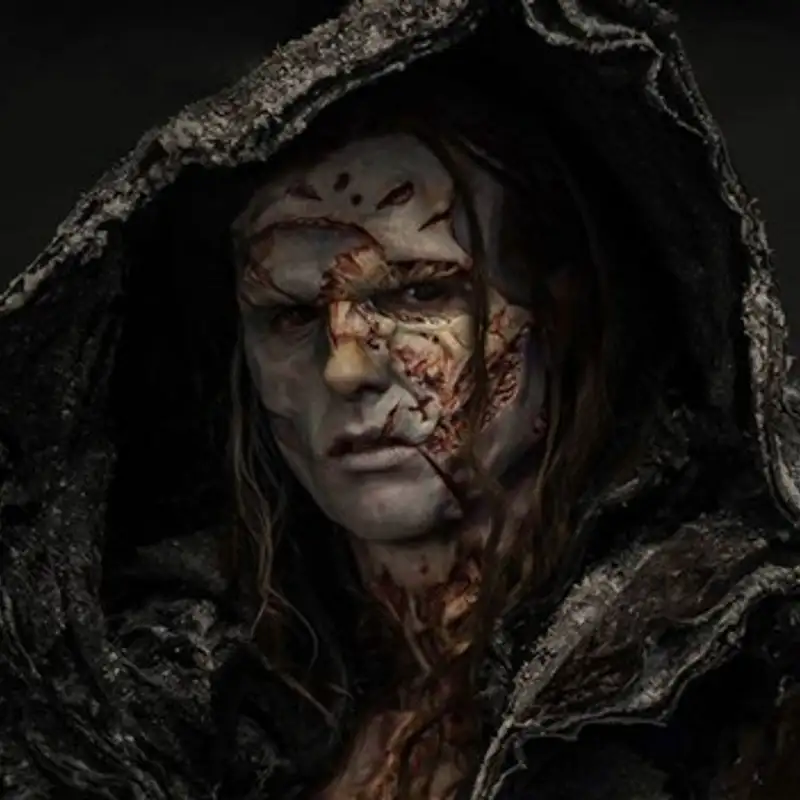
And the, the facial differences
that he has.
So he has, like, stitches and scars
around his face, and his skin is not,
like a color that you would usually see
on a white person.
It's like gray patches of it
are more gray than others.
and yeah, this this very large
man is very angry.
He's trying to get to the
the wounded man that the sailors
have rescued, and he's screaming his name.
Victor.
Victor, Victor, and he kills
six of the sailors right away. We are
we are set
up for how how graphic
the violence is going to be in this movie.
And eventually,
the captain, shoots the ice.
Sinks the creature into the water.
And then begin
speaking to the man who they've rescued.
Who, introduces himself as Victor
and says,
the creature is going to come back.
And you need to send me away to him
because, he won't stop
until he finds me and he can't die.
And so the captain says,
what, how what's your deal?
What's his deal? What's going on?
Except he says it way more poetical
than that.
And Victor says, well,
let me tell you my whole life story.
and then where do we go in our flashback?
Well we go
so we go back to Victor as a kid.
We see Victor's childhood.
He grew up in a very,
well-to-do home.
his dad is a renowned surgeon,
medical doctor.
His mom is a wealthy,
from a wealthy French noble family.
His dad does not love her.
It is a marriage of wealth
and convenience. Yep.
He. Victor,
has a, little brother on the way.
And he is very close with his mom.
And his dad is very cold with him.
His dad is trying to raise him to be
the next generation of Premier surgeon.
We get scenes where his dad's
physically abusing him and verbally
abusing him in an effort
to try and toughen him up
and teach him, And not in a way
that's like typical of the era.
It's It's more in
a way of just actual contempt.
I want you to be this way.
You are instead.
This way, I'm going to be cold
and punitive with you at all times.
And instead of ever expressing
any kind of affection,
I will beat you
when you are displeasing me.
Which I think is like even in cultures
where corporal punishment is normal.
That's not normal.
you know, I'm going to mention a detail
that stuck with me for some reason.
He talks about, like,
his father wasn't around a lot.
And whenever his father wasn't there,
he said, mother was mine.
Which
I think is a hint about his character.
Oh yeah. He definitely has a mommy issues.
His mommy issues. He is narcissistic.
he doesn't treat other people as fully
formed humans
whose emotions and thoughts matter.
That's like a a pattern
that shows up throughout the movie. So
his mom
has a complication with their pregnancy.
His father takes her off
to, try to rescue her.
And deliver the baby. She's bleeding.
We get this very beautiful del Toro
image of, like, the dad has left the room.
He's left a bloody handprint on Victor's
white shirt that, the mom?
Oh, the mom Yeah. The mom was bleeding.
a bloody handprint on Victor's
white shirt, and then it matches the red
handprint on his face from his dad,
slapping him moments before.
His mother dies.
His brother survives.
Victor quickly concludes that
his dad could have saved
his mom and chose not to.
And then his brother, he says
is is everything that I'm not.
He's jolly, he's blond, he's easygoing.
I am brunet, I am dark, I am brooding.
He's he's a goth kid.
In a gothic story.
And then the father dies.
Victor and his brother
are basically separated at this point
go to live with I think Victor I guess
is kind of old enough to be on his own
or at least go to school probably.
And his younger brother
is sent to live with other relatives.
And so affection between them.
You see them, Oh, yeah.
I think throughout the whole movie.
Victor loves his brother. Yeah.
And is one of the few people
that I think that Victor really loves.
Yeah.
Even though he doesn't treat him
you know. So.
Yeah.
So they're separated now.
We're. We're racing ahead in time, Victor.
Real quick, though, I do want to say the,
this isn't super important,
but just the the funerals and more.
So the, the coffins.
So pretty like Is that.
I wonder if that's historically accurate?
Yeah. Is it? What?
I don't know that
I was wondering the same thing.
Or if it's just like, yeah, Guillermo
del Toro Just being like, hey,
let's throw some just crazy death
imagery in there.
I am like, the kind of person who will
throw on a movie or a show and like,
mostly listen while I play a game
on my phone or something.
Not so with this movie.
It is a visual feast.
I wanted to be watching it the whole time
with my eyeballs.
Just lovely to look at.
Including a lot of the violence.
Okay, so now we're a grown up, and,
we are a medical man.
when I say we, I mean, Victor,
we have a presentation before.
I don't know, some kind of organized group
of scientists, like a medical tribunal.
I think it says it's
a disciplinary hearing.
So we don't really know why
Victor's there, but it's presumed
based on the fact
that it's a disciplinary hearing,
that he is there because he has committed
some unprofessional conduct
that he is before a committee to review.
And I believe this is basically to review
whether he should
retain his license or not. Okay.
Yeah.
And he's got a flair for the dramatic.
He brings in the top half of a corpse.
Again. Beautiful visual.
With this creature.
He explains about how he has channeled,
electricity.
And chi. He's
put needles into this corpse.
In in key areas that chi is supposed
to be flowing through,
which I thought was a cool detail
because I think, like,
for far longer than humans have.
Understood the systems and mechanisms
underlying our anatomy.
We have observed things
that we can do to heal ourselves.
And it's like, it's interesting to me
how different cultures, like,
conceptualized those healing methods
and, and theorized
about the mechanisms behind them,
and how there a lot of them were, like,
really getting at something, you know,
like a lot of time, like something
that, is not still well understood.
Like I think, correct me if I'm wrong.
I might be wrong about this.
I think acupuncture
actually holds up in double blind studies.
I mean,
I'm not going to comment
just because I don't know.
I know there have been studies,
I don't know.
I mean, I'm sure there have been studies
that have showed a positive effect of it.
I don't know how rigorous those studies
are or the nature of those studies, but
needless to say, I think the one thing
I can confidently say
is that even if acupuncture
isn't accessing something.
physically,
there, there's so much to be said
about things that mentally improve Yeah.
our well-being.
But also I think even like
in terms of, of, of the physical reality
of like the body and the brain, like
there is so much more going on
than we actually understand.
Yeah. Even today.
Yeah.
And for, for many generations, humans
have been
healing each other, and finding things
that work for some reason.
All right. So.
Yeah. So he's got this corpse.
while.
Victor is performing
this act of reanimating this corpse
basically the entire time, the corpse is
just like gasping for breath.
I get the impression
that the corpses in pain or is suffering.
Yeah, I get that impression, too.
Yeah.
meanwhile, just this room
full of people are just standing around.
Curiously watching.
Yeah, gawking.
There is mayhem and controversy
going on in the room.
But it is not related to cruelty.
It's related
to, you're doing things that only God
is supposed to be able to do, right?
He very significantly tosses
an apple to the corpse.
The corpse catches I think it's a ball.
I thought it it is a
red, spherical shaped could have sworn
it was an apple, Spheroid object.
I thought that somebody, like,
took a bite out of it at one point
because we have the apple and then later
we have the peach. Remember? Yes.
So, yeah, we've got reflexes,
we've got decision making.
it's flashy, it's controversial.
the outraged, you know, judge at the,
at the tribunal says turn that thing off.
He, he cuts the flow of electricity
that's animating this person.
And we see him go back to his,
his, his dark apartment rooms
that have, like,
lots of books and skulls and things and,
Definitely a goth kid.
Definitely a goth kid.
His uncle shows up - Or not his uncle.
Somebody's uncle. A guy shows up.
Well, no, he he he's it is his,
soon to be.
Well, his basically,
his brother is getting married, Victor's
brother is getting married. And
the woman who his
brother is getting married to,
her uncle shows up.
a rich and he's a rich arms dealer.
And he's also a weirdo.
And he was at the tribunal.
Ah, Yes. And he liked what he saw. Yeah.
But he says, you know, basically
what you're presenting is very dramatic.
And there is less, underlying it
than you're trying to make it out to be.
And he says, you know, I want to partner
with you in pursuing this.
Also, your brother and his fiance
are going to be in town soon,
and you should come have lunch
with all of us.
So he comes to have lunch
with all of them.
The, Gosh, what is the character's name?
Harland. Harland? Hart. Heron. Harland.
Here. Harlander. Harlander. Harlander.
So he goes to meet with Harlander,
And Harlander
is taking a staged photograph
of a naked woman.
Again, this motif of, like,
I am an important man doing important
pursuits, and your human discomforts
and emotions do not concern me.
She's really hungry.
She's eating the peaches and he's saying,
like, I need these for the still life.
Yeah. And photography is in its infancy.
He's he is as with many of the men
in this movie,
he is seemingly trailblazing forward
in this new technological discovery.
Yeah, and in doing so,
he does not care if you're cold and hungry
while you're posing for his picture.
And So, yeah, Victor comes in.
Harlander says “I
want to fund your research on this.”
there is a a system in the body,
the limbic system, Lymphatic.
the lymphatic system, and it encases
and has an entry point around the heart.
Yeah.
There's, like this nexus of lymphatic
nodes around the heart that is.
What does the lymphatic system
actually do?
It is primarily part of the immune system.
So it does it
hosts a good amount of immune cells
and is part of like it's
kind of works adjunct
to the circulatory system
to like clear wastes and fight infections.
like when people talk about their lymph
node swelling in their neck,
that's part of the lymphatic system.
So So he says, yes, I want you to use,
this system to restart a heart.
And I have limitless funds for you.
I am super [censored] invested in this.
Yeah.
And Victor is like “Hmmm I don’t know.”
And Harlander is like, “Stop being coy.
Like, you know,
your forthrightness is what I respect
about you.”
The two of them are clearly, like, vibing.
Yeah. intellectually.
There's this or this, part in the scene
where they, like, shake hands
and then they pull each other close
and it like, seems very, homoerotic.
Oh, really?
I didn't even pick up on that.
I mean, I one to pick up on that Yeah.
It just like they
they go to shake hands and then they,
like, pull each other in close
and they're looking, like, deep
into each other's eyes.
Like there's a, there's a sense of.
Yeah. Connection.
homo sociality between men.
Delights and fascinates me.
I remember like in college, I had,
you know, before I like got into fitness.
I had male friends who would like to lift
weights a lot together.
And we would talk about how, you know,
they just go to the gym and they, like,
just lift heavy weights while staring
deeply into each other's eyes.
And I found that so charming. Yeah.
it's a great like, sense of connection
for, for like a group of people that,
like, sometimes can't always
express their affection for one another
very well.
Yeah. Not verbally. Yeah.
So Victor's brother arrives.
They're very happy to see each other.
His brother is so excited
to introduce his fiancée, played by the
wonderful Mia Goth.
Definitely in my top three scream queens.
she tops them all out.
Honestly,
she's so beautiful in this movie. Great.
Costume design in this movie.
Set, set and costume
design are just on point.
And she like the the ingenue
with an incredibly unique way
of looking at the world comes across
beautifully in her performance.
So we meet her.
Victor is like fascinated by her.
The four of them have a conversation.
And the fiancée, Elizabeth, played by Mia
Goth, starts
opining about ideas and how, ideas
such as patriotism and valor
and scientific discovery
that men romanticize and hold up,
as as very important, Like, often
don't hold up in their importance
once you see the human cost
of upholding those ideas, which is never
exacted upon the men who hold those ideas.
Yeah.
And more specifically,
she's referring to war.
Anyway, by the
by the time she's really opining,
the other men have retired for their,
cigars and brandy.
Yeah.
They don't want to hear her Empathize
with the
the peasants
who are dying on the battlefield.
Yeah.
And when she finishes presenting her, her
thesis, she says, now go on with the men.
You know, you've got your very important
cigars and brandy to tend to.
kind of dismissing him. Yeah.
Pegging him as the sort of aristocracy
that she is complaining about.
Yeah. And I think accurately. Yeah.
So he develops a fascination with her,
as Harlander sets him up
in this absolutely gorgeous,
I think it's a water tower.
Yeah. It's so beautiful.
It's it's it's tall, it's broken
down, it's overgrown with vines.
There's this big ass hole
right in the middle of it
that goes all the way down
into the basement.
Very. Both phallic and Yonic.
which I mean, fitting.
Yeah, there's a lot of gender going on.
Oh, we should have mentioned,
he always wants to drink milk.
Victor only drinks milk.
Yes. Which I thought was so significant.
There's some major mommy issues
going on with this guy.
So, yeah, we're in this beautiful tower.
We need to build this big,
complicated structure
with these huge, gorgeous
batteries, and conductors
that are made of pure silver.
And we need to harvest body parts
again, this very, like,
dehumanizing, dispassionate.
He goes to public
hangings and assesses men
who are about to die while
they're still alive, for their body parts.
Just obscene.
And meanwhile, he's
fascinated by Elizabeth.
He's low-key stalking
her. She's on to him.
So she's like,
she is kind of flirting, but doing
so by outsmarting him,
and he continues to underestimate her.
And they go to lunch.
He wants to see what book
she's bought at the market.
He's suggesting that it's like a romance.
No, it's a it's
a scientific text about insects.
And she talks about, like, her,
her fascination with the natural world,
which is very rooted in her faith and her
understanding of intelligent design.
In a lovely way.
she talks about how like beauty
can be seen in like the small things
smallest things. Yeah.
so Victor has his brother
do a bunch of work
setting up his lab for him.
So that he can spend a bunch of time
with his brother's fiancée.
Right.
And as you said, like, this is the one
person who he has real affection for.
Here's
how he's treating him. Victor sucks.
The movie very much is like, oh,
you hate him?
And I'm like, yes, I do.
Thank you for making that so clear.
And And they easily could have failed that
because they're obviously
going through his childhood show why he is
part of why he is so cold and cruel.
Yeah.
Psychologically,
you know, psychologically damaged.
And so they could have made a story
about how this psychologically damaged man
creates
this psychologically damaged creation.
But I think there's more going on there.
Mhm. Or a story that valorizes, like,
he overcame this trauma
and he had this, this pursuit
for for knowledge and discovery
and to conquer death.
but because of his tragic flaw,
he he failed.
And it's like, I feel like the movie
is not that easy on him. No.
So now, he's been frittering away
all of this time
flirting with his future sister in law.
And then, Harlander.
says, you know, “My
patience is running thin.
I'm running out of money.
Like you've got a week.” So, Victor,
we get this gruesome sequence of him,
like doing all this work to finish
building his set up, but also just.
Well, actually,
Elizabeth comes to visit him,
She brings the butterfly
the two of them caught earlier.
Yeah.
And then she basically says to him,
you know, the reason I'm here is to say
we can't do this anymore.
And she's so opining. Yeah.
She says she she monologues
about the anatomy of the butterfly.
And then that is like a springboard
for her talking about, like,
what makes human human,
what makes humans human
versus, the beasts that she studies.
And she says, what makes humans human
is that God endowed us with choice.
I've made my choice.
I feel like this plotline,
part of it is to show
the things that Elizabeth and Victor
have in common, and the very important
ways that they diverge in terms of,
like, their character.
And I don't mean character
in a work of fiction.
I mean character like moral character.
But also, like given that it is 2025,
I feel like
part of what this plot does is give
Victor incel vibes
and make you hate him more.
Yeah. so there's that going on. So. Yeah.
And then we get this gruesome, sequence
But but sorry, just to finish that out,
just to be clear.
So yeah, so she basically says my choice
is that I'm going to marry your brother
and I'm not going to continue
seeing you in effect or,
you know, we're not going to continue this
beyond, you know, we're not going
to turn this into an affair.
And Victor's just. he's shocked. Shocked.
He's like, “Well,
what about ...” but I wanted.
Yeah.
I, I made it very clear what I wanted.
So why am I not getting it?
Yeah. Exactly.
And, he chases after her.
She runs away, and then he.
This is this is when he, you know, he's
he's having trouble at this point.
You know, prior
to this kind of figuring out the thing
that can actually sustain the corpse
once it's, alive.
Oh, yeah.
And something that she said to him
is what gives him the eureka moment.
Something about symmetry.
yeah, yeah.
The symmetry
when she's talking about the butterfly.
Oh, she's actually
talking about the corpse in his office
when she talks about symmetry, remember?
Oh, yeah.
this vivisected corpse from behind.
Yeah, yeah.
And what what is it
that he realizes from the symmetry
Yeah, I mean, he's so, you know,
they talk about how there's
the lymphatic system and then there's
the part surrounding the heart.
And at first Harlander is like, “Oh
we could go into the front.”
and then Victor's like, “No,
if we go in through the back,
there's even better access.” And then.
So he's trying to figure out
how to get in through the back,
and it's not really clear what he changes.
But I guess after having this conversation
with Elizabeth and the conversation
about symmetry,
he's like, gets out of the bath
and is looking at his own back
and he's like, “Ah yes, the symmetry!”
And he like, pulls the plugs out
and puts him in a different way.
And all of a sudden the creature,
you know, the the Proto-creature.
is a prototype. Yeah.
So then we get the gruesome, sequence
where he is just grave robbing like crazy
and just objectifying all of these
With the support
of Harlender’s money and resources
and, like, men, like other troops.
it makes me think of, like, A lot
a common refrain
among like the Jewish groups
that I'm a part of that
have been advocating for the past
more than two years for a cease
fire in Gaza, Something that we say a lot
is that the Torah teaches us that,
every life is a universe.
So each of the tens of thousands of people
who have been senselessly murdered,
for each of them,
the entire universe was extinguished.
And like,
I feel like that it's such a clarifying,
refrain when you think of, like, how
in in war the scale of this death
like to to really remind yourself every
single life contains an entire universe.
And the inhumanness
and the grossness of like him
just chopping up these bodies, Selecting
the the most, the optimal parts.
Yeah.
Picking over all of these universes
for parts.
Yeah.
And we see him, like, mopping the blood,
and like, bagging all these Yeah.
He's certainly not afraid to get his hands
dirty.
No but, like,
not in an admirable way. Yeah.
It's gross. It's. He sucks.
I hate him so much.
And then, in the climactic moment
where he is
going to, channel the storm to
to bring his creature to life.
Harlander Harlander I am so sorry.
Harlander reveals
that he has advanced stage syphilis.
And he says my condition is that
I want you to put my brain
into this perfect body.
My condition for you using all my time
and resources, because up to this point,
he's pretty much just said,
I want you to pursue discovery in science.
which, like, is significant
because it's like all of these great men
who say that
they're pursuing great ideals,
like they've all got a [censored] agenda,
you know?
So. Victor says,
no, I'm not going to do that.
Syphilis is systemic.
It's in your brain as well.
If we if we brought your brain into this
body, it would infect the entire body.
And they fight.
It comes to blows. Harlander.
Harlander Is, like,
so determined to get what he wants,
that he tries to sabotage the procedure.
Take one of the conductors away.
They're fighting over it.
Harlander Falls down that big, beautiful,
yonic waterfall, which, We knew somebody
was going to fall down that thing, right?
Like, as soon as you saw it, you're like,
just a big hole in the floor.
It's going to plummet.
Yeah, it's a big hole in the floor
No guardrails.
stories. It's the gun on the wall.
So yeah, he plummets down.
He crushes his brain.
Victor does his procedure.
It seems that the creature
is not come to life.
He goes to bed, Yeah.
I think it was funny how he fell asleep
to, like, all throughout this, like,
I'm kind of looking at this
as, like, obviously a, analogy of of
birth
and the process of, like, procreation
and like the way he falls
asleep is very funny
because it's kind of like that
stereotypical or that, that typical,
like, man after sex vibes of just like,
like just passed out, like completely
exhausted See, I was thinking of,
like a woman who has just given birth
being like, great, you know,
but yeah, there's,
I think, like the stuff with the mom,
the stuff with the milk, the stuff
with I'm going to create and like
and knowing that this is based on a novel
that a 20 year old woman wrote,
I think that there's a lot in there about,
like a man trying to take away
woman's capacity to create life. yeah.
And they even he Viktor's monologue
at the beginning
tribunal it's kind of funny, though,
because he says, like the
yeah, the creation of life or birth
really has been relegated
to relegated to God basically.
But but here on earth,
we have the chance of,
of trying to control death.
Yeah.
Which is so funny, like the,
the act of creation
has been relegated to God.
Sir, is there anyone else
who maybe participates
in the act of creation pretty actively
that you can think of besides God?
No. Okay.
So, yeah,
the creature comes and finds him.
At first he is so delighted
he introduces himself.
Victor introduces himself
to the. Yeah. First. Victor.
So delighted.
Yeah, yeah.
and the creature immediately
is able to repeat his name.
He shows him sunlight.
The creature feels the sun.
And then he immediately takes him down
into the basement, chains him up,
gives him a blanket,
and just leaves him in this cold,
wet dungeon.
And he openly admits,
I put so much thought into the process
of creating this creature.
I put no thought
into how I was going to parent him.
and to care for him. Yeah.
And it doesn't,
I mean obviously that is the implication
of what he is saying,
but he doesn't even say it
in that
like he says, what I should do after I've,
you know, created this being.
Yeah. He doesn't even really
consider it a being.
Yeah.
It's he's still considering it
very much like
now that I've made this discovery,
I just kind of feel empty inside.
Yeah.
maybe there's like something in there
about like postpartum depression,
I don't know.
I definitely
was thinking during this sequence about,
parents of disabled children
have this analogy that they talk about.
I think that the analogy is very, neutral.
I don't feel any type of positive
or negative way about it,
the way that my mom explained it to me
in terms of her relationship with me
when I was born.
Certainly I felt very positive about.
I've heard other people
use the same analogy in a way that I feel
really negative about,
which is, when you are pregnant,
you are preparing for a trip to Paris,
right?
Like you're researching Paris,
you're making your hotel bookings,
you're buying the right clothing
for what the weather reports say
it will be like in Paris.
The plane lands and you're in Finland.
Which is to say,
like you've been preparing for
your been preparing to
parent a typical child
and then, you arrive
at your parenting experience and it is
with a medically involved disabled child.
You have not prepared for this.
And there's nothing wrong with Finland,
right?
Like Finland is beautiful.
Finland is incredible.
It is not what you have prepared for.
And so you need to figure it out.
That's how.
That's how my mom explained it to me.
Like,
there's this amazing world to explore.
And I did not prepare for it at all.
Especially for an experience
like the one that my mom had where, like,
she had a completely typical pregnancy.
And then due to things that happened
during the birth, she had a disabled
child. Right.
Because it's not like,
you know, you did genetic testing
and you know that you're expecting a baby
with Down's syndrome or something.
And it's a it can be like,
really beautiful metaphor about parenthood
because, like,
no matter what, you're going to be
somewhere besides where you planned to be.
That's parenthood.
It's an act of surrender.
And also meaningfully, when you have a
medically involved infant, that is a lot.
And it is different because, like,
it is an all encompassing
task to parent a baby in the first place,
to parent a medically involved
baby is, you know, that
plus there's a hat on it, right?
So yeah, I was definitely like,
I was thinking a lot during this sequence
about parenthood
as an act of surrender
and his disappointment with the creature,
that the creature didn't
have more of a vocabulary.
And, like how you see that
for parents of disabled children
who are not as lucky as I was, that, like,
you know, you your abilities are different
from what I expected them to be,
and therefore, you're a disappointment.
You are wrong.
And like the mistreatment
that stems from that,
we know that disabled
children are far more vulnerable to abuse.
Than typical children.
And the type of abuse
that we see in the movie.
keeping your child.
I know child, right.
Like it's a seven foot man. But,
but he
at this juncture is meaningfully a child,
and he's kept isolated.
And like, he is not given
any, like, normal human comforts.
Victor says he doesn't know
the difference.
And, like, this ends up
being in this story, as in life,
a self-fulfilling prophecy.
You know, if you have a child
with cognitive differences
and then you keep them isolated
and you don't give them any enrichment,
you don't expect them
to be able to communicate.
And you don't explore ways that
they are able to communicate
that are maybe different from
the types of communication that you expect
out of a typical developing child.
Like, yeah, they're not going to advance,
you know?
That seems very obvious to me
as somebody who is in education.
not so obvious to Victor, right?
He definitely, like, is attached to
one model of intelligence.
and really is showing how much like
his father his father [censored] with him.
Yeah.
In that like his father, you know,
his father treated him the same way.
his father didn't like how Victor's,
expression his, of himself,
and therefore his father put up with him
at best.
Yeah.
the only way that I want you to be
is this way that I have in my head.
And I'm not going to see the
the specialness
and the gifts that my actual child has.
Again, it's like I keep going back to this
phrase parenting as an act of surrender.
If you're not willing to surrender,
if you're not willing to embrace
the reality that you're faced with
instead of the fantasy that you have in
your head, you will be disappointed.
And this is true
of parenting a disabled child,
and this is true of parenting any child.
so, you know, we see this mistreatment
start to take shape.
We see the creature begin
to be afraid of Victor.
And then, and we discover
that The creature can heal.
Kind of like Wolverine.
which, I don't believe
was an original part of
No, that's
that's a Guillermo del Toro joint.
That's not from the original novel.
we're back.
We never left. We never left.
Time is an illusion. Time is a lake.
And what I was saying
moments ago and also centuries ago.
and also
will be saying for forever.
Yeah.
Is that Elizabeth and the brother
are making their way to the castle? Why?
Because she had.
They hadn't heard from Harlander.
Obviously,
because he dead, but they don't know that.
And so she really wants to go find
like check in on him.
so they go So they show up.
Victor is very excited
to show them the creature.
And what? Well,
I think he's really excited.
So it's funny because, like, they show up,
he's surprised because he's like,
I wasn't really ready for this,
but he's happy to see them.
And he's like, come on upstairs.
I want to like,
well he wants to like prime them.
Yeah, Yeah. yeah.
But I don't think he's not really ready.
Ready to show them the creature yet.
He wants them to know
what he's accomplished.
And he does not know.
He does not want them to know
what happened to Harlander.
And he's kind of in this frenetic like,
manic state.
Yeah. He's like, hasn't slept.
And it has just been caring.
Well, caring, quote unquote.
You know, keeping the creature alive Yeah.
And he seems sickly. Yes. Yeah.
So as he's talking to his brother
Elizabeth makes her way down
into the basement and
with no introduction, meets the creature.
Immediately they have a tender
dynamic between the two of them.
And he doesn't hurt her at no point
in the entire movie.
Does the creature hurt her.
And then she kind of challenges
Victor, and says, you're mistreating him.
He says he doesn't know the difference.
And also, something went Victor says.
Yeah. Victor says he doesn't know
the difference.
And Victor says, something went wrong.
He he hasn't learned
anything except for my name.
And Elizabeth says, well, probably
because that word
is the center of his world right now.
That that means everything to him.
And. Then, I think we go right
to the night time
when she makes her way down there
to visit with the creature.
And they have
this sweet moment
where he he gifts her a leaf.
So his favorite pastime down in
the basement is to take these leaves
and set them down in the running water and
wash them, watch them wash away outside.
And he gives her a leaf
because that's all that he has.
And she Accepts it
as the very meaningful gift that it is.
And he learns her name.
Elizabeth and Victor have an argument.
She says there's something
pure and good about him.
Victor says it almost
seems like you're attracted to him.
At this point,
you made a comment about like, now,
now I hate the creature
because he's scamming on my woman.
That's kind of part of the vibe right?
Yeah, that Victor's coming at it
from that perspective so then he tells
William that, basically
something has gone wrong
and that he needs to send them away
so that he can take care of it.
Well, he shows William Harlander's body
and says
that the creature killed Harlander.
Which is the first instance of Victor
blaming a murder on the creature.
And which that's where you're like,
oh, my God, I hate this guy.
And sends them
away because he says, you know,
the creature is a danger to Elizabeth.
so William and Elizabeth
leave in their carriage and they're,
you know, they're making their way out.
And as that's happening,
we go back to the water tower and
Victor is you can tell that he's,
you know, he's basically decided
to just destroy everything.
The whole tower.
He's just going to burn it all down.
With the creature in it, he's
pouring gasoline all over everything.
And I guess he already made this decision,
but kind of like the thing
that finally broke him was hearing
the creature say Elizabeth's name.
right, which is so.
Oh, I was so mad because he was saying,
he was talking to this creature, and he's.
And the creature is just saying
Victor. Victor back at him.
And he's saying, you know,
say any other word.
Show me that you have learned anything.
Give me a reason to spare your life.
And the creature says Elizabeth,
and then he just proceeds
to try to murder him anyway.
because.
Yeah, because he's jealous of Elizabeth's
fascination with the creature.
It's like she has a fascination
with the creature.
And I think it goes
more than just like a fascination
of a creature like I think she is.
She does see the humanity
in, the creature And the innocence.
Yeah.
And and Victor is upset that he can't get
that same reaction from her.
yeah.
Because he doesn't have any innocence.
He sucks.
And I think like at this point
she has also clocked him
for the jerk that he is.
Yeah.
So he just goes on to murder
this guy and then, that he created.
Yeah. Murder his own child.
And then, which again,
you know, there's a lot of instances of.
These kinds of tragedies
befalling disabled children. so
Elizabeth and William come back.
They find that Victor has,
after setting everything on fire.
I think he changes his mind and he goes in
to try to rescue the creature.
Yeah. It almost.
They make it seem like he was like
he because he hears the
the creature screaming his name
as he's leaving the tower.
And then he turns around and he runs back
to the front door, opens it.
And is blown off
by, explosion of explosion of fire.
Yeah.
And that's
how he sustains the injury to his leg.
He loses his leg.
But creature, meanwhile, escapes,
through the pipe that he's been sending.
Leaves out through. Yeah.
And then at this point,
we cut back to the conversation
on the ship.
The creature has arrived. Yeah.
The creature basically barges in on
what has been happening this whole time,
which is Victor telling his story
to the captain of the boat.
And then the creature, as Victor
predicted, comes back,
barges in and says,
oh, Victor has been telling you his story.
Well, let me tell you, mine now.
And so now we go to the flashback
from this point in the story,
from the creature's perspective.
He is in the woods.
He communes
with some kind of antlered animal.
A deer or something.
Again, we see his gentleness.
I think these scenes also happen
in the book.
He's feeding the animal leaves
a pair of hunters come shoot the deer,
and then spot the creature.
They think he's a bear
or some kind of monster.
They start shooting at him.
He, wanders off.
He finds A cabin.
It's the, it's like some kind of storage
or mill house, attached to a residence.
He hides out there.
Again you see.
Wow I didn't notice
this while we were watching it,
but they're definitely
emphasizing his connection with animals
because there are rats,
And they kind of crawl on top of him
and they just all nap together.
And the two hunters are part of a family
that,
that lives
for part of the year in this house.
There is an old man
who is blind, a little girl.
The little girl's mom and the two hunters.
And the creature starts, helping them,
leaving kindling for their fire
He builds them a fence.
The family calls this
the spirit of the forest.
And they leave him gifts too.
And eventually the hunters,
the little girl and the mom leave.
It seems that they stay
with the old man during the summers
and then leave during the winters.
Yeah.
The, the wolves come in
and attack the sheep.
The hunters come and take out the wolves.
And the creature learns
he has a real insight from this.
He says, I realize that, like, the wolves
don't have ill will toward the sheep.
The hunters don't have ill will
toward the wolves.
And yet
the the violence
between them is inevitable,
and such is the way of nature.
Like,
imagine that being one of the first things
that you learn, in an existence
where everybody immediately
sees you and attacks you physically.
Right.
And so the
the family leaves, They're going to sell
like, the furs and the meat and stuff.
And. Yeah.
And they leave the old man alone where he
he lives there usually most of the year.
And then we have the sequence again,
mirroring the book that I think
this is like kind of a famous, scene
from both the movie and the book
where the the creature comes in
and the old man is very warm
and friendly to him.
And they spend the summer together
as friends, and he teaches the creature
how to read, the Bible
and mythology and philosophy.
and then, the
the creature confides in
him that he does
not remember where he comes from.
He only remembers a name.
And the old man says, follow that name.
And so the creature does follow that name.
He finds the ruins of the water tower.
And he realizes that he that he is
reanimated from the body parts of all of
these corpses, and he's horrified by it.
He returns to the old man's cabin.
The wolves have attacked the old man.
He comes in, he takes down all the wolves,
and has a beautiful conversation
with the old man as as he's
dying, as the old man is dying,
where he says where he came from.
And the old man says you're a good man.
And then the hunters return
immediately.
Blame the old man's death on the creature.
Attack him.
Yeah, they shoot him
first, and then he, you know, attacks
one of them and kills them.
And then, like, stumbles out of the house
having been shot.
And then, the other two hunters
still alive, follow him out into the snow,
and he they shoot him again, and then
that's where he falls down in the snow,
seemingly dead. Yeah.
But we know that he's not dead.
Yeah.
He wakes up and he realizes he can't die
and, and this breaks his heart.
he wishes for death at Yeah.
Not only has he just learned
that he is an amalgamation of corpses,
but he must suffer the fate of not dying.
And so the loneliness
is threatening to consume him
and he gets it in his head
that what he needs is a companion.
so he goes to find Victor
who is with William and Elizabeth
on the eve of their wedding
we see Victor interact with Elizabeth.
She is done with him at this point.
He's still in love with her.
The creature comes and finds Victor.
Victor is a smarmy [censored]
He says, “I see that you're well
and that you've learned how to speak.
Have you come to thank me?” the creature.
And I feel like that's.
So that's another
like the way that this movie
is referencing
toxic parent child relationships.
Like, you know,
I brought you into this world.
I can take you out of it,
or I brought you into this world.
And so, like,
you just owe me indefinite compliance.
And. The creature asks for a companion.
Victor. denies him.
And in denying him,
basically calls him monstrous.
And, a horrible thing to doom the world
to his
existence, which is real rich,
coming from a guy who
thought this was a great idea.
the creature starts beating Viktor up,
and there's an altercation.
He’s throwing him around.
And then that’s when is so happy to see
that the creature is alive.
they're, like,
hugging or something, like they're having
a completely innocent interaction.
And then Victor goes to shoot the creature
and instead shoots Elizabeth.
And then she realizes what he's about
to do and steps in front of.
Oh, [censored] Okay. Yeah.
Yeah. Steps in front of the creature,
takes the bullet.
William comes in with some groomsmen.
Victor immediately blames the creature
for Elizabeth's death.
There's more of a scuffle,
and then William gets, wounded.
So then we see the creature scoop up
Elizabeth,
carry her kind of princess style
out of the house.
And William and Victor are left together.
And William's last words
for Victor are pretty intense.
So something like, All of the calamities
in my life had followed from you.
You are the monster.
Meanwhile, Elizabeth
dies in a cave
in the company of the creature.
And, tells him she wishes things could
have been different or she loves him.
I don't think she said she loves him,
but something that they have a kinship
and that she admires his heart And
the creature is very sad.
He wishes only that he could follow her.
And at this point Victor is just dead
set on destroying the creature.
Well, at this point,
the creature is, is enraged
and is just like, you know,
you created me without my permission.
And then you've
doomed me to eternal life.
And he said, and because of that,
I will follow you and haunt you
for the rest of your days, And then, yeah,
I kind of transitions basically
to the point where well at that point
they both have the same goal.
Right.
Like at this point they,
they both want the creature dead. Yes.
So they have a scuffle.
And that's where that key line
that you just referenced comes in,
where the creature says to Victor,
you only listen when I hurt you,
which is, I feel like where
the movie is referencing
the cycle of abuse,
especially like from fathers to sons
to sons to their sons to their sons.
That, like, what else would
the creature have learned from Victor
but to be heard by using violence?
And Victor has a stick of dynamite,
and the creature says, okay,
I'm going to take it.
And, you better hope that it works.
Now run. And Victor runs away.
We hear the explosion
that at the beginning of the movie,
this explosion that the soldiers heard.
the narrative of what has been going in
the flashback has caught up
to the beginning of the film.
So we're back on the ship.
And the ending is, I would say like,
I shouldn't say the most implausible
part of this movie
because everything about this
movie is pretty implausible.
But in terms of like. Character growth.
Victor, apologizes for everything.
Owns his
mistake and harm.
And says, now you're doomed to be alive.
So live.
Yeah.
It it does feel a little shoehorned
in, like.
Okay, we gotta
we gotta make, like, wrap this up
and turn this into a morality tale Yeah.
I wish that the creature had had
that interaction instead with Elizabeth.
And I wish that Victor had not gotten
to enjoy absolution.
But, That's just like my opinion, man.
So Victor dies in the creature's arms.
Oh, he begs him.
To say his name one more time.
He says, please say my name
the way that you did in the beginning.
And he says, you know, my
my father gave it to me and soiled it
with his treatment of me.
Can you please give it back to me
the way that you did then?
So, like, finally acknowledging the gift
that he squandered.
In the creature's trust for him.
Yeah.
And I think that maybe I would push back
on what you said earlier about you
wish it had been Elizabeth.
Because I think it was almost necessary
for the creature to have to forgive
in order for it to kind of complete
the morality tale of, like,
I think the creature could forgive without
Victor getting to enjoy absolution.
Yeah, that's true.
That's like something that, is a big deal
with, like recovery circles and stuff
like trauma recovery.
Recovery from abuse and assault.
You're supposed to forgive,
but not like, absolve of.
Right like, not like via an interaction
with the person who harmed you,
Anyway,
the last shot that we see is the creature.
So first he frees the ship,
he just pushes it because it got
super strength to, And, Oh,
the captain says we're going home.
So he has given up his hubris.
Yeah.
in response
to, like, these cycles of, Prideful men
destroying themselves
and the people around them.
the captain like Harlander
and like Victor, is seemingly on the
same path because he is driving himself
and his men through the Arctic.
No matter what,
they will complete their mission.
The captain has been in the room
with the creature, and Victor and his crew
is still outside, and the crew's like,
there's a creature in there with with him.
We got to kill the creature.
You know,
the creature killed six of our guys.
And so, you know, he opens the captain,
opens up the door and says, no.
let him through Let him through
he deserves to be let free
So by telling his story
the creature has earned
status as a human among humans. Yes.
Which is, a sad state of affairs and also,
less bleak than what we might have feared.
Based on, some of the ways that
all of the ways
that humans have, reacted to him.
Yeah.
and so I think what it was was not just,
you know, everything
Victor had said to him, but also the
the actions of the captain to basically,
you know,
because I don't think
the creature went in there expecting,
I mean, he was on a violent path
going in there.
And he wanted Victor dead, basically.
And so Victor dies,
but I think he kind of realizes when the
captain lets him go, They don't ask him
to, push the ship off to free the ship.
He choose. He he kind of
you can in the scene.
You you see him
think about it for a moment
and kind of look back at the captain
And so it was kind of
that act of goodwill towards him
that And this might be stretching it
a little bit, but like that earlier point
that he learned from the wolves
about Violence kind of being inevitable.
it's almost like he
adds a
building block on top of that of like.
I can choose altruism.
Yeah.
Yeah, I can choose to do the quote unquote
right thing.
And then the,
the last thing that we see is the creature
facing the sun and feeling it on his face
with the tear coming down his cheek.
Which like we remember at the beginning,
one of the first things,
the first interaction between the creature
and victor, was Victor
introducing the creature
to the sun, saying, we love the sun.
The sun feels warm on our faces,
enjoying the sun, and then immediately
dragging him down to the basement
and chaining him away from the sun.
So now he has been
figuratively and literally set free
and can truly feel the sun on his face.
And that's the end of the story.
And it's very beautiful.
So, yeah, what are what are some thoughts
on this that we didn't already?
talk about?
we talked a little bit
about the gender aspects.
I think there's maybe a little bit more
we can expand upon there.
Yeah.
So there's
this whole thing is replete with gender.
We've got Gender, gender, gender, gender.
We've got the,
the mommy issues, drinking the milk.
the the ultimate achievement
of a capital G.
Capital M great man would be usurping
the ability of women
to create life
and claiming it for himself.
yeah.
And then the other gender thing going on
is, the great men and their hubris.
In all of its callous disregard
for the dignity
and well-being of the people
and sentient creatures around them.
And Elizabeth, as an example
of the
the counterbalance, the challenge to that.
Do you think this film speaks with
a feminist ideology or a feminist lens?
Do you think so?
I do, And it's interesting because Victor
starts out obviously as a kid
being sort of like the creature,
like being curious,
enjoying like the close relationship
he has with his mother.
And there are signs of it being,
like, narcissistic, like she's mine. But
in some ways, before.
His mom dies.
Victor is somewhat like the creature.
And in a similar way,
I think the creature kind of as.
He develops and learns
and then goes through tragedy
also becomes like Victor,
like kind of like blinded
by this rage of destroying himself
and also, destroying Victor.
And then in the end,
Victor
is not able to break out of that cycle,
but the creature is I think it's
interesting kind of their parallel
to some extent how the, how their lives
parallel each think the, their lives
parallel each other, is really crucial for
I think, what would be a main takeaway
for most viewers, which is like
which one of them is truly the monster
you would expect it to be the creature.
It's actually Victor,
but is he even actually a monster?
What does it mean to be a monster?
Does it mean to look monstrous?
does it mean to do monstrous things?
Or does it mean to have something
fundamentally broken and cruel about you?
Because, we can see, as you referenced,
the seeds of Victor's
narcissism even in his boyhood,
but not all narcissism.
Narcissism is malignant
or malignant in all situations.
So, I think every capital G, capital M
great man
has some real narcissistic tendencies
because it takes some level of narcissism
in order to attempt
to do something impossible.
Right.
And I think by, by showing us victors
redemption and absolution
at the end, it's,
it's even challenging its own challenge.
The movie is right.
Because the the first challenge is, oh,
the monster isn't the creature.
The monster is actually the great man
whose hubris,
created this creature
and caused all of this tragedy. But.
Oh, is he even really a monster,
or did he have a tragic flaw?
I like that it engages with that question
on several levels.
I'm thinking of a Lindsay Ellis video
essay called My Monster Boyfriend.
It talks a lot about Guillermo del Toro.
And The Shape of Water in particular.
And she tracks like, beauty
and the beast stories
like different iterations of beauty
and the beast stories, through the ages
and how they tend to serve as,
parables peddling the morality of the era.
And also, like, they reflect back
modern day anxieties
from whenever that story is told.
So the first beauty
and the beast story is like
a parable that can help
prepare a young woman to
enter into an arranged marriage by saying
like, well, if you're just very, you
know, demure and submissive, eventually
your beast will turn into a prince.
And then another example that she brings
up is King Kong,
where we see like that, that
that film is clearly reflecting back
racial anxieties.
And then also we see
one of the first iterations of,
like, the purity of the woman
finding the humanity in this creature.
Right.
And then The Shape of Water,
Now we're really, meaningfully
engaging with how these stories
about people with spoiled identities,
you know, monsters, deformed people.
People who are seen as in some way
not fully human.
are not truly the monster.
And the real monstrous thing
is the stigmatization and the violence
against, othered social groups.
And you see examples of that
in The Shape of Water.
Wicked.
What else?
There are lots of stories like this
Frankenstein,
the one that we just watched.
Obviously, the entirety of the X-Men
struggle is like the them
as mutants versus like the humans
who want to try to kill them
because they're different.
these kinds of stories, always remind me
of, the book Stigma
by Erving Goffman
and the concept of spoiled identity.
It's a moving target, right.
Like identities that would fully push
someone to the margins of society.
like, that's always shifting.
And hopefully it's shifting in such a way
that fewer and fewer people
are marginalized to that degree.
Although lately I'm rather pessimistic,
and I think maybe it's more just a matter
of who falls
into the category of the scapegoat de jure
but there is a difference between
stigma and marginalization
that makes it so that you face
structural barriers or experience
microaggressions and spoiled
identity stigma where, like.
truly cannot exist in society.
To the point where, like there were ugly
laws in the books
right until the late 1970s
in part of this country Yeah.
where if you were sufficiently,
Deformed, quote unquote deformed,
it was literally illegal for you
to be out in public. And.
I think stories like Frankenstein
or Wicked are engaging more
with that type of stigma.
There's no logical reason why these
people should be so marginalized and yet.
Right.
it comes out of this of more conservative
members
of society, people who tend to believe
in a natural order of things.
And when that natural order is broken
according to their terms,
they have these feelings of disgust
and these feelings of disgust
are so powerful to them that they feel
that they must do something about it.
they feel compelled to speak out
to say something hateful
to legalize, things about that restrict
certain people from ever showing up,
Yeah to try to legislate
certain types of people out of existence
like we're from
currently seeing with trans people.
I don't know.
Have we talked about this on the pod
before?
I know we've talked about it
between the two of us, but,
Disgust as an emotion being,
and this surprised
me when I learned it
actually a learned response.
So like disgust because it feels
so visceral, almost physical.
And because it's an important emotion
to protect us from contamination
and, like, illness.
You know, it is
it is good that we are disgusted by poop
because we can catch a lot of diseases
that could kill us if we get too close
to poop or, like, get it anywhere
near our mouths or any other orifices.
And so too
that like when you first look at disgust,
it seems as if it is, pretty simple
and evolutionarily advantageous.
But actually it is learned
babies are not disgusted by poop.
We have to teach them.
And so when we have that disgust response
to somebody with a facial difference,
or somebody who is gender
non-conforming in
a way that like falls
outside the lines of what we've,
what is socially inscribed as natural,
as good as normal.
And we have a disgust response.
It feels as if, like we are drawing on
primal knowledge
about what is good and right and natural.
And in reality, it is a learned response.
And, and what is natural does include
bodily variance and gender
variance and all kinds of variance,
because nature is weird and messy.
And so I think,
I think these types of stories
really, draw on that.
And like the heavy presence
of Christianity
and Christian theology in Frankenstein
kind of highlighted that for me.
Yeah.
and the model of, of Christianity
coming from Elizabeth
that is so charitable,
and loving, and restorative.
Yeah.
You know, I,
I until we started talking about this,
I didn't even really appreciate the fact
that.
Yeah.
Elizabeth is as would
likely make sense, a Christian or,
you know, is
certainly a believer in God,
and I, I totally missed that point because
because she is so empathetic in not to say
that Christians aren't empathetic,
but just Because I can easily associate
Christianity
with this sense of natural order.
Elizabeth finding beauty in
something like insects and that kind of
going against what would be considered
the the standard of beauty of her time.
I just it kind of went over my head
that she
was a believer in God and of It’s
her humility.
Right?
It's not that she thinks that there's
not a natural order.
It's think it's that
she thinks that there is a natural order,
and it is too great and profound and
complex for her to wrap her mind around.
So she that's the faith piece.
She puts her trust in God
and in the moments of like, symmetry and
and like all of the the variation
in the natural world that fascinates her
is her way of like glimpsing
a piece of that
natural order that she understands
to be beyond her comprehension.
And I think that's a really restorative
interpretation of that.
Like there is a natural prescribed
order of things.
It's like, well,
maybe you can have that belief, but it is.
It's one thing to have that belief.
It's another thing
to have that belief and say,
and I know what it is
and you're not part of it.
Like that's the hubris.
Yeah, Yeah.
So how have we
learned to live in a society?
I think
this is like, this isn't the
most obvious takeaway, I guess from this,
but it's the first thing
that popped into my head
simply
because it's a Guillermo del Toro movie.
And it is to make a lot of room
for beauty.
And the types of beauty
that are not like what we would
necessarily
expect, things
that are beautiful, in a way that are,
that is maybe challenging
or fills us with awe.
or maybe evokes discomfort or disgust.
Yeah.
And I think, part of this movie and also
part of a book that we may be discussing
sometime soon, is exploring
how, in a way,
death is beautiful in its own merit.
Because what could be a greater
source of wonder and awe than oblivion?
Yeah,
Which isn't to say that like, death is.
Well, I don't know.
I think we'll, we'll leave it there
because I think we'll have much more
to discuss on it in a future episode
Yeah that’s a cool thing about, like,
gothic art, right?
Is like, engaging with death and engaging
with the beauty of death without,
in a way that that normalizes it. Yeah.
You know,
because it is, as natural as breathing.
Yeah.
And no matter what
our station on this earth,
we are all unlike
Frankensteins creature, condemned
to death and condemned to live I love you.
I love you, too. Okay. Okay. Bye bye.
Bye bye.
It didn't.
And the buttons don't like me.
This is like the fog machine
in, uhm, James and the giant peach
that hated me. Yes.