Everything is Tuberculosis
Hi. Hi, Hannah.
How are you doing today? I'm good.
How are you?
I'm doing good.
I am excited for this episode,
and I want to start out
with a couple of disclaimers.
Oh, okay.
One, we are doing this episode
with the podcast-a-thon.
I'll add some information on that
at the end about how you can,
go and find out about other podcasts
that are, recording this week
I'll be including a link to support
Partners in Health,
which is a health organization,
that promotes building
and maintenance of health systems.
In countries where they have.
Been neglected
for various structural reasons.
various structural reasons. Yes.
and then also the caveat
that since I am going to be primarily
leading this episode,
there's going to be a lot of like
weird stitching going throughout Oh, hush.
Sam said
to me one time last week
that made me laugh.
I said, you know, do I talk so much
more than you do when we're podcasting.
And you said, well, it's
it starts out as more like 60/40,
but then the ratio shifts after I edit out
all of my ums and uhs.
Yeah. Yeah.
All right, so enough about us.
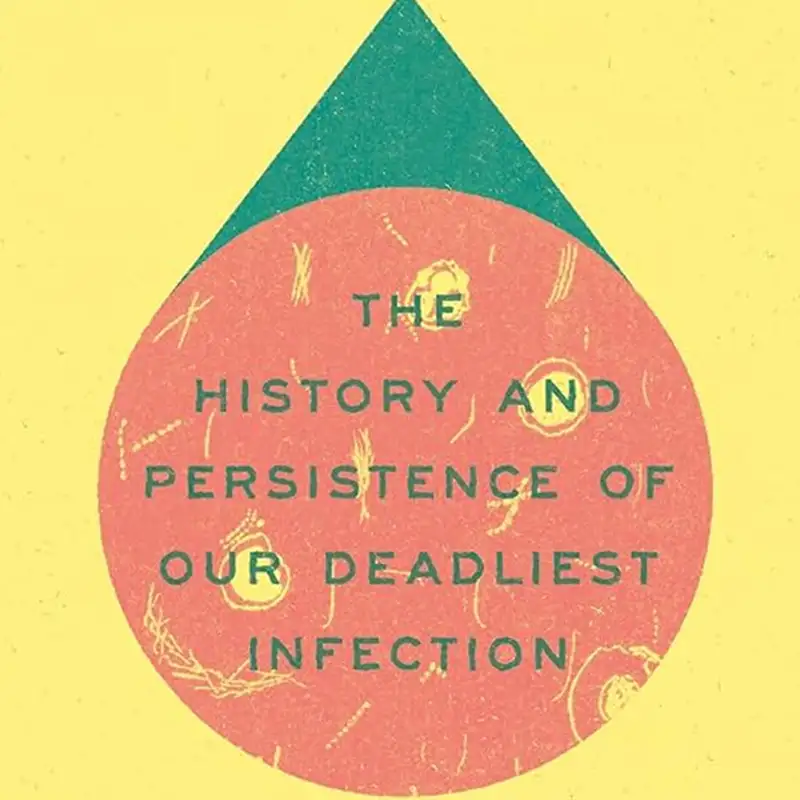
Today we are talking about the book
Everything Is Tuberculosis by John Green.
My parents dog, Sylvie,
thought that this book was delicious.
Yeah, it is a delicious book.
If you're a dog, it's delicious to your,
taste buds.
Yeah.
And if you're a human, it's delicious
to your brain.
It's delicious in a way that is both
thought provoking
and at times enraging. Yes.
I got very frustrated reading this book.
It had more for a literary
and sociological mind
than I would have expected.
The premise of the book,
basically, as the title would imply,
it's about the disease tuberculosis,
which you may or may not have heard of.
Especially if you are living in the US
or other Western countries
or globally North countries.
However you want to frame it,
but typically not a disease
that we think of super often.
I mean, I think we all have heard of it,
but don't know many people who know
people who have had tuberculosis.
To the extent that someone
may have heard of it in a Western country,
it would probably be someone who has had
HIV and had a compromised immune system,
or it was somebody
who, is a fan of opera and like stories
that take place in historical periods
where consumption was a big deal.
And in that case,
they might not even realize, as I didn't
before I read this book,
that consumption was tuberculosis. Yes.
And there is John Green goes on
throughout the book
much about the mythology of consumption,
aka tuberculosis, and how our perspective
as a Western population
has shifted over time.
and how the mythologizing of tuberculosis
has been gendered and racialized.
Yeah.
There is like, one story in the book
that is a through line,
and it is a story of,
What is the kid’s name?
Henry. Henry.
Henry is both John Green's
first son's name
and also the name of,
this person
when John met him, Henry was a kid.
Although an older kid than John realized.
He's like a teenager.
He's 15 or 16.
think he's, like, closer to 17 or 18 when.
No, really. Okay.
because John Green thought
that He was like 8 or 9.
Yeah.
he thought that the Henry
that he was meeting and his son
Henry were about the same age when in fact
they were almost ten years apart. Yes.
And this was mostly due to the fact
that the Henry that he met
was actively, diagnosed with tuberculosis
and was suffering from that
And that can make people,
especially at that age,
appear much younger
than they actually are.
But Henry Reider is his name.
Henry Reider's story is very much a
through line through the book.
But outside of that, each
chapter is kind of its own.
Like historical short story
about Tuberculosis.
And how our perspective on it was shaped
by thinking of the time
and how it has changed since then.
it's not really a book
that has a clean summary.
And like you said, I think Henry Reider's
story is something that,
if you have not read
the book, would be something
that you should go and read it
because it is a compelling story.
So the premise of Everything is
Tuberculosis is that tuberculosis
is not a disease caused by a bacteria,
but by humans and human choices.
that is the central argument,
the central theme throughout this book.
And this obviously
is going to come as kind of a, “wait,
what?” it's going to cause people pause
because We're so accustomed
to thinking of disease
as a biomedical phenomenon.
something based in science.
humans don't cause infections,
bacteria are the cause of infections
or by, like, microorganisms.
Yeah, There's a science to this.
Like you can't just ignore
the science is is kind of a perspective
that I think many people would,
have in response to this.
It's so funny that, like,
when, humanities and social science,
people try to point out
social construction,
the a common like knee jerk response
is, well, you're ignoring the science.
As if those two things
are mutually exclusive.
Yes, and so, I think the thought
with any disease, with any
especially like infectious disease,
is that if we can understand
what's happening at a cellular level
with the microorganism and our body,
then we can cure the disease,
we can fight it, we can get rid of it.
And yet
we have, for over 100 years now
known about the microorganism,
the bacteria, Mycobacterium
tuberculosis,
that is the cause of tuberculosis.
And for over 50 years, we've
had a treatment for it, A cure right?
yeah, a treatment,
and a cure for this infection.
And yet in 2024, 1.23
million people died from tuberculosis
and 10.7 million people had tuberculosis.
And obviously this is not something
that is equally distributed.
This is something that is going to affect
those nations like the global South, more
so than those of the global North,
or what you would hear considered
like developed versus developing countries
and also, the individual people
who are most vulnerable to these,
this disease are younger and older. Yes.
and yeah, this kind of defies
the logic of modern science.
We know how to treat it.
We know how to stop it.
And yet it's one of the, like, ten leading
causes of death in the world.
So, like, wha- What's going on here?
the entirety of the book
kind of follows that through line.
what were some points in the book
that you found compelling or what
were some of the thoughts that you had
after you finished this book?
I think maybe I was less surprised
than you were by
what you just articulated,
because I'm I'm pretty accustomed to,
understanding the world
and specifically understanding health
in terms of, political and social systems.
And so it didn't feel revelatory to me.
Or I should say, it
didn't feel surprising to me because
revelatory has a positive connotation.
That a disease that we understand
and know how to cure and prevent,
is a leading cause of death.
And so, like the aspects of the book
that I gravitated toward were more
how we mythologize
and imagine around this bacterium.
And like how our abstract
associations
and literary associations with it change
depending on whether the body that it's
affecting is a masculine or feminine body
and whether the body that it's affecting
is a white or racialized body.
But in terms of the point
that you just articulated,
I would say my biggest reaction
was one of frustration.
Yeah, but not surprise. Yeah.
And before we go further,
because I what I really want to get into
is, is more of our thoughts about the book
rather than what the book has to say
itself, because I think, again,
the book kind of stands for itself in
what it's saying
you know, everything I just discussed
gives you an idea of what the book is.
If that sounds interesting to you,
you should read it.
And also like
if even if it sounds slightly
interesting to you,
you should read it. Yeah.
Because it's written in a very accessible
and engaging way.
It's not a it's not a rough read.
No, no, not not like science heavy.
You know, this is John Green.
If you didn't know, he's
the guy who wrote The Fault in Our Stars.
An Abundance of Katherine's, as a seasoned
YA novelist,
he knows how to make a book accessible.
Yes. And also thread a narrative.
But here are some quotes from the book
that I think would be a good reinforcement
of what we just said.
We cannot address tuberculosis
only with vaccines and medications.
We cannot address
it only with comprehensive STP programs.
We must also address the root
cause of tuberculosis, which is injustice.
In a world where everyone can eat
and access health care
and be treated
humanely, tuberculosis has no chance.
Ultimately, we are the cause.
Here's another quote.
honestly, I think this one
was the best quote that I came across.
People who are treated
as less than fully human
by the social order
are more susceptible to tuberculosis,
but it's not because of their moral codes
or choices or genetics.
It's because they are treated as less
than fully human by the social order.
That I think really is
where the insight
and also the the frustrating
and enraging part of the book
comes from It's this idea that, like.
Because we in the global
North are separated
from this disease and we don't see it
often, It's not a big deal.
I think after finishing the book,
if I had to re
title it, I would call it
Everything is Capitalism.
And that sounds very cliche to me.
And it sounds,
kind of like a clickbait-y title.
I think it's good that John Green book
probably was not called
Everything is Capitalism. But.
what I'm hearing in John Green's voice
Is this yearning
for a world where everyone is treated
in a way that he was most likely treated,
because John Green and myself, both,
as you
know, white men in America,
are beneficiaries of a capitalist system.
Like everything that we have accomplished,
everything
that we have to be, not everything.
But, you know, a lot that we have to be
grateful for, our quality of life is all
thanks to the fact that we have been
valued over and above
many other people in the world.
And so what I hear in
John Green's voice is maybe something
that I can associate with,
which is this yearning for.
a better world despite the world
you grew up in working for you.
Working for you? Yeah. Yeah.
Well and he brings in specific anecdotes
from his,
interfacing with the health care system.
Yeah. Yeah.
And I think we should like
maybe an additional disclaimer is,
not everyone living in the US
does have health coverage.
Right.
so I grew up with this perspective
that kind of centered capitalism and it,
it didn't center capitalism in a sense
that like
I would have said, it centered
capitalism growing up, you know,
I think it's interesting
that like capitalism, I feel like
is a word or concept
that is used more maybe by the left.
but I think like the word capitalism,
the idea of capitalism
really came to prominence
from Marx and his writings on capital,
rather than like something
that the proponents of, like
the Industrial Revolution thought of as,
as, you know, I don't think they thought
of themselves as capitalists.
I think they were proponents of natural
law and natural hierarchies
and natural competition.
Right.
Whereas, like Marx,
in writing about capitalism,
was pointing at a constructed injustice,
something that
he didn't perceive
to be an extension of natural law.
And I think on the left,
we talk about capitalism a lot
because we don't understand it
to be just the way things are.
Whereas I think on the right, capitalism
is seen as a moral good
because competition and hierarchy are seen
as the natural order of humanity.
And, and the natural world. Right.
so that was the perspective
I grew up with, was this natural state
of human affairs
and the world being a result of that,
not a result of systems
that have been constructed Exactly.
to uphold artificial hierarchies.
So while I had a capitalist
perspective growing up,
I wouldn't have called it that. No.
and so what I think both
this book is, is trying to do or,
does and what I am in the process
of myself trying to accomplish
think my perspective has definitely
shifted beyond a capitalist framework But
shifting from,
like this capitalist perspective into.
I'm going to call it
a relational or health perspective.
Or, you know,
if you are a diehard leftist,
you probably would say like a communist
perspective or a socialist perspective.
I think the leftist response
there would be you were never a capitalist
because the true capitalists are those
that owned the means of production.
Yes, but I was a proponent of capitalism
in the sense
that I Reinforced
its perspective unknowingly.
And I know I have shifted away from that.
I don't quite know
what I've shifted towards
and I think that's maybe
also where John Green is at,
I think some of the critiques of the book
is that John Green didn't lean into,
like some of the more critical,
discussions
of capitalism and the way that it, kills
people, kills people
and inherently as a system creates
these systemic injustices.
Yeah. Creates a system
where some will die.
Inevitably. Right.
For the, benefit of the, of the people
who won't die.
Yes. think what
what the book is trying to get at for me,
someone like a reader
like me to see that, like, this framework
of capitalism, whether or not
we realize that's what we are holding.
This idea
that, like tuberculosis is a disease
we haven't solved because of market
inefficiencies is wrong.
And what we need to shift to is a more
relational understanding of all this.
And say that it's not it's
not a matter of money.
you know we're building AI data centers
all over the country.
There's, there's money.
Especially in the world we live in today.
I mean, the promise of the internet
was to connect the world.
And in a lot of ways it has.
But, if we continue to use it
to prop up the voices of this,
like techno-progress end point of humanity
where technology is going to save us
all, we have all the solutions
we just have to keep..
Let the smart people keep inventing
our way towards a better future.
We're going to continue
to leave people behind,
and we're going to continue
to let people die.
We have the resources, but the people who
own those resources don't have the will.
Right.
Because the system in place incentivizes
consumption and profit for shareholders.
And that's evil.
Yeah.
you go back to that quote it's,
you know, people who are treated
as less than fully human
by the social order.
It creates these, perspectives
where we then mythologize
that these people were somehow, morally
deficient.
Right.
Well, because, if we're invested
in believing that, ultimately the best way
to end suffering and inequality in
the world is to just keep
on relentlessly pursuing
scientific and technological progress
and discovery.
And yet we see that in reality,
people keep on dying.
Then we have to make up a secondary story
in order to prop up the first.
And that is that the people who are dying
must be inferior in some way, morally,
intellectually genetically, genetically.
Yeah. and that's where stigma comes in.
Yeah.
and, you know,
I made an interesting point earlier,
which I think we kind of disagreed
on, which is that, like,
if you ask the average American,
whether they think their life
is worth more
than that
of someone who lives in Sierra Leone.
I said I think most people,
at least if you,
you know, out loud would probably say no,
you know, we're all humans.
And yet the state of the world
doesn't reflect that seemingly..
Obvious and agreed upon truth.
Yes. Yeah.
And you came at it from
a different perspective I think, though.
Yeah.
I mean I think it always depends
on how you phrase the question.
But I do think that, at least
the average Trump voter
would probably tell you
that, people who live in
Sierra Leone have a lower IQ.
Or, have inferior physical fitness
or like are in some way
inherently inferior to a white American.
Yeah. I’m pretty cynical about that.
after my country reelected,
the guy who described countries
like Sierra Leone as shitholes.
Yeah. And dismantled USAID.
and dismantled USAID and threw parties
about it and made jokes about it.
Yeah, yeah.
I think we've both heard the perspective
that, Yes, maybe the world's not perfect,
but do we really think we can
look to a place like Africa as a place
you know, where humanity will,
will see its progress continued?
Right.
Which to me like I mean yeah obviously.
Yeah. Why not.
Africa is huge.
Yeah.
But, it was this, perspective
that was just taken for granted
that obviously, like, you know, the US
or the Western world is the focal point
of human civilization, Right,
Which is like bonkers racist, Right.
Yeah.
But so racist
that it doesn't realize it is.
so enveloped
in, in natural law of human history
and the state of human affairs that it
just doesn't understand itself as racist.
I don't think that any racism
understands itself as racism.
I think we're describing like peak racism
right now.
Yeah.
this capitalist perspective is able
to creep itself in because it lends itself
to these biases that we already have,
and it confirms, the biases
in a way that makes it seem
objective and scientific.
you know, these racist perspectives
get legitimized by capitalism
and it's in the same way
that the US gets kind of mythologized
as the greatest nation on earth.
you know, the world's
greatest democracy kind of thing,
that we are the chosen ones.
The book makes me think
about how this capitalist perspective
that is inherent to many people's way
of thinking as natural and isn't
even recognized as a perspective, is
just recognized as the way of the world.
we need to discard that and instead adopt
a more, arguably socialist or at least,
you know, some, perspective
that sees people as equals and sees
the relational value between people
and not the market transaction of people.
In, in building up
this, capitalist mythology
that the market will, unearth
the most good.
That global capitalist competition
will mean that those lives
that flourish are the most valuable ones,
because the market is neutral
and a moral arbiter.
Obviously that's evil,
but it also misses the reality that,
our health outcomes
are all interdependent.
And that uplifting the health
outcomes of the poorest people,
will uplift the health
outcomes of everyone all over the world
because our health outcomes,
are intertwined,
and the more global
our society becomes, the more true that is
There will always be people
in the richest countries in the world
who, cannot be vaccinated, who,
their health is compromised in some way
such that a bacteria or virus
that would not kill,
you or me would kill them.
And if we minimize the amount
of that bacteria or virus in the world,
they will not be exposed to it.
And in fact we've done that with other
we've done that with other diseases.
We could do that with TB. Yeah.
If we had the will to. Yeah.
And so like even this idea
that the -
how many people a year die of TB?
1.23 million Jesus.
That the 1.23 million people
who are dying of a preventable
and curable disease
every year are sacrificed
at the altar of progress,
and that their deaths mean
that, the lives of people that TB
doesn't touch, are protected is not true.
That, in fact, eliminating TB in Sierra
Leone means TB will not come to the US.
And that investing in health outcomes
anywhere is investing in health
outcomes everywhere.
Saving lives anywhere is saving lives
everywhere.
Yeah.
one would think we would have learned
that from Covid. yeah.
And but I mean even with Covid
we saw because of the way
that capitalism promotes
this very individualist perspective
where everything
kind of starts from the individual
and then slowly
like expands out from there.
You know, it's all about, well,
I don't feel comfortable wearing a mask
or I don't feel comfortable
getting this vaccine.
you can only imagine that as a choice
that affects yourself in your own body.
Right. Yeah.
And instead,
you know, seeing as the foundation,
the connections that you have to
so many people and the ways
that like your actions impact
their lives And their actions
impact your life.
And understanding that as fundamental.
No person is a world unto themselves.
I mean we do say all the time
that every person
is their own universe,
but that's a completely different
idea than any one person
can survive on their own.
Yeah. It's impossible.
but yet
that is kind of the fundamental nature
or the fundamental truth of capitalism
is that it is the individual
that is the foundation, the,
foundational unit of the system.
And everything expands from there.
And so if the
if the individual is not getting value,
then therefore there is no value.
if someone at an individual level
believes, I don't, care if,
someone else gets tuberculosis
in another country that's an ocean
away from me, then there is no value in it
to that person.
There's no value in
what if an individual person believes
that tuberculosis is a disease
that affects poor countries.
And these countries are so far away
from them
that in their lifetime,
they probably will never experience
any major interaction with tuberculosis,
then in that person's life.
From the perspective
of a capitalist individualist perspective,
there is no value in fighting
tuberculosis.
Ah, okay. Yes.
Versus a perspective that sees
health and sees as a fundamental unit
the relations between people,
not the individual person,
but the relations between people
as the fundamental unit.
No person is a single person.
Everyone is connected and therefore there
is going to be a value in uplifting
and helping our neighbors,
even an ocean apart.
Yeah.
And that's like a pretty fundamental
belief in every major religion isn't it.
I'm thinking of a quote from the prophet
right now.
I believe it's from the chapter on buying
and selling actually, which is funny.
Yeah.
But in a way I think you could almost say
that this, capitalist perspective
has tricked us into
basing all our moral decisions
and actions off of an individualist
framework
rather than a relational framework.
Yeah. Can I read it? Yeah.
“For the master, spirit of the earth
shall not sleep peacefully upon the wind.
Till the needs of the least of you
are satisfied.” Yeah.
Which is,
very pretty version of another quote
that I had brought up
for us to close out on today.
From Miss Rachel.
Okay.
“No child anywhere
will have the brightest future possible
until all children
everywhere are taken care of
and given everything they need to thrive.”
And one of John Green's points is that,
the disease
tuberculosis is where the drugs are not.
Which is basically to say that the drugs
that will treat and cure tuberculosis
inexplicably
can't find their way
to the people who need it most.
And I think the quote unquote inexplicable
ness of it is capitalism.
It's this enforced hierarchy of the world
that sees these communities ravaged
by tuberculosis as unimportant. Yeah.
And the, the specific iterations
of that include things like,
drug companies that have the patents
on the effective drugs.
Keeping prices high artificially.
Lack of infrastructure so that people
do not have access to health clinics.
And distrust of medical providers
and medical institutions of the people
that they're serving.
And vice versa.
And also needing to have a lot of food
when you're being treated
for tuberculosis
and not having access to food.
Stigma. Local stigma.
that marks people who are ill
with tuberculosis as morally suspect.
You know, all of these things are part
of what you're referring to.
As the system
that dictates that a life in Sierra
Leone is less valuable
than a life in the United States.
Yeah.
Despite what,
you know, this conventional belief
that no human is worth more than another.
You know,
we can say that and believe that.
And yet that's not the reality.
That's not the,
the belief that the world is reflecting.
And by the world I mean our human choices
and structures that we've built.
Yeah.
Political reality, has not been built
based on that premise.
It has been built on the premise
that the greatest moral good
is to generate the most value
for shareholders.
Correct. Yeah.
And, are we at, what have we learned
about loving each other?
Yeah. What have we learned about
acting more loving in a society.
I I think this is something
I've been coming back to throughout
this, episode, and also just something
that I've been thinking about
for both a while
now, kind of since I started doing my work
with Fatphobia
and the medical treatment of obesity.
A through line to this has been My science
brain
wants to think of these things
as objective and apart from me.
And they are,
but they are also just as much,
if not more, a product of what
I think of them in the sense
that like
if I think tuberculosis is important,
then I will consider donating money
to support efforts
that will build the health infrastructures
needed to get rid of the disease.
If I don't think of tuberculosis
as important
because it doesn't really have a place
in my day to day life, then
despite tuberculosis
existing out in the world,
it will effectively not exist
within my brain.
Yeah.
and likewise if you think that
tuberculosis is, is important
you might more likely vigorously support
political candidates
who would invest in global health
initiatives with much more resources
than are available to you to donate
to an organization like Partners in Health
and vigorously work to remove
from political power politicians
who would slash, funding
that save lives from tuberculosis
and other preventable diseases.
Yeah. We're.
Yeah, we're talking about tuberculosis
here because that's the topic of the book.
But really, I think this is a reflection
on the state of health in our current.
Global society.
Yeah.
I grew up in a household
with two sisters from Ethiopia.
So health outcomes in the global
South felt very close to home for me.
it did not feel like separate
out of sight out of mind.
And it is always struck me
as very obviously wrong.
And very obviously constructed very
obviously the result of evil human choices
and not reflective of an ethical hierarchy
that makes any sense whatsoever.
That's fair.
because I remember, the shock
when I came back from Ethiopia
of going to a grocery store,
and seeing so much abundance in one place,
and almost being sickened by it,
for a while after visiting that part of
the world, seeing something like a hot dog
eating contest seemed grotesque to me.
I guess because my worldview is so rooted
in poverty exists everywhere,
And if you want to see poverty,
you don't have to go to Africa.
You don't have to go to Asia.
You can look in your own backyard. Right?
And the corollary to that being,
that in countries in the global South
that, Americans
might think of as developing or,
less advanced,
less civilized,
because they lack as much infrastructure.
Or we imagine them to lack
as much infrastructure often.
we flatten the people there as objects of,
tragedy or inspiration.
And I really buck against that a lot.
I think that people experience
extreme deprivation, and live in survival
mode in quote unquote developed countries,
and people
flourish and thrive in quote
unquote, developing countries.
And it is also so that the scale of
poverty is meaningfully different.
qualitatively
the poverty is meaningfully different.
If you live in a place
where there are sidewalks or no sidewalks,
if you live in a place where
there are grocery stores full of food
or there aren't,
and if you live in a place
where there is a reliable power grid
or there isn't,
and so I think like that
nuance of,
the humanity is the same everywhere.
And the conditions are meaningfully
different in different places.
And holding both those truths at the
same time in tension with each other,
is something that I could always do better
at in my understanding of the world.
Yeah.
romanticization is just another form
of stigmatization.
Yeah.
pitying, people in other countries
because of a perceived lacking.
Is in effect, objectification. Yeah.
And I think like I have corrected
so much in that direction
because like literally
my sisters are from Ethiopia right.
Like it feels very close,
very normal to me that like obviously
Africans
are not separate and apart from me.
But I think like at times
I have overcorrected in that direction
to say like, well, poverty in Africa
is no different from poverty here.
It is, it is. Yeah.
This was a tricky one.
We got real abstract.
I had trouble keeping up with you.
Oh, yeah. Yeah.
But, thank you for suggesting
that we do this book
for the podcast-a-thon.
Yeah.
And as I said up front,
there'll be a link in the podcast
shownotes where you can contribute
to Partners in Health,
which is our chosen donation, Also,
if you're listening to this five years
from now and the podcast-a-thon has long
since ended,
You can still donate to Partners
and Health
I’m sure Partners in Health
will still be a thing.
Yeah.
I'm sure it wouldn’t
be difficult to find another charity,
that is doing similar work
in trying to, correct
injustices that have been the result
of human choices.
Human choices.
I love you. I love you, too.
I'm making the human choice to love you.
Oh, Yay! Let's have lunch.