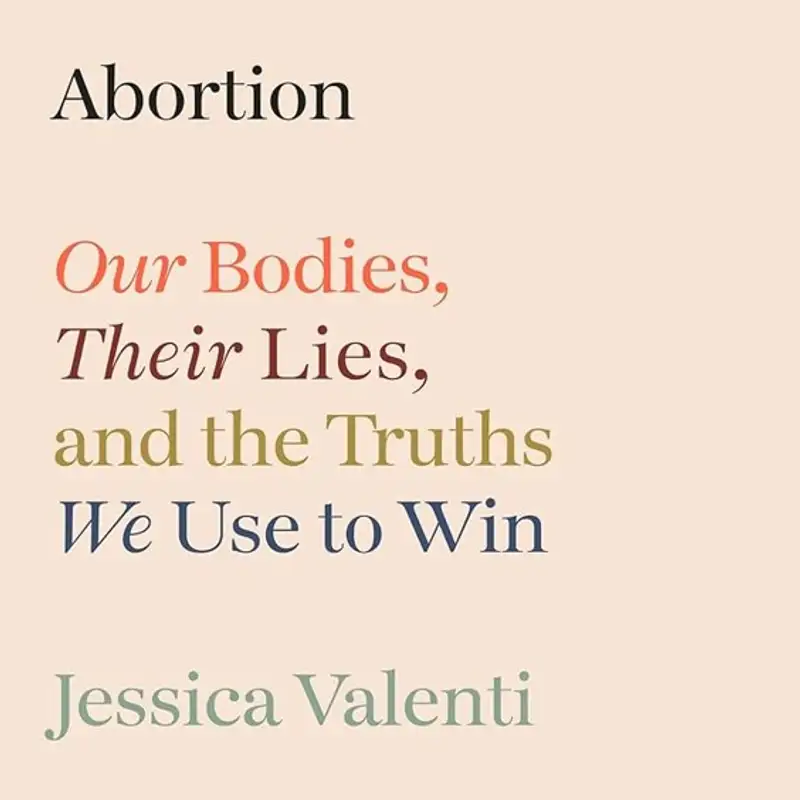
Abortion by Jessica Valenti
Hi, Hannah.
Hi, Sam. How's it going? It's great.
I'm so excited to talk to you today
about two things that aren't upsetting
or disturbing at all.
Yeah we really
chose two topics.
sunshiny rainbow topics
-- For a sunshiny rainbow day.
It's not a sunshiny rainbow day.
No, it's an overcast day
and, we're talking
this episode that we're recording right
now is going to be about abortion,
the concept and the nonfiction book
by Jessica Valenti.
Yes. By Jessica Valenti.
And to put a content warning up front,
we obviously will be talking about a
sensitive topic in
that we'll be talking about abortion
and some of the, more graphic,
like medical.
Yeah, we're going to be graphic, medically
graphic cases, cases of what I would
term maybe a form of medical abuse,
which is like, denial of care,
which has sometimes, you know,
upsetting and gruesome results.
Although we won't be lingering on those
or talking about those in great detail.
And then we will be acknowledging
the existence of rape
because it is a part of this conversation.
Yeah. So just a warning up front.
If those topics are upsetting to you,
you might want to skip this episode
or come back to it on a different day.
Yeah.
And the way that
this came about was, that we
we were
talking past each other a lot
when it came to abortion,
when it came to reproductive rights --
I feel like past each other
not a lot, but like in
in our conversations, that does.
Well. We talk to each other a lot.
So it happens that we also talk
past each other a lot.
But yeah, sorry yeah,
also we've only been dating for a year
and we're still figuring each other out.
and I think that we each approached
the concept of abortion
with a different set of premises,
although I think by the time we met
each other, you were pro-choice already?
Yes. Yeah.
But you you didn't come up pro-choice? No.
And so sorry I said that very emphatically, as if that was like, a good thing.
said it
very emphatically because I very much
did not come up pro-choice.
For those who don't know us.
I came up
in a very conservative background,
and so therefore
I came up in a pro-life background.
Very Yeah. Pro-Life.
And I came up in a like I would say,
passively
pro-choice, community, family culture.
And then when I got to college
and, became a gender studies
major and started volunteering
as an abortion clinic, escort,
I quickly became,
so very pro-choice that I wouldn't
even term the pro-life crowd pro-life.
I would term them, anti-abortion.
anti-choice.
Yeah.
Anti-choice really
because, well, we'll get into it, but,
but because of that, by the time
we started getting to know each other, I
and and we started getting
to know each other in a post-Dobbs world.
So I have a lot of anger about this. And,
and my attitude was very much like,
if anyone is
anti-choice
in favor of abortion restrictions,
meaningful abortion restrictions,
then what that must mean
is that they simply do not like women
and want women to suffer, or die.
And when I say women in this context,
the word woman definitely includes
lots and lots of people
who cannot get pregnant.
Like trans women and women who aren't
fertile and post-menopausal women.
And all these, you know, different,
beautiful types of womanhood.
But I do think that, that the impulse
to control,
reproductive health
care access is driven by misogyny.
And so that's why I will use that language
not to deny anyone's womanhood.
And. The reason why I thought this was
because it seemed
so obvious to
me that abortion restrictions
injure and
harm and kill women,
and I didn't realize that
that couldn't be obvious for someone else,
particularly post Dobbs.
And I would get really worked up
a lot of the time.
And I remember one morning
I was reading a news article
and I said something to you, Sam, that
I had said a lot of times before, which is
women are bleeding out in their cars
in the hospital parking lots.
Women are getting sepsis.
This is inhumane.
This is
this is completely irrational.
And I had said this to you before,
and you never really had the strong
reaction
that I would think that one ought to have
to that kind of graphic language.
And on this day,
you realized what I was getting at,
and I realized what you thought
I had been saying.
Right. Which is that. Women were
dying, bleeding
out in parking lots
because of the fear of going into...
Is what you thought I was saying.
-- Yeah -- But
you realized what I was actually saying
was that they were being denied
abortion care. Yeah.
And you were really surprised by that?
Yeah.
Yeah.
And I was shocked
that you were shocked by that.
Yeah. Yeah.
Well, and it and this will come up
in our discussion today because it is
one of the big points in the book is that,
you know, there's this idea that
on the conservative side,
there's this idea that if you really need
an abortion for medical reasons,
you'll you can get it.
Yeah.
Which like is, is so far from
the reality as I understand it,
which is to say, you know, reality,
that it hadn't even occurred to me.
And so there's ignorance on my side,
too, of like,
the faulty premises that,
I don't know, half the country
is being fed, that fueled this idea
that it is in any way
reasonable to restrict abortion care.
that's
what we're going to get into today is,
the realities of abortion care.
In the context of, like, a state
that restricts it, restricts it.
But more importantly and hopefully
more interesting, the like the differences
between the premises that we each
had about this medical procedure and like,
the politics around it, that caused,
so many miscommunications between us
and maybe cause
a lot of miscommunications between
other people
and the people that they love.
Yeah. Yeah.
So On my, part, I decided
to read the book Abortion
by Jessica Valenti.
So, abortion.
With the subtitle Our Bodies, Their Lies
and the truths we Use to win,
is a 2024 book by Jessica Valenti.
Valenti is a feminist author and activist
who co-founded the blog Feministing
in 2004, of which 19 year old
Hannah was an avid daily reader.
Valenti has a master's in women's
and gender studies from Rutgers
and has written a handful of nonfiction
feminist books.
Her latest book, abortion,
the one we're discussing today,
began in response to the 2022
Supreme Court
case reversing
Roe v Wade, known as the Dobbs decision.
after the decision, Valenti started
a newsletter called Abortion Every Day,
where she writes about the state
of abortion in a post-roe America.
the book that we're covering, chronicles
long standing conservative viewpoints
and attacks on abortion and birth control
to illustrate where we may be headed.
It serves as a good introductory
text to the status of abortion in a Maga
America.
Yeah.
I mean I feel like that,
that really just kind of hits
at the nail on the head
as to why I read the book.
It's a good introductory text.
Jessica Valenti is a good journalist.
And, like, has been meticulously
chronicling.
And gathering evidence.
In support of a lot of her claims.
So I think it is very fact driven,
while at the same time also.
Very passionately written
as it should be in regards
to the inhumanity of what is happening.
And today we're talking about a book
and Sam has read the book and I have not.
Yeah.
And I think that was because like again
as this being like an introductory text
to kind of the state of abortion
as it stands today, you,
while not having read the book, are pretty
much heard and understand
a lot of the points that are made
in the book and have seen and heard
a lot of the evidence that is brought up
in support of the argument Yes.
I'm not in the learning stage,
I am activated.
I actually volunteer as a clinic escort
and donate to an abortion access fund.
Yeah.
So I thought about going through
some quick facts that the book brings up
that we probably won't get into too deep.
Because I think there are
some more surprising things
that the book had to say.
Just to kind of establish
like a foundational,
point for us in the listeners
to, to disembark.
Yeah.
And I would love it if as you share
these facts, you tell me about
what your reaction to them was
when you were reading the book.
Yeah.
I think most of these things are things
that I already knew to be the case
Oh okay or
or it wasn't a large leap for me
to to follow the evidence
and understand the argument.
and it's surprising how much of this is.
Medical fact that is not understood
or just blatantly either
ignored or misrepresented
by conservatives. Yes.
So, number one,
abortion is safer than pregnancy.
That is certainly true,
given the, drugs that we have available
available today, for abortion.
Yeah, for new listeners.
Sam is a pharmacist.
So, whereas pregnancy, you know, is a.
Maybe I'll let you like pregnancy is a I'm
going to talk off the cuff about it
because I'm a, I'm a lady
and I feel less self-conscious
about talking off the cuff about it maybe.
Pregnancy is cool as hell.
Yeah, pregnancy is amazing.
You're growing a person in your body.
It's also pretty horrific.
If you don't want to be experiencing it.
Because there is a life form growing in
your body, literally sapping your energy.
Which, you know,
when that energy is freely given
and you can't wait to meet your baby
seems pretty awesome.
And miraculous.
A baby is a pretty complicated
organism.
And I think it's incredible and cool.
That, so many humans are capable
of, you know, growing one of those.
And also, a lot of stuff can go wrong.
And even when everything goes
perfectly right, it's incredibly taxing.
And it can change your body permanently.
Yeah.
Which, you know, when you go into it,
intentionally and with joy,
is fine.
We do lots of things
that change our bodies permanently.
But, if
you you don't choose
to undergo
such a dramatic physical process,
I think one can easily, viscerally
understand how very horrific that is.
Yeah. Yeah.
I want to know more about how like 16 year
old Sam would have reacted
to that factoid, but we don't have
to get into that just a second.
yeah.
I mean, I think that, the purpose of this
is just to say that, like,
I think when I thought about this section,
I just wanted it to be like,
we're not here trying to argue
Pro-Life versus pro-choice.
We've already stated that pro-life is
a, at best, misinformed ideology.
And so, you know,
this isn't a philosophical discussion
on the morality of abortion, I think
is what we’re trying to establish -- No.
Yeah.
And if that's what you're looking for, a
you should look elsewhere because
neither of us is philosophers, Correct.
Yeah.
So the second point is that there are,
as we discussed in the beginning,
with women bleeding out in hospital
parking lots,
there are definitely negative
consequences of denied abortions.
And also just the fear that is, seeded.
seeded. Yeah. The fear that’s seeded
around abortions
makes it even harder for women
seeking one.
Yeah.
And when you say the fear
that’s seeded around abortions,
you mean not only in women
but also in doctors?
Yes. For sure.
Which we'll get a little bit
more into that.
But, the next point is that abortion
regret, which is the idea that, like.
After or even years
after having an abortion.
Women generally report some,
form of regret of getting the abortion
is largely a myth.
Yeah.
It was also like abortion regret
was something that if I was aware of it
when I was like college age and early 20s,
it was only like I was vaguely
aware of it as a stupid talking
point of the right wing.
I did not take it seriously as a concept.
Yeah. Yeah. Let's see.
This was actually an interesting
statistic. And,
if you want, like, this is the specifics
of where these statistics come from.
You can find the book
and find the references that the book uses
for these statistics.
But six out of ten women
who get abortions already have children.
That is certainly different
from what the conservative media, I think.
Or, you know, conservatives
would generally portray abortion
as like young promiscuous teenagers
trying to look for a way out
of, their
the consequences of their actions right.
-- Yeah the consequences of their actions.
Yeah.
God, I'm so tempted to, like,
get into all of these factoids
and start unpacking them.
Yeah,
and I think we will. To a certain extent.
But, we'll keep going
You're the one who read the book.
You lead the way. Yeah.
This is another point that, I didn't
necessarily know, but wasn't too striking.
Given my medical background,
maternal morbidity and mortality.
So both, like illness, injury
and death is increasing in states
with abortion restrictions.
No. Shit.
Yeah.
Conservatives don't like birth control,
which Oh, yeah.
That was another, miscommunication
that you and I had.
Yeah, that, like, conservatives are quote
unquote coming for birth control.
Do you mind if I tell that story?
Yeah. No.
It was like a few days
after Trump was reelected.
And I was freaking out.
And Sam was freaking out
bit less,
I would say, meaningfully less than I was.
And I, you know, I probably
a lot of people can relate to this, but
I felt like every day I would say, oh, my
God, they're not going to regulate food.
How am I going to get safe produce?
Oh my God.
What's going to happen to public schools?
What's going to happen to my healthcare?
What's going to happen to housing prices?
What's going to happen to my job?
Like, you know, new considerations
occurred to me every day.
And that day, the consideration
that it occurred to me was,
will I no longer be able
to get my birth control?
And I said this to Sam,
and Sam was puzzled.
I remember you being like,
why would you think that?
And I was like,
because why wouldn't I think that?
And, and you said, well,
I don't know why the Trump administration
would be motivated
to just take people's health care away.
And I said, that's all they've been doing.
That's all that the Christian right
has been doing for the past 20 years.
What do you mean you don't know why
they would do that? Yeah.
And I think more specifically
to get into that point,
there is a lot of fear mongering
that happens
within the conservative Christian right
about birth control and the, quote
unquote, lack of safety of it
or the way it changes people.
Yeah, that's true.
But you were kind of talking
from the opposite of that.
You it was it
mystified you that I would be worried
about birth control restrictions.
Right.
Because I didn't really know
that this was a a thing.
Yeah. that,
like conservatives were actually, like,
wary of birth control.
Yeah.
And I don't I don't want to come across
like, I'm attacking you at all. Like.
And the next day I looked up
a bunch of articles about, like,
judicial decisions that restricted
birth control access and sent them to you.
And you were like “Ah. yes.
Sorry.
Makes sense that you're worried.”
It was like, not you.
You were not being a butthead about it.
You you were,
We were navigating differences
in our in our backgrounds.
yeah, I think that was
that was part of the disconnect
that motivated you to read this book.
Yeah.
Okay, so, with those points
established as, like,
sort of a foundation of where,
maybe where I was at kind of entering
into the, our relationship,
in terms of things that I either already
understood or quickly,
read and, understood to be fact.
Let's talk about a couple points
that the book brings up
that I found the most striking.
And this is not a super long book,
but there is a lot of information
with a lot of references in it.
So yeah, so I've just picked a couple.
There's, you know, the book is a lot more
than what we'll be discussing.
Yeah.
I do recommend the book, especially
for someone who is not familiar with the,
I hesitate to say politics of abortion,
the landscape of abortion,
the reality of abortion,
Especially, the landscape in 2025.
Whoo. Is bad.
So the first point I wanted to bring up
was actually a quote from a study
by Lift Louisiana.
Lift Louisiana is a, abortion
rights group, and they, in March of 2024,
they released a report
called Criminalized Care
How Louisiana's Abortion Bans
Endanger Patients and Clinicians.
And this was basically,
this was taken from the report.
And then I'll let you know
when there's, there's,
you know, when word for word
quote from the report comes up,
Louisiana's abortion
ban is one of the strictest in the nation.
Doctors who perform abortions can face
15 years in prison.
So in order to as one doctor
put it, preserve the appearance
of not doing an abortion.
They give women C-sections.
One patient was just 20 weeks pregnant
when her water broke
far too early for a fetus to survive.
She wasn't given a choice, just surgery.
A Louisiana emergency medicine
physician explains.
And this is the
actual quote from the report.
“This person has had a C-section,
and that means that she's at higher
risk for any future pregnancies.
She can no longer deliver vaginally.
The appropriate thing to do would be a D&E
without subjecting the patient
to this unnecessary abdominal surgery.
But my colleague didn't feel like
she could do that while remaining
in compliance with the law or appearing
to remain in compliance with the law.” So.
so I just want to like,
chime in real quick.
That is not necessarily true,
that after having a C-section
you cannot deliver vaginally.
But that is a different conversation
for a different day.
But I did feel the need to go.
Oh not quite true.
But yeah that's a major abdominal surgery
as opposed to a D&E
which would be dilation and excavation.
Yeah.
Which is where the cervix is dilated
using medicine.
And then is there through a vacuum
or some other device
or maybe even a medicine.
The contents of the uterus are excavated,
and I'm not, like,
trying to say the contents of the uterus
as a way to, like, sound really callous.
It's just it's not always a fetus
that are the contents of the uterus.
Yeah. Yeah.
So instead, this
major abdominal surgery is done where,
like, a lot of layers of the body
need to be opened up,
and that has a big effect
on the abdominal, the core muscles.
Yeah.
And the the recovery and risk are.
Yeah. You're cutting so much more.
Yeah.
Everything about surgery
nowadays is to try and to make it
as as minimally invasive as possible.
And we'll get into,
I think, in one of the, other
parts, hearing from a quote from,
an anti-abortion group
that talks about how
C-sections are the preferred method,
and that just goes against the,
again, this general trend that, like,
we are trying to make surgeries
less invasive.
Any time you cut into skin,
cut through muscle fascia.
It is number one,
increasing the risk of infection.
And number two, weakening that tissue.
Yes, it will recover, but it
it won't recover to where it was before.
And so yeah.
So that but the whole point of this is
that they're doing this,
the doctors are making medical decisions
out of fear for going to jail.
Now what would what would 18 year old Sam,
how would 18 year
old Sam have reacted to that.
That is a difficult one,
because 18 year old Sam didn't even know
he was going to be a pharmacist yet
or go into the medical field.
So, a lot of this would go over his head
to begin with.
I think 18 year old Sam,
when presented with this information,
would probably say something
to the extent of, well.
You know, let's hear both sides or like,
I'm not a, medical professional.
Yeah.
Something, something to the effect of,
okay, this report is saying this, but,
you know, is that medical consensus
or, you know,
I don't even know if 18 year old Sam
would have had the language
of medical consensus.
Okay.
What about,
like, 20 year old Sam, 21 year old Sam?
Yeah.
I mean, I think Sam, prior to pharmacy
school would have said,
how old was Sam when he
first like a year of pharmacy school
under his belt?
I'm bad with chronology.
What would he have said? No.
How old would he have been?
Oh 20.
Two. Okay.
I think maybe the more relevant point here
is that 18, 20, 22 year old Sam.
Didn't interact
with this on this level at all because.
Kind of the extent of abortion
discussions, at least to that point
in his life,
was revolved around the idea
that You know, best case scenario,
an abortion might be medically necessary,
but it's still a, not morally bad thing,
but it's still not a preferred thing
because of this view that a fetus is alive
and is a or not.
Not that a fetus is alive.
This view that a fetus is a person.
and just kind of this strict
morality applied that.
Okay.
Well they're a person. Therefore if you're
doing something to that person
that would prevent them from surviving,
then you're killing them.
And killing is bad.
It was like this, this logical chain
that totally disregarded
the woman, as a life and focused in on,
in a supposedly objective way.
Well, killing is bad and abortion
is killing, and therefore abortion is bad.
and I know we've tred this ground before,
but I don't remember
exactly what you said.
with bodily autonomy entering the chat.
Yeah. This flow of logic.
what would be the response
to the point that we have this thing
called bodily autonomy.
And it means that,
if you need my kidney in order to survive,
you will die without my kidney.
And I only need one kidney.
Yeah.
In order to live a long and healthy life.
Yeah.
I still cannot be, compelled
to donate my kidney to you.
And in fact, even if I am dead already,
I am no longer using my body.
I cannot have been compelled during life
to donate any of my organs.
And yet,
a pregnant person must be compelled. To
donate their body.
Their organs.
And their health to another, quote
unquote, life.
What, what would be the response
to that line of reasoning?
I mean, I think I could
I could speculate about it.
But again, I think
the more important point here is that Sam
at that time hadn't
really even encountered these arguments.
Oh, yeah. Yeah.
this was, you know, abortion discussion,
especially as someone who's
without a uterus.
like the extent of pregnancy
discussion in my life as,
like a serious topic was.
Basically, don't get someone pregnant
you are willing to be there for them.
That was kind of like the extent
of my moral discussion of pregnancy.
Mmmmm.
And that's really interesting
because like from my point of view
it was more like well obviously
the guy might not stick around.
So given that, you know,
there was not this sense of like,
you know, the man is as responsible,
or I should say the,
the non-pregnant parent.
Yeah. Is as responsible as.
Oh, and I'm sorry, can I,
like, do a quick side note?
Yeah.
Like, when I'm talking about, the misogyny
that drives the anti-choice movement,
I'm going to use gendered language.
They want to hurt women.
They want to harm women. Yeah.
When I'm talking about, like,
the realities of pregnancy
and abortion care,
I'm going to try to use
gender neutral language
because you do not have to be a woman
to get pregnant.
Yeah. That's all.
So, Yeah, it was like,
kind of this cynical pragmatism.
like.
Yeah. Like, if
if you get pregnant,
like, the person who got you pregnant
probably won't stick around.
And if they do,
they probably won't be very helpful.
So given that, what do we think, given
the reality that, like,
the pregnant person is going to end up
being the primary parent?
Well, and I think what goes unsaid
in the conservative viewpoint,
kind of the underlying,
as we've discussed several times before,
this kind of sense of just natural law.
Is that a pregnant
woman has a duty as a mother
to sacrifice for her kid.
Yeah. It's
kind of like how it's portrayed.
And so this idea
that we should be focused on two lives,
if we're even going to grant it that far.
I would say that, that
that wasn't even the reality.
The reality was “Well
the mother's obviously
expected to be a mother,
so we don't need to consider her autonomy.
Therefore it's this life
and this person that what we're calling
from the conservative viewpoint, a person
This fetus that is the one to be regarded
and therefore anything that would hurt
or kill this
what we're calling a person is wrong.
And therefore abortion is wrong.”
because this tiny person
is voiceless,
is vulnerable,
is the perfect, picture of innocence.
Yeah.
there is this
valorization glamorization of,
like, innocence and sweetness
and smallness and vulnerability
as moral purity,
where, like, particularly among,
feminine-coded people like
forceful expressions of autonomy
or even just expressions of autonomy
take away from moral purity.
Yeah.
And so, like, you deserve less regard.
Yeah. The more autonomy you express. Yeah.
A fetus is a perfect, quote
unquote person to defend
because they can't disagree with you.
They can't speak for themselves. Yeah.
But to be fair to this conservative
mindset that you grew up with,
there was not a sense of like, obviously
the non birthing parent
will just skedaddle.
There was a sense of as a man, what you do
is you step up
and be there for your family, right?
Right. Yeah. Right.
And that was like, not part of my
perception of this worldview at all.
I was like, no,
they just want to have it both ways.
They just want to burden women.
Yeah. Yeah. Yeah.
I think another thing about
the conservative worldview around this
that I find really interesting is like,
it's it's really telling how
younger Sam would not have known that
pregnancy is a lot more dangerous
than abortion.
Younger Sam would not have known.
That or I don't know that this is true,
but, like,
it is part of the conservative perception
that in cases of rape.
You're less likely to become pregnant.
I think that that speaks to an ideology
of, like,
natural processes are morally good
and will work out in our favor.
Yeah.
And external intervention, is unnatural
and therefore morally bad.
This is an insight
that you've shared with me.
I think we've we've probably hinted at it
or, you know, skimmed the surface of it.
There is,
certainly within conservative viewpoints.
There's this just this.
Yeah.
Idea that natural what is natural is good,
is right is morally pure.
but what is natural
is never really questioned.
It's just what's natural.
Yeah.
And what's natural is
what seems natural to me.
Yeah.
Based on my, my cultural background
and my set of unexamined biases.
But I will say, like,
I totally get the allure of this
because as you heard
me, like, wax poetic about pregnancy.
Like, I get it, it's it's miraculous.
It's incredibly cool.
I get seeing it as a moral good.
And one of the most beautiful things
that nature is capable of.
I just also don't kid myself that
because it's miraculous
and beautiful and natural and incredible
that nothing can possibly go wrong
because it's a moral good.
Yeah.
I don't know, maybe it's patronizing
for me to say kid myself,
but my worldview doesn't accommodate that.
I don't believe in, intelligent design.
Right. Yeah.
And so if you don't believe in intelligent
design, it's a little easier to say
this is a miraculous, incredible,
beautiful process.
And it can go wrong in so many ways
because evolution
does not result in perfection.
Yeah. That's not how it works. Yeah. Yeah.
But God, everything he designs is
perfect --Works in mysterious ways.
-- That to.
But everything that he designs is perfect,
right?
Yeah.
And so to say,
pregnancy is more physically dangerous
than this human intervention
of abortion, like, does not compute.
Yeah. Yeah. Yeah.
Okay, so the next, quote
that I'll be taking from
is from the Charlotte Lozier Institute,
and they are an anti-abortion group.
Word. They are actually the.
So I believe
Wikipedia said they are like the research
and education arm of the Susan B
Anthony List organization,
which is an explicit
they basically are a PAC, a super PAC for.
Or I,
I don't know what the difference between
a super PAC and a PAC is, but they're
they're a political action committee
who fund candidates who are
anti-abortion
or in their terminology, pro-life.
So this, was something that was written
on their website, at least as of 2023,
“The Charlotte Lozier Institute,
one of the nations, one of the nation's
largest and best funded anti-abortion
groups, explicitly recommends
that treatment for emergency abortions
be done by labor induction or C-section,
which they call medically standard.”
It is absolutely not standard. no.
“The group claims
a C-section is a more appropriate method
of separation,” --
Oh my goodness -- “because
it shows greater respect
for the human dignity of the fetus,
even if she is too young
or sick to survive.
Unsurprisingly, dignity
for women isn't mentioned.” Right.
And before we discuss that real quick,
I just wanted to say this comes from page
40 and the previous, quote
that I read is from page 41.
So they're both like
from the same section of the book.
But just in case anyone wanted to, like,
actually go in and read more about this.
You know, like, obviously
this is horrifying and upsetting
for reasons that we've already covered,
but something that's
really interesting to me
about the way that they frame this
is they refer to the fetus as she.
Yeah, I was thinking the exact same thing.
Do you want to talk about that?
Well,
I would assume it's to make them seem
as if they are a feminist pro-woman group.
Yeah.
I think it's to put, like,
this, veneer of feminism over it.
Like, we support all women,
including the unborn ones.
Yeah. Yeah.
And I think we kind of touched on this
already in the last point that, like,
so this basically this anti-abortion group
is making the statement
that C-sections are medical standard,
which, again, just goes against the idea
generally that and I'm not a surgeon.
I am a pharmacist. So surgeons,
please come in. Yes.
Our vast surgeon audience,
our many hundreds of surgeon listeners.
Yes. Please correct me for this
if I am wrong, but I would generally say
that as medical technology advances,
we are looking for ways
to become less invasive
with our surgeries.
every time you talk to somebody
who's like,
oh, I'm, I'm getting a hip replacement
or I'm getting a knee replacement,
and here's how they're doing it.
Now they just make one small
incision over here and they don't have to,
you know, break this bone or.
Yeah, like that's always
the exciting thing that they talk about.
So I'm pretty sure
that that definitely means that okay
I'm kidding.
That's anecdotal evidence,
but but no, that's my impression as well.
Yeah. Yeah.
And so the other kind
of somewhat sinister thing about this
is the idea that, like,
this organization, the Charlotte Lozier
Institute, is a research and education
group.
Yeah, that it aint.
Yeah, they are funding their own studies
and coming up with their own,
quote unquote, medical
standards that go against,
what the majority of medical consensus is.
Yeah. it's a common tactic.
It's like like astroturfing
is when they fake a grassroots movement
in favor of something,
but it's actually funded by, like,
a special interest lobby or,
like, false flag
or like, attacks
that are made to look like
an unreasonable opposition,
like this kind of.
Oh, we're a neutral research into.
And, what's it?
Research and education
education organization.
Yeah. We don't really have an agenda.
That's a lie.
Yeah. Or, these crisis pregnancy centers.
We're here
to help you figure out what to do now
that you're pregnant and we're neutral
and we're care providers.
But in fact, actually,
and birth control is bad.
And you should Right. Yeah.
I think the other, striking
use of language in this quote is the part,
where they talk about a more appropriate
method of separation.
That specifically, the line was the group
claims, the group claims
a C-section is a more appropriate
method of separation.
So already They're using the phrase
a more appropriate method of separation
in place of abortion,
because obviously, an anti-abortion group
doesn't want to say that the group claims
a C-section is a more appropriate
method of abortion.
they're using the word separation
as if we are again, this, this, this,
you know, belief
that the fetus is a person
and therefore we are going to separate
the mom and the fetus.
There's
something of like a no true Scotsman thing
going on here where it's like abortion
is the thing that we don't like.
And so if we're like acknowledging
a medical carve out
where it's necessary,
then it must not be abortion.
Exactly. It must be something else.
And that the book goes into this,
into that point more, a lot more.
Yeah.
And I think as we get into some of these
other points, we'll see, why,
this idea that I grew up with that,
if an abortion is really needed,
medically needed,
a conservative would support it.
Is, is
if taken from
the aggregate of the conservative opinion.
is not actually true.
Right.
And, something about Jewish law
is that, Jewish law
says that if the
if the pregnant person's life
depends on an abortion,
then the abortion must be performed.
And so, like,
I feel like that's
a really interesting detail
with all of the religious freedom
justifications for these arguments.
And a lot of credence is given to,
conventional Christian beliefs Yeah.
about abortions.
And, well,
we are a Christian nation after all.
Shut up.
Yeah. Keep going. Sorry.
I don't know why
I'm apologizing for talking on our podcast
that I'm supposed to talk on.
No, no.
Yeah.
No, I mean, I think that's actually
a really interesting point.
And as I've gotten to know
you more and know
and, and become more,
familiar with Judaism, and Jewish culture,
I am learning a lot of interesting things
that Jewish culture
is apologizing for talking on my podcast
that I'm supposed to be talking on.
Oh, yeah.
Is that a Jewish thing to do? -- What?
is that, a
Jewish thing to do? Over apologizing?
I think so, yeah. Also stomach pain.
Yeah. I'm feeling a draft.
Yeah. Anyway.
Okay, so the next point.
So this came from a journal
of the American Medical
Association
internal medicine report in 2024.
And this is where things do
get a little bit more graphic.
So, if you've been fine up to this point,
just, again, reminder
that there is the content warning,
that we spoke of in the beginning.
This report was titled
“Rape Related pregnancy
in the 14 states
with total Abortion bans.”
So this report, from Jama was conducted
from July of 2022 to January of 2024.
There were an estimated
519,000
completed vaginal rapes in the 14 states,
with abortion bans
resulting in 64,000 pregnancies.
Boy oh boy.
And that just blew my mind.
Like,
and that's like that's what we can verify.
I mean, when you read about, like,
the stockpiles of unprocessed rape
kits and like, the amount of rapes
that are never reported.
Yeah. Yeah.
I think that actually is estimating.
I don't think that's all verified reports.
I think that is an estimation.
Oh word. Okay. Never mind. Yeah.
But regardless.
519,000 over the span
of a year and a half, 519,000.
Cases of rape.
And it's not
like this was just a number that they,
they're just kind of guessing here.
I mean, they're basing this off
of the best data that they have.
And like,
if you think about it for a second,
it makes a great deal of sense that rape
would, be as or more likely to result
in pregnancy than consensual sex.
Because in consensual sex,
you have a say in condom use.
Yeah.
Right. In rape, not so much.
That's like kind of the whole point. Yeah.
and also because rape is so traumatic
and because,
people who have experienced rape
are not necessarily so likely
to recognize it for what it is right away.
You might not seek out your plan B.
Yeah. Yeah.
Or if you live in a place
with a lot of abortion
restrictions,
you might not be able to get your plan B.
Yeah. Yeah.
Yeah. Yeah. So again 519,000.
Like, I just just that number alone
as a
as an estimation of the number of people.
And this is just in 14 states.
This isn't in all of the United States.
And this is over a period of a year
and a half.
And it's July 22nd,
July of 2022 was picked.
That was when the Dobbs decision came out
and Roe v Wade was appealed.
Or repealed. Through January of 2024.
So we're talking like the first again,
the first year and a half of,
a post-roe America.
And I'm sorry to like, be upsetting,
but like when you think about this
on a human level, when you think about
a traumatic violation
like rape, that that takes away
your sense of control over your own body.
Yeah.
And then being forced to experience
pregnancy where which is,
you know,
I have to imagine that in that situation,
it's another profound
and traumatic violation.
Your body is changing so quickly.
And in many really unpleasant
and painful ways.
Yeah. you know, nausea.
Rashes.
The the the amount of medical violations,
er, medical interventions for just like,
everyday discomforts
that are intensified by pregnancy are,
like, less available to you.
And then the prospect
of having to go through giving birth.
That's so scary.
Yeah.
Like, it's so upsetting to think about
And never mind to live through.
I think
this is this might be a little misogynist,
and you can, smack you on the hand.
Yes. For it. But.
And it's not even really a joke,
but like a common refrain
that guys will say in the company of one
another
when talking about women's health is, boy,
am I glad I'm not a woman.
Really? Oh, yeah.
Like because of just the.
Number of.
More medical issues
that a woman would typically go through
than a Oh, man.
See, this is, This is how I can tell I'm
cis because I'm like, well,
the alternative is having
just, like, a penis dangling around.
How undignified.
Like, what if someone kicks you?
I don't know.
Seems really unappealing.
Yeah. getting kicked.
Is that misandrist of me? No.
So that actually,
that wasn't the only number.
Again, I just wanted to pause on, like,
the 519,000 rapes, like,
and like, regardless, like,
this is just surprising to me.
Not in just a post-roe
versus pre-roe America
or post versus post-roe
America versus Roe America, I guess.
But just in the number of,
like, contextualizing the number of rapes
that happen in 14
states over a year and a half period.
I would not have thought
it was anywhere near that number.
Oh, see, that would be surprising to you.
That would be very surprising to me.
And that was something that was surprising
to me.
Reading the book now.
That would not be surprising to me. Yeah.
so 519,000 and it resulted in 64,000
pregnancy, Right.
64,000
people got pregnant from these rapes.
And again, just a whole like over
the course of a year
and a half, like,
these are numbers of people.
Like, I would have I would have said maybe
it was in the single digit thousands.
We're talking
60 times more than that.
so as kind of the conservative
stand in in our discussion, again, I hope
the listeners know
that I'm not a conservative,
but as a someone from a conservative
background -- I
they would have figured that out by now.
I feel like
that would be a
Just as much of a shock for,
you know, a conservative because there's
this there's this idea that,
this is also the idea that I grew up with
was that.
Okay. Yes.
Like, maybe we do say there's an exception
for abortion in the case of rape,
but that's so rare that, like,
we don't need to frame our,
discussion around that.
Why do you think?
And I have a few ideas in my head, but
I'm more interested, at least at first,
to hear why you think conservatives
think that that would be so rare.
So I'm wondering if part of it
is that, like,
conservatives think that rape is a lot
rarer than it actually is?
Oh, yeah, for sure. Why?
Why do you think.
Well, and I, I, I my best guess is that.
there's this idea that.
Oh, boys will be boys therefore like
I imagine that if confronted
with these numbers and actually
this actually did happen with this study
where this report from Jama, you know, a
fairly well recognized,
internationally recognized,
like medical journal
comes out with these numbers
that are, again, estimations.
But like,
they're not just polling numbers,
you know, that they are basing it
on the best data available.
And then in response to this,
I think it was,
it might have been a turning point,
Oh my gosh.
or, turning point
or another one of the conservative groups,
you know, the
study comes out and then they’re “like,
oh, come on, that's you're
you're like, overexaggerating this.
Like, that's not really the case.”
I wonder this is like something
that I don't know if on a different day
I would I this would occur to me.
But I'm thinking this
after the conversation
that we had at that table over there
about an hour ago.
And bear with me because I'm
articulating something
that I have never thought of yet.
someone like you,
you know, even when you were,
when you voted for Trump,
when you would have identified
as conservative, you would never dream
of harming somebody in that way. No.
And I think most people would never dream
of harming somebody in that Yeah.
We know that most rapists rape many times.
And so this boys will be boys veneer.
That I understand as rape culture. Yeah.
Maybe to the conservative mind, it seems
silly and disconnected from reality.
Because if you have a conservative mindset
and also you would never dream
of harming someone in that way,
they must just be outrageous jokes.
Yeah. you know what I mean? Yeah.
And also like outrageous jokes
that are only made
in certain settings among adolescents
who kind of grow out of it.
Yeah.
It's not really something that we do
in our family.
Whereas, like,
from my mindset, understanding
all these things as rape culture.
Yeah.
As as like the types of social norms
that give cover to rapists.
Yeah.
it comes across as a lot more sinister
when I like, you know, hear
frat boys chanting no means yes and yes
means harder or whatever.
Yeah. And,
like, I think it
dovetails with what we were talking about
in terms of, like, how actually a lot of
crudeness and irreverence
and profanity is almost more left
coded than right coded.
Because that boys will be boys
conservative attitude is like,
yeah, boys will be boys.
That's locker room
talk like that's marginal.
That's not mainstream.
Yeah. You know that's not what we believe
in our community
and we don't behave that way.
That's like weird edge
cases of boys blowing off steam.
Yeah. And I would never do that to them.
And nobody
I know would do that to a woman.
It would be cruel and violent
and bad to do that to a woman.
So obviously they're just weird jokes.
Yeah. You know what I mean?
And I think it also gets into a discussion
of, well, rape can't happen
if two people are married.
Oh, yeah. So that.
Yeah,
that gets into a whole different thing.
so so that's where they start
questioning these things or like, oh,
well, what was the woman doing Like, yeah.
What was she wearing?
It gets into the victim blaming.
And so it,
it it's, it's trying to cast doubt on
what a rape actually is
when it's simply an unwanted Right.
And I think what you're describing
is just like straight up misogyny.
It's funny,
I almost feel like I'm being more
forgiving of the conservative mindset
than you are because I'm
like getting really curious about it
and you're like, over it.
You know what I mean?
But yeah, I think that's totally true.
And I think that speaks to like,
a core moral value on the left,
or a core moral feminist value
is, consent and bodily autonomy.
Yeah.
And right wing morality
doesn't seem to flow from that
from from,
you know, avoiding causing harm
to other people, avoiding
violating other people's,
consent and autonomy,
but instead flows from like hierarchies
and systems of authority
and compliance with,
what is natural and what is good.
And those are like
really two different worldviews.
Yeah.
And and that is like complicated
to hold in tension
with the reality that like also
I think for a lot of,
a lot of human nature is
to not want to harm or hurt other people.
And so you, you can have this idea
that, marriage is a natural,
God ordained institution.
That means that you have unfettered access
to your wife's body
and you love your wife,
and you wouldn't want to hurt her
or make her uncomfortable.
Yeah.
Which is hard to like because I'm
so viscerally
opposed to the first premise.
Yeah.
I have trouble holding in my head
that the second relationship
reality is true.
Yeah.
If you really believe in in patriarchy,
how could you also defer to your wife's
comfort and safety?
Those are two things that are hard
to hold in your head at the same time.
Yeah.
But we must,
because they're key to understanding.
How people who have compassion
and empathy and good intentions
and genuine love
for women can perpetuate worldviews
that harm women en masse.
Yeah. Yeah. Yeah.
and I think it's important that we pause
on these things and talk about it
and talk about these differences.
I do feel like
that is what makes us interesting.
Oh, yeah. For sure, for sure.
I mean, well, I guess
that's really up to our listeners, but,
so the second point that this study found
was that 90% of those pregnancies, again,
so we're talking about 64,000 pregnancies
over a year and a half, 90% of them,
which is 58,000 pregnancies,
occurred in the nine states,
with no exceptions for rape.
Yeah.
So, again, the study was looking at the 14
states with some sort of abortion ban.
And not necessarily a total abortion ban,
but some sort of ban
on or limitation on abortion.
In the nine of those 14 states
that had no exceptions for rape,
that resulted in 58,000 or 90% of
those pregnancies that occurred from rape.
So this, this conservative
talking point that like, if rape is really
or if an abortion is really needed
or if there's a rape,
then the woman will be able to get care.
You have nine states here
where that's not possible.
a woman who gets pregnant
will have to carry
that pregnancy through
even if they are raped.
and then beyond that, which we'll go into
in some of our other points, like
if the
women tried to leave the state
to get an abortion,
especially if they're a minor who like,
has very little access to resources,
may not be able to rely on their parents
for this.
You know, these states are going
after groups and individuals
who are trying to help out these girls.
By by getting them abortion
care outside of the state
and calling it human trafficking.
Oh my God.
And oh my God
there's so much to unpack there.
But we don't have time.
Yeah.
Yeah I mean there's
where do you think that conservative idea
stems from, that If you really needed
an abortion, you would be able to get it.
It seems silly to me.
Yeah.
And the book talks a little bit about
how about conservative
women and their, support
for anti-abortion measures.
How there is seemingly
this kind of underlying belief that, well,
if I really needed an abortion or
if my daughter really needed an abortion,
we would get them one.
How? the book maybe explains this better.
My, my idea is that
people are responding
to a political measure.
The the right to access to abortion
and saying that that is generally bad.
And I don't want that to be widespread.
But if someone really needs it
like and when and when they say someone,
I think what they're really saying is
if I or someone I loved really needed it,
and it would be okay.
it, it reminds me of like there's
this liberal joke about when I voted
for the leopards
eating people's Face party,
I never thought that the leopards
would eat my face.
Yeah. And it's that's bringing it to mind.
But I'm wondering if, like, some of this.
Well, if somebody was raped,
if somebody was sick,
if somebody had a non-viable pregnancy,
then of course they would.
They would be able to get an abortion.
I'm wondering if that's coming from like a
just world fallacy
that is like more part of,
like the conservative, mindset
And the problem is, is that it comes up
against this ideology that
a fetus is a life.
And if a fetus is a life
than any abortion is murder.
or not. A fetus is a life.
A fetus is a person.
Yeah.
It's breathlessly, shockingly cruel,
wrapped up in a veneer of
caring for the most vulnerable.
Yeah. Yeah. For sure.
Yeah. Okay. Keep going.
Okay, so the next point,
and a lot of these points
have to do again, these are points
that I found the most, I guess, shocking.
obviously, we know that conservatives
generally don't support abortion,
but I think what these points get at
is the idea that conservatives
will especially on a
for at a, on a political standpoint, say,
we support like common sense
access to abortions
or something like that.
You know, you might even hear that
from like a more, liberal, politician.
this idea that,
we need to restrict abortions,
but if if someone really needs it,
then then they should be able to get it.
And this is all these
points really go to show that
that's not how its playing out
-- that's not how that happens in reality.
It's kind of like how, most gun owners
and gun users,
support common sense, gun control.
But the NRA is such a powerful lobby
that the laws don't reflect that.
Yeah.
So this was a quote from Kristen Hawkins,
who is the president
of the anti-abortion
group students for life.
I think it was well, this
this was in 2023.
This article is written by Jessica Valenti
in 2023.
About this comment
that Kristen Hawkins made
in a podcast, I'm assuming,
which was not too much before that.
So here's the quote.
Surprisingly,
people tend to think that every woman
who is a survivor of sexual assault
gets pregnant, which is not true.
About 5% of women
who survive sexual assault get pregnant.
And actually,
the horror of the sexual assault
actually helps prevent
a lot of pregnancies itself,
because your body's natural response
to this atrocity that's happened.
Yeah, it's kind of like the Todd
Akin quote, like the female body.
If it's a legitimate rape,
the female body has ways of shutting
that whole thing down.
Yeah.
And it's funny because you
you mentioned that Todd
Akin quote in the article
that Jessica Valenti writes
in the paragraph immediately above this,
she says, yeah, that's right.
Over a decade
after former Missouri Representative
Todd Akin said, if it's a legitimate rape,
the female body has ways
to try to shut that whole thing down.
I almost had it verbatim. Yeah.
so that's just plain misinformation.
That is not medical
fact that's being spread.
And to what end?
Again, it’s trying to dismiss this idea
that rape
is that serious of a thing,
because it promotes or it rape.
Must not happen all that often.
And when it does it won't have these long
term consequences because like did
you know that if you are having a bad time
that the sperm can't reach the.
I'm sorry to laugh.
It's just so outrageous.
Yeah, yeah.
And then so my response to
this would be okay.
So if a woman who was raped
does get pregnant, then what?
What are you proposing
because it's so rare
that she doesn't deserve.
I mean, it's
even if we assume that what you're saying
is right, which it's factually not,
that women's bodies reject pregnancies
due to rape,
what does that mean in the world where,
you know, 5% of women,
who get raped, get pregnant?
Are you saying that those 5% of women
don't need to be considered
when we're making,
when we're considering access to abortion?
Right. And then, like,
but I just feel like this myth.
that the horror of rape prevents
pregnancy.
It dovetails with this idea
that what is natural is good,
that it is designed to be morally good.
And so, because rape is morally bad, Yeah.
it then wouldn't, result in pregnancy
because natural processes
reflect fundamental morality
in nature. Yes.
Which is unfortunately not true.
It would be real convenient,
but it's not true. Yeah.
And that underlies
so many conservative viewpoints.
I mean, you could apply that
same thinking to their position
on, trans health care, on gay
marriage and marriage.
Yeah.
Like just even racial hierarchies.
Yeah. Yeah.
where we have tried to create data to show
that there is this racial hierarchy.
We've, you know, we've gone out of our way
to try and,
codify in science -- Codify Eugenics.
-- Yeah.
and then the most infuriating
thing about it all is that it's it's then,
umbrellaed under. Well.
Facts
don't care about your feelings, Right.
And it's like you're not saying facts
-- You’re making up facts.
Yeah.
You are saying things
that you feel are right.
If you know, if anything, this, that,
that is the quote that the left
should be saying to the right.
It is so -- In so many cases -- I love to
hear you get worked up about this,
because I feel like for so long
I was getting all worked up about it.
And you're going, yeah, Yeah.
Okay,
Okay, so there's one more, example
that I wanted to go over.
Before we kind of start to wrap things up.
Yeah.
So we're continuing the discussion
of, like,
It would be common sense
that women would have access to abortions
if there was a medical exception
or if there was a,
you know, in the exception of rape.
And so we've talked about rape.
Now, here's a case of medical exception.
So this is the story of Kate Cox,
who, in 2023,
she was unable to get an abortion
in her home state,
even though she was diagnosed
with a dangerous and non-viable pregnancy
with the help of the center
for Reproductive Rights,
which is we love the center
for Reproductive Rights.
I've applied for two jobs
there. They did not interview me.
That's okay.
That's okay though. Yeah.
So with the help of the center
for Reproductive Rights,
Cox filed for an emergency order
asking for an abortion,
a plea to prevent her baby's suffering
and to end her own.
a just world, it would be unthinkable
for a woman to have to beg the courts
for such a thing.
But Cox doesn't live in a just world.
She lives in Texas,
and so she and her lawyers hoped
that her obviously dire circumstances
would clear the way for her to get care.
Instead, the state fought Cox's request.
And by the way, Texas is one of the states
with no exceptions for rape. Yes.
you know, this wasn't rape, but,
breathtaking cruelty.
Instead, the state fought Cox's request.
Lawyers for Texas claimed her life wasn't
sufficiently at risk, arguing
that countless women give birth every day
with similar medical histories.
as if this nightmare pregnancy
was just business per usual, the state
didn't even bother to address the fact
that the pregnancy was non-viable,
because Texas doesn't have an exception
for fatal fetal conditions.
Still, a sympathetic judge
who got emotional during her ruling
granted Cox's request.
She called what the law was doing to Cox
a genuine miscarriage of justice.
Yes, That ruling didn't stand for long,
though.
Texas Attorney General Ken Paxton soon
sprang into action,
asking the state Supreme Court
to reverse the judge's decision,
all to prevent one single woman
from getting care.
Paxton, the state attorney, Texas state
attorney general, was so intent
on forcing Cox
to carry this pregnancy, in fact,
that he sent letters to three
hospitals in Houston threatening them
with criminal charges if they provided
or assisted in giving her an abortion.
You know, and and you hear about this shit
and you hear about women
being thrown in jail
for having a miscarriage.
And it all adds up to obviously,
the anti-choice
crowd simply hates
women and wants them to suffer and die.
And that's like that. That is the
that is the attitude that I
had approaching our earliest conversations
about reproductive rights.
Yeah. Yeah.
and I, I hate to say.
Well, you can fire back at me for this.
I think it's a little
not not more nuanced than that.
I would say it's different than that.
they're obviously not going to say
they hate women.
And, No I mean they, they are so caught up
in patriarchal norms
and what is natural and just.
And the natural, duties
of motherhood that they can't see that
what they're doing or choose
not to or in the worst cases, as you said,
are actually supportive of
things that harm women.
Yeah.
There's like A whole set of mythology
is, constructed in order
to justify this torture and cruelty.
Yeah.
Which I think is,
I hope what we have been unpacking
for the past hour and a half or so.
Yeah.
and the point is that, like, this bird's
eye view that you and I have right now of,
you know, this attorney general
going out of his way to,
to force this woman to go through
this horrible medical ordeal
and the women who are prosecuted
and jailed for having miscarriages,
which we haven't even touched upon today.
And the women who are forced to undergo
pregnancy after they've been raped, like
you simply do not have
this bird's eye view.
If you,
grow up with
this set of conservative premises.
if you grew up like I did. Yeah.
but the the thing is.
And where where my ignorance starts is
I assume that everybody is seeing
the same reality that I'm seeing.
And so if you are against,
abortion access and reproductive health
care access more generally,
if you're in favor
of restricting these things and it must be
driven by a hatred of women,
and I hope that what we've talked about
today has elucidated.
that. It's more complicated than that.
And which is not to say that
we should forgive or justify or defend
any of these policies, No, but that maybe
the thing that we've learned today
that can help us to act
in a more loving way in society
is, to get curious
about how our
anti-choice or
like self-described
pro-life loved ones understand
these things to to ask more questions,
and spend
less time lecturing, because that is
what deep organizing looks like, right?
Like deep organizing?
Yeah, like deep canvasing.
I kind of.
I get the gist of what you're saying,
but maybe Sure.
Like, if you just were talking
about political canvasing.
You'd usually be talking about, like,
talking to someone who's more neutral
or even, like, already agrees with you,
but isn't active yet.
But deep canvasing is when you have,
you know,
multiple, longer, deeper conversations.
Yeah.
And, like,
try to bring them over to your side.
But, like, honestly, the,
the real goal is human connection
and mutual understanding, right?
And, as far as canvasing
and organizing goes,
I would say it's not a good use of
our time or resources because you're not
you're not going to convince people over,
you know, a conversation
at their doorstep or even,
a conversation over a cup of coffee.
But if these are your loved ones. Yeah.
you might be able to win them over. Over
a period of months or
years Or like,
perhaps another important goal
is simply to be understood
and to understand them,
I also think that a way
that it is really necessary
to act loving in society, to practice
love in society
is to
vigorously lobby
for abortion rights and reproductive
rights in general, and to use our time
and resources and money to improve
reproductive health care access. Yeah.
And what are some organizations
that we can support with our time
and with our money that are furthering
that goal?
there's the abortion access fund.
There are different abortion access funds.
If you Google abortion access fund,
and then the name of your state,
one will pop up. Yeah.
And, Planned Parenthood, center for
Reproductive Rights, Reproductive Rights.
So maybe what I'll do is in the show notes
for this, I'll link a group or two
that if, you feel compelled,
you can help support, Before we close out,
I do want to give my point of view
coming out of this.
So, you know, we talked in the beginning
how a lot of these things just weren't
really, issues that I heard discussed
to the extent that it was in this book,
to the extent that we discussed it
today, the to the extent that I was having
those kinds of conversations
all the time from when I was like 15.
Yeah. Yeah.
And and I think that is a problem.
So there's this idea and maybe,
I don't know if it's more so,
a conservative thing, but it's certainly a
like a, I would
call it maybe an American thing that,
you know, you don't talk about money,
religion or politics.
politics and, you can avoid
ad hominem, you can avoid name calling,
you can avoid accusations,
and you can still show.
The pain and concern and passion.
You know, this is really important to me.
I feel really sad that this happens
to so many people that these are
these are the medical realities.
These are the traumas
that so many people go through
when they can't access abortion care.
That's not ad hominem.
Yeah. That's just saying how you feel.
And sharing the reality that you know
to be true.
Right.
And and I think that is something
that I have learned Oh so well from you.
Oh, wow. Really?
Because I feel like I get so hotheaded
and i alienate people so badly,
or I just avoid it entirely.
I'm like, working to that.
Was my Tashlich Like casting off of my sin
was to be more patient and also more open.
And it's a process.
None of us are perfect. We're all flawed.
These are all things that we don't
need to say, but that we say every time.
Yeah.
but, you know, for me, I think the thing
that I really took away from all
this was like,
this was information that I just didn't
know or in some sense have access to.
I mean, sure,
I could have like, found this information,
but because I grew up in such a in such
an insulated culture and community,
I just took for granted the viewpoint
that, oh,
everyone kind of must share that.
maybe our debate is should governments
step in
and like, intervene on abortion?
Like maybe that was a debate to have,
but but never really interacting with the
like reality of what people go through in
trying to get abortions
and in trying to get medical care.
because why would you talk about
medical realities.
That's impolite.
Some people are squeamish.
Yeah.
It's also a little bit I'm not saying
the things that I actually believe.
Right. I'm saying, also,
you know, talk of people's
sexual functioning and sexual health.
Yes. It's not polite, but it's like, well,
if you're
if you're going to advocate for laws
that limit people's reproductive
health, you do need to be able to talk
about reproductive health.
Yeah. In detailed ways. Yeah.
And, and I think, to piggyback off that
and also to refer back to the quote
I made earlier about like, it's
not polite to talk about money
or religion or politics.
That's actually something
that I've always kind of felt a
like, an impulse against.
Because who does it help that we don't
talk about money, religion and politics?
and I think based on our discussion here
today,
it doesn't help the people
who are really affected by it. No.
It helps, the existing, status quo,
and balance of power.
Whoo!
That was,
that was kind of a heated one.
Yeah, it was other, but, like.
No, I don't know if we're gonna have time
to record the other one
today, Yeah, but I think that will be
a really good one.
Yes. For sure.
I'm looking forward to hearing
what people have to say about it. Yes.
Shout out to Morgan and Salam. Yes.
our number one fans our number one.
And I think only so far, fans.
Okay.
All right.
Talk to you soon Hannah.
I love you, Samwise.
Love you!
yours is great.
I'm gonna cut that out. --
Hahahahahahaha.
-- I don't know that that was kid
friendly.
-- Is this supposed to
be kid friendly this episode?